
23 Aug Commercial Mold Remediation in Long Beach: The 2026 Professional Recovery Guide
The mold inspection and remediation industry reached a valuation exceeding $1.5 billion in 2026, reflecting the increasing pressure on property owners to manage climate-related moisture risks. If you oversee a facility in our coastal region, you’re likely aware that a single moisture event can quickly evolve into a complex liability and health crisis. You don’t just need the mold removed; you need a solution that satisfies insurance adjusters and health inspectors without forcing a total building shutdown.
This guide offers a professional recovery framework for commercial mold remediation long beach, emphasizing a methodical approach that prioritizes your bottom line. We’ll examine how to protect your structural assets from Long Beach’s unique humidity levels while adhering to the latest Cal/OSHA standards. By the end of this guide, you’ll understand how to navigate the remediation lifecycle with minimal downtime, ensuring your property remains a safe and compliant environment for employees and customers alike.
Key Takeaways
- Learn why Long Beach’s consistent 60%+ average humidity creates a high-risk environment for microbial growth and how to identify early warning signs in coastal commercial properties.
- Discover the methodical steps involved in commercial mold remediation long beach, from initial moisture mapping to establishing negative air pressure for complete containment.
- Understand your legal obligations under Cal/OSHA and the IICRC S520 standard to ensure your business remains compliant and avoids costly environmental liability.
- Explore business-first restoration strategies like phased remediation and after-hours scheduling that keep your facility operational while the work is underway.
- Gain insights into the specific architectural challenges of Long Beach buildings and why a local partner is vital for achieving long-term prevention.
Understanding Commercial Mold Risks in Long Beach’s Coastal Environment
Commercial mold remediation is a specialized environmental protocol that goes far beyond standard janitorial services. It involves the systematic identification, containment, and removal of fungal colonies within complex commercial structures. For facility managers in our region, commercial mold remediation long beach is a necessity driven by unique environmental factors. While 85% of office buildings have faced water damage, the local coastal climate creates a specific set of variables that accelerate microbial activity faster than in inland areas.
The Long Beach factor is primarily defined by high relative humidity, which frequently averages above 60%. This persistent moisture in the air provides the necessary nourishment for dormant spores to activate. The constant exposure to sea spray and salt air plays a significant role in degrading building envelopes. These corrosive elements weaken sealants and masonry over time, allowing moisture to seep into structural cavities where it becomes trapped. Once inside, the temperate climate prevents rapid evaporation, turning wall voids into incubators for growth.
Common commercial hotspots for moisture accumulation include:
- HVAC Systems: Condensation in ductwork and around cooling coils can distribute spores throughout the entire facility.
- Flat Roofs: Common in industrial and retail centers, these structures often suffer from ponding water after marine layer condensation.
- Subterranean Parking: Poor ventilation and high ground moisture often lead to systemic growth on concrete and drywall surfaces.
The Economic Impact of Neglected Mold Growth
Ignoring these environmental risks leads to rapid structural degradation. Porous materials like drywall, acoustic ceiling tiles, and fiberglass insulation lose their structural integrity when compromised. Beyond the physical damage, the liability risks associated with Sick Building Syndrome can lead to significant legal exposure. In the competitive Long Beach commercial market, documented environmental issues can severely decrease property valuation and impact lease-ability, as modern tenants frequently require proof of healthy indoor air quality.
Mold vs. Mildew: Identifying the Threat Level
Distinguishing between surface mildew and systemic mold is vital for determining the appropriate technical response. Mildew typically appears as a flat, powdery growth that remains on the surface, whereas mold penetrates deep into building substrates with fuzzy or slimy textures. Understanding Indoor Mold helps in recognizing that musty odors in a lobby are often the first sign of hidden leaks behind decorative finishes. Fungal colonies can begin to form on damp organic materials within a 48-hour window after a water intrusion event.
The Industrial-Grade Remediation Process: A Methodical Approach
A methodical recovery begins with a precise industrial hygiene assessment that moves beyond simple visual inspections. We utilize advanced moisture mapping tools, including infrared thermography and digital moisture meters, to locate hidden water pockets within structural voids or under flooring systems. These professional diagnostic tools allow technicians to identify the exact source of intrusion, ensuring that the moisture problem is fully resolved before the physical cleaning begins. Adhering to EPA guidelines for commercial properties, a detailed scope of work is established to prioritize occupant safety and building stability throughout the project lifecycle.
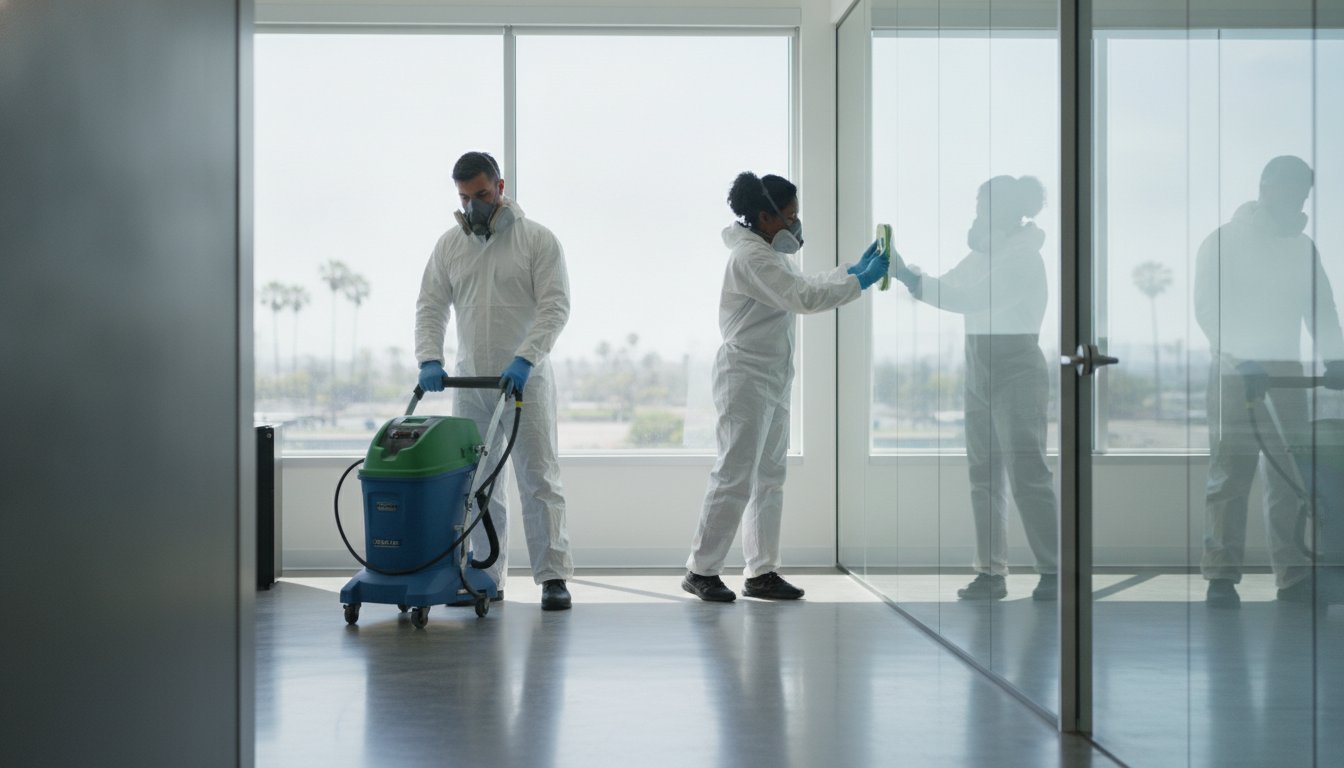
Once the assessment is complete, the next critical step is establishing negative air pressure within the work zone. This engineering control ensures that disturbed spores do not migrate to unaffected areas of the building during the removal process. We utilize high-capacity HEPA-filtered air scrubbers to cycle the indoor air, removing microscopic particulates while advanced dehumidification systems pull moisture from the structural environment. Any non-salvageable porous materials, such as contaminated insulation or saturated drywall, are removed under strictly controlled conditions. This disciplined sequence is essential for effective commercial mold remediation long beach.
Containment Strategies for Large-Scale Properties
Managing a large-scale facility requires specialized containment protocols to protect business continuity. We utilize 6-mil polyethylene sheeting to create physical barriers, effectively isolating work zones so your daily operations can continue in unaffected areas of the building. In multi-story office buildings or complex retail spaces, managing airflow is difficult; we use specialized air scrubbers to maintain strict Indoor Air Quality Testing standards. This meticulous separation of work zones prevents the spread of contaminants through shared ventilation systems and elevator shafts.
Post-Remediation Verification (PRV)
The process isn’t finished until the property passes a Post-Remediation Verification (PRV). This involves third-party clearance testing to provide an unbiased assessment of the work’s success. For a remediation to be deemed successful, it must meet three primary criteria: the area must be visually clean, free of musty odors, and air samples must show spore counts consistent with or lower than outdoor levels. This documentation is essential for commercial liability and insurance compliance. If you’re currently managing a property crisis, consulting with a certified environmental restorer can help you navigate the recovery process with minimal disruption to your staff and customers.
Compliance, Liability, and Standards for Long Beach Businesses
Maintaining compliance is a critical priority for any facility manager facing an environmental crisis. The industry gold standard is the ANSI/IICRC S520, which dictates the principles of physical removal and moisture source correction. Adhering to these rigorous standards ensures that commercial mold remediation long beach isn’t just a surface-level fix but a legally defensible restoration of the property. Beyond industry standards, California OSHA (Cal/OSHA) enforces strict Workplace safety standards for mold to protect employees from respiratory hazards. Failure to meet these requirements can lead to “substandard condition” designations under California law, potentially triggering a presumption of uninhabitability until a public health official deems the property safe.
In Southern California, businesses must also account for South Coast Air Quality Management District (SCAQMD) regulations regarding dust and microbial aerosolization. While SCAQMD is often associated with asbestos, the principles of containment and air filtration are vital for preventing the spread of fungal spores into the local atmosphere. We maintain meticulous documentation of every containment barrier, pressure log, and disposal manifest. This record-keeping is essential for property disclosures and mitigating future litigation risks, especially with the 2026 implementation of new post-disaster remediation laws.
Navigating Commercial Insurance Claims
Understanding the nuances of your policy is the first step toward financial recovery. Most commercial property policies differentiate between “sudden and accidental” water damage and “gradual” mold growth caused by long-term maintenance neglect. The latter is often excluded or capped at a low limit, such as $10,000. Providing professional documentation, including moisture maps and remediation plans, significantly speeds up the payout process. If the mold stems from a recent plumbing failure, coordinating with a team experienced in Water Damage Restoration in Long Beach ensures that both the water intrusion and the resulting microbial growth are handled under a single claim.
Tenant-Landlord Responsibilities in Commercial Leases
Responsibility for remediation often hinges on the specific language of the lease agreement. In a standard Triple Net (NNN) lease, the tenant is typically responsible for most maintenance and repairs, which may include addressing environmental issues within their space. However, Long Beach building codes and California’s Toxic Mold Protection Act place increasing responsibility on landlords to ensure a property is habitable. Certified environmental abatement provides a clear paper trail that protects both parties. It demonstrates that the property has been restored to a safe state, effectively mitigating the risk of toxic tort litigation or disputes over lease-ability in the local market.

Minimizing Business Downtime During the Remediation Lifecycle
For a commercial property, the true cost of microbial growth isn’t just the invoice for removal; it’s the potential loss of revenue from operational shutdowns. We prioritize a “Business-First” methodology that keeps your facility running while we work. By utilizing phased remediation, we isolate specific contaminated zones, allowing your staff to continue their duties in unaffected areas. This strategic segmentation is a hallmark of professional commercial mold remediation long beach. We also offer after-hours and weekend scheduling to ensure that the loudest and most invasive parts of the process occur when your customers and employees aren’t present.
Strategic HVAC isolation is another critical component of minimizing disruption. Rather than shutting down the entire climate control system, we employ localized containment and temporary filtration. This prevents cross-contamination of spores through the ductwork while maintaining comfortable temperatures in the rest of the building. By managing the environment with this level of precision, we eliminate the need for building-wide evacuations. Our goal is to solve the environmental challenge without creating an operational crisis.
Operational Discretion and Public Perception
Maintaining a professional image is vital during a property crisis. We use discreet staging areas and, when requested, unbranded equipment to keep the remediation process low-profile. Communication with your team is equally important. We help you provide transparent, fact-based information to employees to prevent unnecessary alarm. A calm, methodical presence reassures stakeholders that the situation is under control and that their health is the top priority. This “steady hand” approach maintains morale and protects your brand’s reputation throughout the recovery.
Rapid Response and Recovery Timelines
Speed is the most effective tool in preventing a small leak from becoming a systemic disaster. Rapid response is critical for commercial mold remediation long beach because fungal colonies can establish themselves quickly after a water event. For a typical office space, remediation might take three to five days, whereas larger retail environments may require a more extended, phased schedule. While this guide focuses on commercial needs, you can find additional details on the biological risks in our guide to Toxic Mold Remediation. If you need to establish a recovery timeline for your facility, you can contact our commercial response team for a methodical assessment.
Choosing a Local Long Beach Partner: The Coastline Advantage
Since 1985, Coastline Environmental Solutions has operated as a dependable local guardian for properties across the coastal corridor. We serve Long Beach, Lakewood, and surrounding cities with a methodical approach that national franchises often struggle to replicate. Our deep understanding of local architecture allows us to address the unique moisture challenges found in historic Belmont Shore bungalows and modern downtown high-rises. We don’t just treat the visible symptoms of a leak. We act as meticulous restorers who identify and solve the root cause of every environmental issue to ensure a permanent, long-term resolution.
Our expertise extends beyond standard commercial mold remediation long beach. We provide a comprehensive suite of environmental services, including asbestos and lead abatement, which are frequently discovered during the remediation of older commercial structures. By managing these hazardous materials concurrently, we streamline the recovery process and reduce the need for multiple specialized contractors. This integrated service model ensures that your property meets all safety standards under a single, unified protocol, saving you time and reducing the complexity of your restoration project.
Our Commitment to the Long Beach Community
Our commitment to the Long Beach community is reflected in our rapid response times and deep-rooted professional network. We maintain direct relationships with local industrial hygienists and building inspectors, which facilitates faster clearance testing and smoother regulatory approval. National providers may struggle with the specific nuances of local building codes; however, our decades of experience in the area ensure that your restoration plan is tailored to the specific legal and environmental requirements of Southern California. We prioritize local businesses because we’re invested in the resilience of our own community.
Getting Started: Your Professional Assessment
Starting your recovery begins with a professional assessment. During the initial commercial walkthrough, you can expect a methodical evaluation of all visible and hidden moisture sources using advanced detection technology. We provide clear, transparent project estimates and detailed reporting that satisfy both insurance adjusters and corporate stakeholders. This structured approach moves you from a state of emergency to a feeling of organized resolution. You can take the first step to secure your property with Coastline Environmental Solutions to ensure a safe, certified return to normalcy for your employees and customers.
Securing Your Facility’s Future and Environmental Safety
Managing a commercial property in a coastal environment requires more than just reactive maintenance. It demands a methodical strategy that addresses high humidity risks and strict California regulatory standards. By prioritizing a business-first approach, you’ve learned how to isolate contamination zones and maintain operational continuity without compromising the health of your employees or customers. Professional commercial mold remediation long beach is about more than just surface aesthetics; it’s a critical investment in your property’s valuation and your legal protection.
Since 1985, our team of certified environmental professionals has served as a steady hand for local business owners facing property crises. We combine advanced detection technology with a meticulous restoration philosophy to solve moisture issues at their source. Whether you’re dealing with a sudden plumbing failure or a complex HVAC contamination, our 24/7 emergency response ensures that your recovery begins immediately. Don’t let environmental challenges disrupt your progress. You can Request Your Commercial Mold Assessment from Coastline Environmental Solutions today to restore your facility to peak condition and ensure long-term safety for everyone inside.
Frequently Asked Questions
How long does commercial mold remediation typically take in Long Beach?
Most commercial projects require between three and seven days to complete, though the timeline varies based on the severity of the moisture intrusion and the total square footage involved. For a standard office space, the process typically fits within a five-day window. Larger retail or industrial facilities often utilize a phased approach that may extend over two weeks to maintain operational continuity. We prioritize a methodical timeline that ensures thorough decontamination without unnecessary delays.
Can my business remain open during the mold removal process?
Yes, your business can typically remain operational by utilizing advanced containment strategies and phased work schedules. We establish physical barriers using 6-mil polyethylene sheeting and maintain negative air pressure to isolate the work zone from occupied areas. This prevents the migration of spores while allowing your staff to continue their daily tasks in unaffected sections. We also offer after-hours and weekend scheduling to perform the most invasive tasks when your facility is empty.
Is commercial mold remediation covered by my business insurance policy?
Coverage generally depends on whether the mold resulted from a “sudden and accidental” peril, such as a burst pipe, rather than long-term maintenance neglect. Many commercial policies include a specific mold endorsement, though these often have coverage caps, frequently around $10,000. It’s essential to review your policy’s “covered perils” section. We provide the detailed documentation and moisture mapping required by adjusters to help facilitate the claims process for commercial mold remediation long beach.
What are the most common signs of mold in a commercial HVAC system?
The most frequent indicators include persistent musty odors that intensify when the air conditioning activates and visible spotting around supply vents or diffusers. You might also notice an increase in employee reports of respiratory irritation or headaches, often associated with “Sick Building Syndrome.” Our technicians inspect condensation pans and cooling coils where moisture naturally accumulates. If you suspect your HVAC system is compromised, a professional assessment is necessary to prevent building-wide spore distribution.
Does Coastline provide mold clearance certificates for commercial properties?
We coordinate with independent third-party industrial hygienists to provide post-remediation verification and formal clearance documentation. This ensures an unbiased assessment of the work’s success and provides you with a legally defensible certificate for your records. This documentation is vital for satisfying insurance requirements, meeting property disclosure laws, and reassuring tenants of the building’s safety. We believe that a successful project must pass visual, olfactory, and rigorous air quality criteria before being considered complete.
What is the difference between mold testing and a mold inspection?
A mold inspection is a comprehensive physical evaluation where experts use infrared cameras and moisture meters to locate the source of a leak. In contrast, mold testing involves collecting air or surface samples for laboratory analysis to identify specific fungal species and spore concentrations. While an inspection tells you where the problem is and why it happened, testing provides the data needed to confirm if indoor levels exceed outdoor baselines. Both are essential for a methodical recovery.
How does coastal humidity in Long Beach affect mold recurrence?
Long Beach’s consistent 60% average humidity and persistent marine layer create an environment where mold can quickly return if the root cause isn’t addressed. High ambient moisture allows spores to colonize damp surfaces within 48 hours of a water event. To prevent recurrence, we focus on structural drying and improving building envelope integrity. Simply removing the growth without managing the indoor microclimate often leads to repeat issues in our coastal Southern California climate.
Are there specific Long Beach city regulations for commercial mold abatement?
The City of Long Beach does not maintain a unique municipal code for mold, but it defers to the California Health and Safety Code and state housing laws. New legislation, such as Senate Bill 610 effective in 2026, places stricter requirements on landlords for post-disaster remediation. Compliance for commercial mold remediation long beach relies on adhering to IICRC S520 standards and Cal/OSHA workplace safety requirements to ensure the property remains habitable and legally compliant.