
30 Aug Commercial Mold Testing in Long Beach: Protecting Your Business and Tenants
Could an invisible environmental factor in your building be your largest undisclosed liability? In our coastal climate, moisture intrusion is often a silent threat to both structural integrity and tenant health, making commercial mold testing in Long Beach a critical priority for asset protection. You likely understand that maintaining a commercial property involves more than just aesthetics; it’s about mitigating risk and ensuring a productive workplace. However, the complexity of California’s environmental regulations and the fear of costly business interruptions can make addressing air quality feel like a daunting hurdle.
This guide explores how professional environmental assessments serve as a vital risk management tool for property owners. You’ll discover how to protect your assets from potential lawsuits, navigate the disclosure requirements of the Toxic Mold Protection Act, and secure certified proof of building safety. We will break down the latest industrial hygiene standards, explain how visible mold triggers substandard classifications under the California Health and Safety Code, and provide a clear roadmap for methodical remediation that keeps your operations running smoothly. By following a structured approach to detection and containment, you can maintain compliance while ensuring a healthy environment for every occupant.
Key Takeaways
- Understand why Long Beach’s unique coastal humidity and marine layer increase the risk of structural moisture intrusion and mold growth in commercial properties.
- Learn how professional commercial mold testing long beach utilizes advanced infrared thermography and air sampling to detect hidden hazards before they become costly liabilities.
- Navigate California’s complex mold disclosure laws and ensure your business fulfills its legal duty of care to employees and tenants.
- Identify the specific physical signs and persistent odors that signal it’s time to transition from routine maintenance to a formal environmental assessment.
- Discover the benefits of a methodical, all-in-one approach that combines certified testing with professional mold remediation for a seamless return to normalcy.
The Importance of Commercial Mold Testing in Long Beach
Commercial mold testing long beach is a methodical diagnostic protocol designed to quantify fungal presence within a business environment. It’s much more than a casual walkthrough; it’s a professional assessment that utilizes precise instrumentation to identify specific mold species and calculate airborne spore concentrations. This scientific approach provides building owners with a data-driven baseline of their indoor environment. Understanding the exact nature of a fungal presence is essential because what you can’t see often poses the greatest risk to your property’s value and your tenants’ safety. Professional testing bridges the gap between suspicion and certainty by offering several key advantages over a simple visual check:
- Surface vs. Air: Visual inspections only identify surface growth that’s already become extensive, while testing captures hidden airborne spores.
- Species Identification: Laboratory reports distinguish between common nuisance molds and more concerning toxigenic species.
- Hidden Colonization: Scientific analysis can find colonies growing behind drywall or inside insulation that hasn’t yet reached the surface.
- Legal Documentation: Data-backed results provide a professional “shield” by proving you followed industry standards for building safety.
Coastal Environmental Factors in Southern California
Long Beach’s geography creates a unique set of challenges for property management. The persistent marine layer acts as a natural humidifier, often pushing indoor relative humidity levels above the 60% threshold where mold thrives. Many of the city’s commercial structures feature aging infrastructure with porous building materials that have absorbed decades of salt air and moisture. Hidden moisture pockets often form in old plumbing chases or poorly ventilated storage areas. Properties located near the Port of Long Beach face additional environmental stressors, including particulate matter that can settle into HVAC systems and provide a nutrient base for fungal colonies. For a comprehensive overview of indoor mold and its causes, understanding these localized moisture drivers is the first step in effective prevention.
Protecting Business Continuity and Employee Health
Maintaining high indoor air quality (IAQ) isn’t just a regulatory checkbox; it’s a fundamental component of operational success. Poor air quality is a primary driver of “Sick Building Syndrome,” a condition where occupants experience acute health effects that appear linked to time spent in a building. When employees suffer from respiratory irritation, headaches, or fatigue caused by elevated spore counts, productivity inevitably drops. Proactive commercial mold testing long beach helps you identify these issues before they impact your bottom line.
Meticulous testing also prevents the nightmare of unplanned business closures. If mold is allowed to proliferate unchecked, the eventual remediation often requires extensive containment that can shutter an office or retail space for weeks. By identifying moisture sources early, you can address the problem through targeted repairs rather than a full scale evacuation. This proactive stance reduces the likelihood of tenant litigation and ensures your property remains a safe, profitable asset.
The Methodical Process of Professional Mold Assessment
A professional investigation is far more than a simple visual check. It’s a precise, multi-step investigation into a building’s ecosystem. When performing commercial mold testing long beach, the primary objective is to locate the moisture source and quantify the biological load. This starts with a meticulous site walk-through where technicians use moisture mapping to visualize the extent of water intrusion. This phase is critical because mold often thrives in hidden cavities where visual detection is impossible.
Strategic air sampling serves as the backbone of the diagnostic process. Technicians collect specific air volumes from suspected areas and compare them against outdoor baseline samples. This comparison reveals whether indoor spore concentrations are artificially elevated, indicating an active growth source. While air samples provide a broad view of air quality, surface sampling—using swabs or tape lifts—allows for the identification of specific colonies. These samples are then analyzed by certified microbiologists to determine the exact species and potential toxicity. Adhering to EPA guidelines on mold remediation ensures that the diagnostic phase leads to a safe, compliant restoration arc.
Advanced Diagnostic Tools for Commercial Buildings
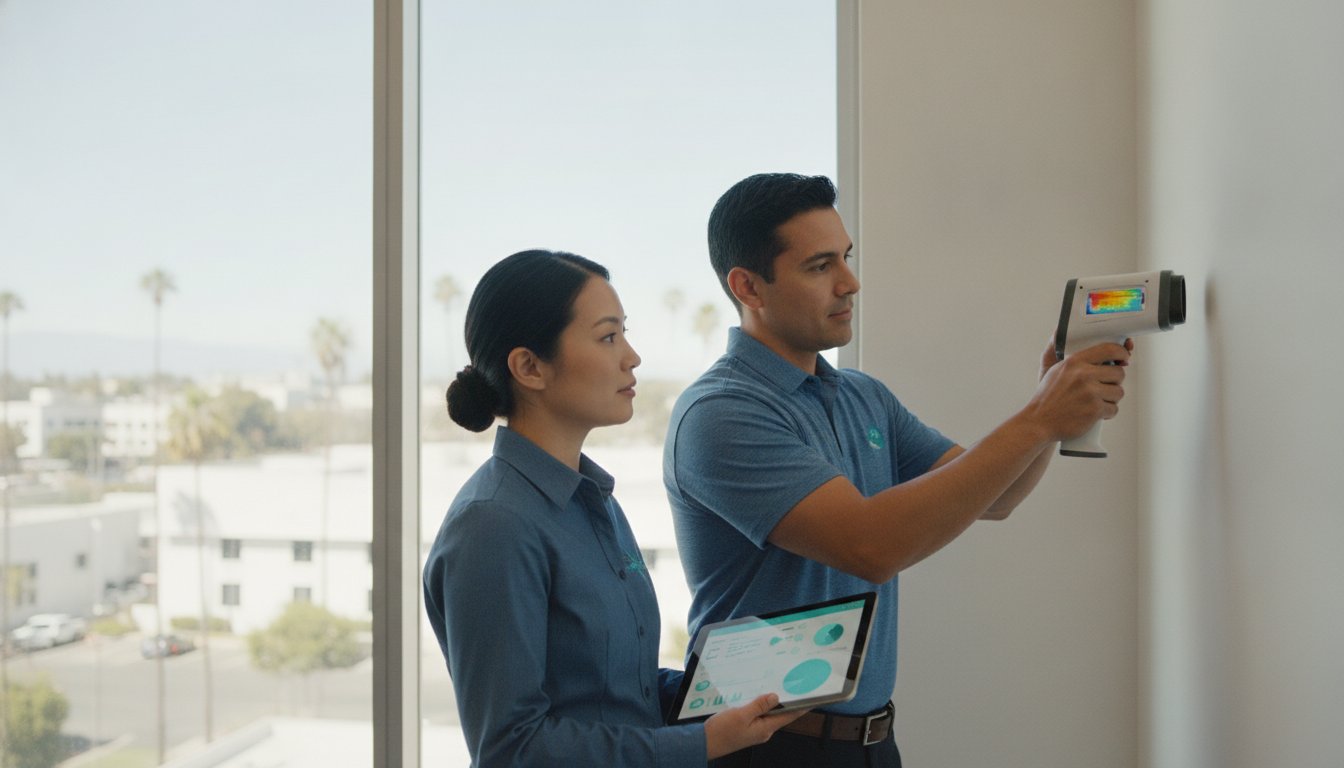
Modern assessments rely on sophisticated technology to see what the human eye cannot. Infrared thermography is a primary tool for identifying thermal anomalies behind commercial-grade drywall or within masonry foundations. These temperature differences often point directly to slow-leak plumbing or failing building envelopes. Technicians also utilize digital hygrometers and moisture meters to quantify the saturation levels of structural materials. In large-scale facilities, laser particle counters provide real-time data on microscopic pollutants, allowing for the immediate identification of zones with compromised air quality.
Interpreting the Lab Report: What the Numbers Mean
The laboratory report is a technical document that requires professional interpretation to be useful. It lists spore counts per cubic meter, which we analyze against industrial hygiene standards to determine the severity of the issue. We look specifically for “marker” species, such as Stachybotrys or Chaetomium, which almost always indicate long-term, hidden water damage. If you’re concerned about the health of your facility, requesting a commercial indoor air quality assessment is the first step toward clarity. Once any necessary remediation is finished, a final clearance test is mandatory. This secondary round of testing proves that spore levels have returned to a normal fungal ecology, providing the certified proof of safety that insurers and tenants require.
Navigating Commercial Compliance and Liability
California law places a significant burden on property owners to maintain a healthy indoor environment. Under the Toxic Mold Protection Act, commercial landlords are required to provide written disclosure to prospective and current tenants if they’re aware of mold that could pose a health threat. Additionally, since January 1, 2022, landlords must provide the “Information on Dampness and Mold for Renters in California” booklet to prospective occupants. Professional commercial mold testing long beach acts as your primary defense by documenting your adherence to these transparency requirements. By establishing a clear record of air quality and structural conditions, you fulfill your “duty of care” to occupants, which significantly reduces the risk of negligence claims.
When environmental issues arise, documented testing reports serve as empirical evidence in both insurance claims and legal disputes. These reports move the conversation from subjective complaints to objective, laboratory-backed data. For large-scale facilities or complex industrial spaces, we often coordinate with industrial hygienists to ensure that every square foot meets the most rigorous safety standards. This methodical approach ensures that your compliance strategy is as robust as your building’s foundation, providing a “calm professional” response to potentially chaotic situations.
Tenant-Landlord Responsibilities in Long Beach
In Long Beach, habitability complaints are overseen by the city’s own code enforcement department rather than the broader Los Angeles Housing Department. This local oversight means that visible mold can quickly lead to a “substandard” classification under the California Health and Safety Code. To protect your investment, an immediate response is essential. Testing allows you to differentiate between moisture caused by tenant activities, such as improper use of HVAC systems or blocked ventilation, and structural failures like failing window seals or roof leaks. Identifying the root cause early prevents a minor maintenance issue from escalating into a high-stakes legal battle over habitability or lease violations.
Insurance Requirements for Commercial Property Damage
Navigating the insurance claims process requires more than just a policy; it requires meticulous documentation. Professional testing facilitates a smoother recovery by establishing the “post-loss” condition of the property with scientific precision. Commercial adjusters demand data that meets specific industrial hygiene standards before they’ll approve extensive remediation budgets. By providing a comprehensive laboratory analysis, you ensure that your claim is backed by the technical evidence necessary for a full and fair settlement. This documentation also serves as a benchmark for the final clearance, proving that the property’s air quality has been restored to its pre-loss safety levels.

When to Schedule Commercial Mold Testing in Long Beach
Identifying the right time for commercial mold testing long beach requires a proactive approach to facility management. While some issues are obvious, others remain concealed within the building’s infrastructure. If you notice persistent staining on ceiling tiles or localized bubbling in wall paint, these are indicators of active moisture intrusion that require scientific verification. Persistent musty odors that seem to circulate through your building’s air distribution system are another critical trigger. These scents are often the first sign of hidden colonies that haven’t yet reached a visible surface.
You should also consider testing if staff members report a sudden increase in respiratory issues, headaches, or allergy symptoms that improve when they leave the office. Beyond health reports, any significant water event mandates a professional assessment. Whether it’s a burst fire sprinkler line or localized flooding from a seasonal storm, residual moisture trapped in flooring or wall cavities can lead to rapid fungal growth within 24 to 48 hours. Establishing a baseline immediately after a leak ensures that your remediation efforts are targeted and effective.
The HVAC Connection: Mold in Air Distribution
Commercial HVAC systems are prone to condensation, especially in the humid coastal environment of Long Beach. When moisture accumulates on cooling coils or within ductwork, it creates an ideal habitat for spores to multiply and spread. Incorporating vents and air handlers into your indoor air quality testing is essential for identifying these hidden sources. If you notice dark dust buildup around supply vents or a drop in filtration efficiency, it’s a sign that your system may be distributing pollutants rather than removing them. Routine testing of the air distribution system prevents these microscopic particles from circulating through the entire facility.
Pre-Acquisition and Post-Renovation Testing
Testing is a vital component of commercial due diligence. When acquiring industrial properties in areas like Lakewood or Wilmington, identifying legacy moisture issues is essential for accurate asset valuation. Many older buildings in these industrial corridors have experienced years of unaddressed leaks that aren’t immediately apparent. Similarly, post-renovation testing confirms that construction activities didn’t introduce excessive moisture or trap fine dust within the building’s envelope. Confirming that air quality hasn’t been compromised during a remodel protects both your reputation and your bottom line. If you suspect an environmental issue in your facility, you can schedule a professional assessment to secure your property’s safety and ensure long-term compliance.
Comprehensive Remediation and Environmental Solutions
Selecting a single partner for both diagnostic assessments and toxic mold remediation creates a more efficient recovery arc for any business. When commercial mold testing long beach confirms an elevated fungal load, the transition to containment must be swift to prevent spores from migrating through shared corridors or ventilation systems. Our teams implement rigorous containment protocols, establishing physical barriers and utilizing negative air pressure to isolate the affected zone. We deploy industrial-grade air scrubbers and HEPA filtration systems to strip microscopic pollutants from the environment, ensuring a rapid return to safe air quality standards. Once the physical removal is finished, we conduct a final Clearance Test to provide the technical documentation that certifies the building is safe for employee re-entry.
This integrated approach ensures that the remediation plan is perfectly calibrated to the specific mold species and concentrations identified during the testing phase. We provide a meticulous record of every action taken, from the initial moisture mapping to the final air quality verification. This level of transparency is essential for fulfilling your legal obligations and maintaining clear communication with your insurance carrier. By managing the entire process, we eliminate the delays and miscommunications that often occur when multiple contractors are involved, allowing you to focus on your core business operations while we handle the technical restoration.
The Coastline Advantage: 40 Years of Local Expertise
Since 1985, Coastline Environmental Solutions, Inc. has provided a methodical response to environmental hazards across Southern California. We’ve spent four decades mastering the unique challenges of the local climate, serving commercial clients in Long Beach, Huntington Beach, and San Pedro with specialized restoration teams. Our dual certification in both diagnostic testing and hazardous material remediation ensures a higher degree of accuracy and accountability for every project. We don’t just identify the problem; we provide a seasoned, authoritative hand to guide your property back to normalcy. Our deep roots in the community mean we’re as invested in the safety of your building as you are.
Next Steps: Securing Your Commercial Property
Protecting your tenants and your investment requires a definitive understanding of your building’s current environmental health. You can request an immediate on-site assessment to begin the process of professional risk mitigation. Within the first 24 hours of a mold investigation, our technicians will perform a comprehensive site walk-through, deploy advanced moisture detection tools, and establish a scientific sampling plan tailored to your facility’s specific needs. This rapid response provides the clarity needed to make informed decisions and prevent minor issues from escalating into major liabilities. Contact Coastline Environmental Solutions, Inc. for a Professional Assessment today to secure your property and ensure long-term compliance.
Proactive Asset Management for a Healthier Facility
Maintaining a safe commercial environment requires more than routine maintenance; it demands a methodical strategy for environmental risk management. By prioritizing commercial mold testing long beach, you protect your business from the hidden liabilities of coastal moisture while ensuring full compliance with California’s strict disclosure regulations. Advanced diagnostics bridge the gap between suspicion and certified safety, providing the laboratory data needed to navigate insurance claims and tenant relations with confidence.
Since 1985, Coastline Environmental Solutions, Inc. has acted as a dependable guardian for local property owners. As certified environmental remediation experts, we provide the technical precision required for complex industrial hygiene assessments. Whether you’re dealing with a sudden water event or suspected HVAC contamination, our team offers 24/7 emergency response for water damage to prevent long-term structural degradation. A healthy building is the foundation of a productive business, and taking action today ensures your property remains a secure, profitable asset for years to come.
Secure Your Building with Professional Mold Testing Today
Frequently Asked Questions
Is commercial mold testing different from residential testing?
Commercial assessments differ significantly from residential ones due to building scale and mechanical complexity. While residential testing focuses on single-family living spaces, commercial mold testing in Long Beach evaluates high-volume HVAC systems, commercial-grade building envelopes, and larger occupancy zones. These inspections often require coordination with industrial hygiene standards to ensure the facility meets workplace safety requirements. The methodical approach we use accounts for the specialized materials found in offices, warehouses, and retail centers.
How long does a commercial mold test take to complete in Long Beach?
The on-site portion of a professional assessment typically concludes within a single business day, depending on the facility’s square footage. Once samples are collected, they’re sent to a certified laboratory for microscopic analysis. You can generally expect a comprehensive report within 24 to 72 hours. This timeline ensures that the data is both accurate and timely, allowing for a rapid response if hazardous conditions are identified in your Long Beach property.
Will my business need to close during the mold testing process?
Closing your business is rarely necessary during the initial testing phase. Our technicians use non-invasive diagnostic tools, such as infrared cameras and moisture meters, which don’t disrupt daily operations or tenant activities. Air and surface sampling are quiet and localized, allowing your staff to continue their work without interruption. If extensive bulk sampling is required behind walls, we can schedule that work during off-hours to maintain your business continuity.
What are the most common types of mold found in Long Beach commercial buildings?
Coastal properties frequently see elevated levels of Penicillium and Aspergillus, which thrive in the humid marine layer. In buildings with aging plumbing or roof leaks, we often identify marker species like Stachybotrys, commonly known as black mold. Cladosporium is another frequent find, often colonizing HVAC vents and damp insulation. Identifying the specific species through commercial mold testing in Long Beach is essential for determining the correct remediation strategy and assessing potential health risks.
Can professional air duct cleaning improve my mold test results?
Professional air duct cleaning can significantly improve indoor air quality by removing the accumulated dust and organic debris that serve as a food source for mold. When HVAC systems are clean, the volume of circulating spores is naturally reduced, which is often reflected in lower airborne concentration counts during follow-up testing. This service is a vital component of a comprehensive maintenance plan, especially in older Long Beach buildings where decades of salt air have settled in the ductwork.
Who is responsible for mold testing in a commercial lease: landlord or tenant?
Responsibility typically depends on the specific terms of your commercial lease agreement and the source of the moisture. Generally, the landlord is responsible for structural issues like roof leaks or failing building envelopes that lead to mold growth. Tenants may be liable if the mold resulted from their own activities or equipment malfunctions. Because California law emphasizes the implied warranty of habitability, landlords should conduct testing immediately upon notification to mitigate legal risks and determine the root cause.
What certifications should a commercial mold inspector have in California?
While California doesn’t currently issue a state-specific mold license, you should look for inspectors with nationally recognized certifications from organizations like the IICRC or the ACAC. These credentials signify that the professional has mastered the technical standards for hazardous material management and industrial hygiene. Our team has maintained these rigorous standards since 1985, ensuring that every assessment is conducted with the methodical precision required for commercial compliance and legal documentation.
How much does commercial mold testing typically cost for a warehouse or office?
The investment for a professional assessment varies based on the total square footage of the facility and the number of samples required to establish a clear baseline. Large warehouses with multiple zones may require more extensive air sampling than a small retail storefront. We recommend a preliminary walkthrough to determine the scope of the investigation. This ensures you receive a diagnostic plan that provides the necessary data for insurance adjusters or regulatory compliance without unnecessary expenses.