24 Sep Commercial Water Damage Restoration in Wilmington: The Complete Facility Manager Guide (2026)
Every hour standing water lingers across an active manufacturing or warehouse floor isn’t just racking up repair bills; it’s threatening your facility’s operational survival. In busy industrial corridors exposed to coastal moisture, securing dependable commercial water damage restoration Wilmington managers rely on means immediately halting moisture migration before secondary microbial growth compromises building assemblies and inventory.
You already understand the acute stress of mounting downtime costs while your maintenance team races to salvage equipment, structural materials, and client deliverables. Sifting through rigorous commercial property insurance protocols while trying to contain thousands of gallons of trapped water only adds severe friction to an already high-stakes emergency.
In this complete operational guide, you’ll discover how to rigorously evaluate restoration partners, contain industrial water losses rapidly, and protect business continuity. We preview psychrometric structural drying fundamentals, industrial extraction workflows, and carrier-ready documentation practices that satisfy adjusters and return your square footage to full service without delay.
Key Takeaways
- Immediate triage under IICRC S500 standards prevents standing industrial water from escalating into high-liability biohazards within coastal humidity zones.
- Selecting the right provider for commercial water damage restoration Wilmington facilities demand requires auditing heavy-duty equipment reserves, master drying credentials, and verified local dispatch times.
- Managing commercial water losses in older industrial properties often requires simultaneous compliance with environmental regulations governing mold remediation and asbestos-containing materials.
- Engineered structural drying applies precise psychrometric science and deep extraction to pull trapped moisture from deep structural assemblies rather than relying on superficial air movement.
- Partnering with an established local restoration team ensures rapid physical containment and carrier-grade documentation that expedites complex commercial insurance claims.
Emergency Commercial Water Loss in Wilmington: Initial Risk Assessment and Priority Triage
Industrial facilities operating along the Wilmington waterfront face unique logistical hazards when pipe failures or roof breaches occur. High ambient humidity from the Pacific marine layer prevents standing moisture from evaporating naturally, accelerating the saturation of drywall, subfloors, and warehouse pallet stock. Securing certified commercial water damage restoration Wilmington facility engineers trust starts with immediate physical safety triage before recovery crews arrive on-site.
Before stepping into any flooded production zone, staff must isolate the building’s main electrical distribution panels and lock out compromised machinery. Water conducts electricity through concrete floor slabs rapidly, creating life-threatening conditions for internal maintenance teams. Once power distribution is rendered safe, engineers can evaluate the physical scope of the intrusion.
Classifying Water Categories in Industrial and Commercial Facilities
Proper mitigation protocols depend entirely on identifying the source of the loss. The industry defines three distinct water damage categories under IICRC S500 standards:
- Category 1 (Clean Water): Originates from broken domestic supply lines, overhead fire sprinkler heads, or clean appliance feeds. It poses minimal initial health risk if addressed immediately.
- Category 2 (Grey Water): Discharges from commercial washing systems, cooling towers, or process wastewater containing chemical or biological contaminants that cause illness if handled improperly.
- Category 3 (Black Water): Grossly unsanitary intrusions resulting from municipal sewer backups, harbor storm surges, or coastal flooding. These carry severe pathogens and require certified biohazard protocols.
Remember that Category 1 water degrades rapidly. In Wilmington’s warm, humid coastal air, clean water standing on commercial slab foundations often transitions to Category 2 within 24 to 48 hours, radically increasing inventory loss and liability.
The First 60 Minutes: Containment Protocols for Facility Managers
Mitigating business interruption demands swift tactical containment while waiting for commercial water damage restoration Wilmington deployment units. Follow these critical stabilization steps within the first hour of discovery:
- Isolate the Source: Shut down the facility’s master water control valve or relevant riser isolation valves immediately to stop the flow.
- Erect Containment Barriers: Hang 6-mil polyethylene sheeting across warehouse bays and corridors to isolate dry logistics areas from the wet zone.
- Execute Critical Documentation: Take comprehensive, high-resolution photographs and videos of standing water levels, wet inventory, and compromised building assemblies before shifting any machinery.
Commercial Water Restoration Contractor Buying Guide: Essential Selection Criteria
When an industrial warehouse or manufacturing plant floods, dialing a national clearinghouse often leads to subcontracted crews arriving with undersized residential equipment. Large commercial footprints require heavy infrastructure, dedicated mobilization logistics, and verified technical mastery. Selecting a reliable partner for commercial water damage restoration Wilmington facilities trust means looking beyond generic marketing promises and scrutinizing equipment reserves, technician certifications, and local dispatch capability. For broader property protection and operational resilience beyond emergency water mitigation, enterprises often coordinate with comprehensive facility management specialists such as WB Holding AG to safeguard physical assets.
Evaluating Industrial Fleet Capabilities and Equipment Capacity
Commercial square footage cannot be dried using consumer-grade air movers. A capable industrial partner must possess specialized machinery capable of handling massive water volume and ambient coastal vapor:
- Large-Scale Desiccant Dehumidifiers: These systems deliver continuous low-grain depression air, which is necessary to pull deeply bound water from thick concrete slabs and structural timber exposed to marine air.
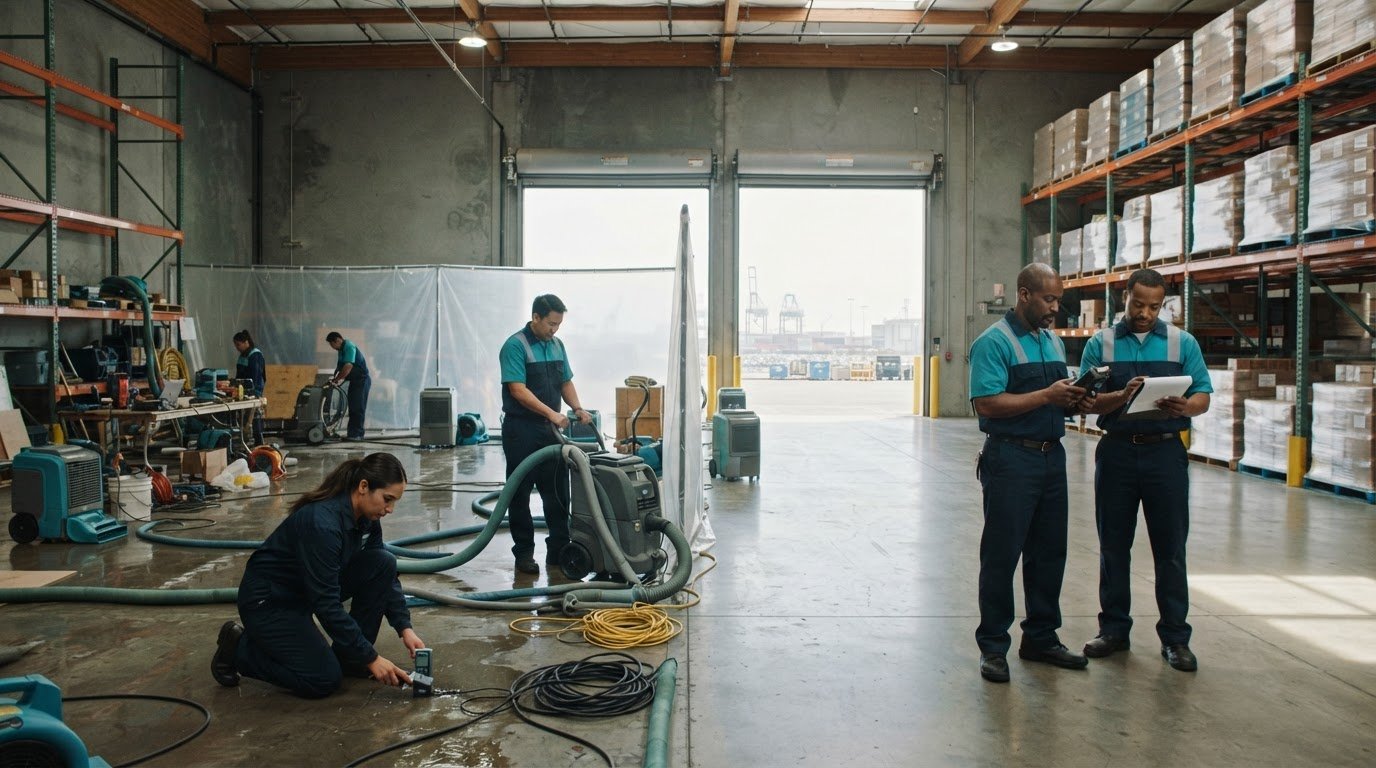
- Truck-Mounted High-Volume Extraction Units: Heavy-duty pumps evacuate thousands of gallons per hour, preventing liquid from settling into sub-grade machinery pits and utility chases.
- Infrared Thermal Imaging and Penetrating Meters: Advanced diagnostics map moisture migration behind industrial assemblies without unnecessary physical demolition.
Insurance Claim Alignment and Documentation Accuracy
Carrier disagreements often delay business resumption longer than the physical restoration work itself. Seasoned commercial contractors prevent claim friction by executing continuous psychrometric logging. Technicians record temperature, relative humidity, and grains per pound (GPP) every single day to demonstrate steady, measurable drying curves.
Aligning structural recovery logs with established industry benchmarks, such as EPA guidelines for mold remediation, protects building ownership from future occupant liability. Reliable contractors also format inventories and structural repairs using standardized Xactimate pricing models, ensuring commercial adjusters receive the exact line-item breakdowns required for rapid claim authorization. If your team is updating its emergency preparedness plan, connecting with seasoned commercial restoration specialists before disaster strikes ensures seamless operational defense when pipes burst.
Managing Compound Hazards: Asbestos, Mold, and Coastal Humidity in Wilmington Facilities
Commercial properties across Wilmington often date back several decades, supporting heavy logistics, manufacturing, and maritime operations. In these aging structures, pipe failures or roof breaches rarely present as simple moisture problems. A rigorous initial risk assessment must evaluate underlying hazardous materials before any demolition or aggressive drying begins. Trapped water quickly combines with high ambient humidity and regulated building components, complicating structural recovery.
Navigating South Coast AQMD and Hazardous Material Protocols
Industrial facilities constructed prior to modern safety standards frequently house asbestos-containing materials (ACMs). These are often found in 9-inch vinyl composite tiles, pipe insulation, acoustic plaster, and joint compounds. When wet drywall or flooring requires removal, standard demolition practices cannot proceed unchecked.
Under South Coast Air Quality Management District (SCAQMD) Rule 1403, disturbing building materials without certified testing exposes property owners to severe legal penalties and worker safety liabilities. Placing high-velocity air movers across untested, damaged drywall can cross-contaminate entire warehouses with toxic fibers. Managing complex losses requires an integrated provider capable of executing commercial water damage restoration Wilmington operations alongside certified asbestos and lead abatement.
Preventing Secondary Microbial Proliferation in Coastal Marine Climates
Wilmington’s persistent marine layer creates outdoor relative humidity levels that routinely climb past 75 percent. Opening warehouse bay doors to “air out” flooded spaces merely imports additional vapor into wet drywall, accelerating fungal development within 48 hours.
Controlling this environment requires commercial teams to implement strict physical and atmospheric isolation:
- Negative Air Pressure: Deploying industrial HEPA air scrubbers captures airborne fungal fragments and dust, exhausting air outward to protect uncompromised logistics zones.
- Targeted Humidity Control: Maintaining indoor relative humidity below 50 percent deprives dormant spores of the moisture required for colonization.
- Antimicrobial Application: Technicians treat exposed structural framing, concrete slabs, and utility channels with EPA-registered antimicrobials, halting mold growth at the molecular level.

The Industrial Structural Drying Process: Engineering Rapid Facility Recovery
Effective structural drying is applied physics, not simple ventilation. When industrial water breaches occur, moisture rapidly migrates into porous framing, drywall, and structural subfloors. Restoring these heavy building elements requires establishing a steep vapor pressure differential. The air inside the containment envelope must be maintained significantly drier than the moisture trapped within building assemblies. Successful commercial water damage restoration Wilmington industrial operators rely on depends on executing this recovery methodically.
Phase-by-Phase Industrial Drying and Dehumidification
Achieving rapid structural stabilization demands a disciplined, multi-stage mechanical workflow:
- Phase 1: High-Volume Physical Extraction: Submersible pumps and industrial extraction equipment pull standing water from slabs and floor finishes. Removing water physically is over 500 times faster than removing it via evaporation.
- Phase 2: Thermodynamic Evaporation: High-velocity centrifugal air movers are arranged at 45-degree angles against floor and wall junctions. This targeted airflow disrupts the boundary layer of saturated air clinging to materials.
- Phase 3: Deep Mechanical Dehumidification: Low-grain refrigerant (LGR) and desiccant units process moisture-laden air, condensing vapor into water or exhausting moist air outside the building envelope.
Deep Slab and Cavity Moisture Extraction in Commercial Spaces
Commercial concrete slabs and industrial wall assemblies present stubborn drying challenges. Water readily seeps underneath industrial epoxy floor coatings, vinyl tile layers, and into sealed metal-stud cavities. Left unaddressed, hidden moisture rots structural framing and bubbles expensive floor finishes months after the initial event.
Specialized restorative drying relies on positive and negative pressure injectidry wall systems. By coring small inspection ports behind base coves, crews force warm, dry air into wall cavities while pulling saturated vapor out. Daily readings using penetrating electrical resistance probes and thermal imaging cameras monitor deep moisture dissipation across the entire building slab. When deep water threatens heavy machinery or building integrity, schedule commercial water damage restoration to immediately deploy psychrometric drying equipment and stabilize your facility.
Partnering with Coastline Environmental Solutions for Wilmington Commercial Restoration
When unexpected water intrusions jeopardize operations, relying on distant corporate clearinghouses introduces unnecessary operational friction. Facilities along the South Bay waterfront require an experienced restoration partner with localized infrastructure and proven technical execution. Coastline Environmental Solutions provides comprehensive commercial water damage restoration Wilmington industrial operators count on, delivering methodical emergency containment and complete structural drying across the Port industrial corridor.
Serving Southern California commercial properties continuously since 1985, our organization bridges the gap between mechanical moisture mitigation and licensed environmental safety. Rather than managing multiple disconnected vendors, facility directors benefit from dual capabilities that merge structural drying with certified asbestos and lead abatement under full IICRC S500 compliance.
The Coastline Commercial Priority Response Advantage
Rapid physical deployment is fundamental to containing business disruption. Strategic proximity to major industrial arteries ensures our specialized mitigation fleets arrive on-site promptly to stabilize your building envelope:
- Direct Communication Channels: Speak directly with experienced restoration specialists who understand complex plant logistics, avoiding detached third-party call centers.
- Phased Operational Continuity: Custom restoration strategies isolate affected machinery bays and storage areas, enabling uncompromised warehouse zones to stay operational.
- End-to-End Project Supervision: Dedicated commercial project directors manage every phase of recovery, from initial bulk water extraction to daily psychrometric verification.
Initiating Emergency Commercial Recovery in Wilmington
Mitigating long-term property liability begins the moment an intrusion is detected. Our field supervisors conduct comprehensive baseline moisture mapping using penetrating meters and infrared diagnostics, establishing targeted drying standards for structural assemblies and concrete substrates.
Clear documentation is just as vital as physical drying. Our technicians maintain transparent digital moisture logs, complete photographic inventories, and standardized line-item estimates aligned directly with commercial insurance adjuster expectations. When an unexpected pipe rupture, process leak, or storm breach threatens facility operations, trust the seasoned team at Coastline Environmental Solutions to execute clean structural recovery and restore your square footage to full operational capacity.
Restoring Wilmington Industrial Facilities with Decisive Action
Managing an industrial water loss demands calculated speed, psychrometric precision, and strict environmental compliance. Uncontrolled moisture combined with coastal humidity rapidly degrades building assemblies and idles vital production lines. By implementing rapid containment protocols, rigorous moisture logging, and certified drying standards, facility directors can mitigate financial disruption and satisfy commercial insurance carriers without unnecessary delays.
Coastline Environmental Solutions provides over 40 years of continuous commercial restoration experience across Southern California, protecting facilities since 1985. Our dual expertise combines advanced structural drying with licensed asbestos and lead abatement, eliminating contractor delays while keeping projects fully compliant. When moisture threatens your operations, depend on our rapid local mobilization across Wilmington, Long Beach, and the Port industrial corridor. Safeguard your business continuity today: contact Coastline Environmental Solutions for the commercial water damage restoration Wilmington facilities trust.
Frequently Asked Questions
How quickly should commercial water extraction begin after an industrial facility breach in Wilmington?
Commercial water extraction should begin immediately, ideally within the first two hours of discovery. Wilmington’s high coastal humidity accelerates microbial proliferation within 24 to 48 hours. Rapid physical extraction prevents standing Category 1 water from degrading into contaminated Category 2 or 3 states, dramatically limiting inventory loss, concrete slab saturation, and structural degradation across large facility floorplates.
What makes commercial drying different from standard residential water damage restoration?
Commercial restoration involves massive cubic footage, complex building assemblies, and strict business continuity requirements that standard residential setups cannot support. Industrial projects require heavy-tonnage desiccant dehumidifiers, high-capacity truck-mounted extraction pumps, and 460-volt power distribution rather than small consumer units. Technicians must also navigate industrial equipment layouts, hazardous materials, and multi-layered logistics without halting facility operations.
How do coastal Wilmington weather patterns affect drying times for commercial buildings?
Persistent marine air and high outdoor relative humidity eliminate the effectiveness of natural ventilation in Wilmington commercial facilities. Bringing humid coastal air into a saturated warehouse introduces more moisture rather than evaporating it. Effective commercial water damage restoration Wilmington teams use closed-system mechanical desiccant drying. This technique artificially depresses indoor vapor pressure to pull trapped moisture from deep structural components regardless of outside ocean air.
Will our business need to shut down operations entirely during the commercial water restoration process?
Total facility shutdowns are rarely necessary when restoration teams establish proper physical containment barriers. Field supervisors construct heavy 6-mil polyethylene partitions and deploy HEPA-filtered negative air systems to isolate flooded zones from active production areas. This phased containment approach allows administrative offices, dry logistics bays, and unaffected assembly lines to continue operating safely while crews extract water and dry structural components nearby.
What environmental regulations apply when restoring older commercial properties in Wilmington?
Restoring pre-1980 industrial facilities requires strict adherence to South Coast Air Quality Management District (SCAQMD) Rule 1403 governing asbestos. Before cutting into saturated drywall, acoustic tiles, or vinyl composite floor assemblies, certified testing must verify that hazardous materials won’t become airborne. Commercial operators must partner with contractors carrying dual qualifications in both structural drying and licensed asbestos abatement to avoid severe regulatory penalties and liability.
How do restoration contractors detect hidden water trapped beneath commercial concrete slabs?
Technicians locate trapped sub-slab moisture using non-invasive thermal imaging cameras, impedance meters, and deep-wall penetrating resistance probes. Infrared thermography identifies evaporative cooling patterns across slab surfaces, revealing water migration tracks under commercial tile or epoxy coatings. Technicians confirm these boundaries with radio-frequency meters and relative humidity probes, providing accurate mapping without drilling or damaging extensive warehouse concrete floors. Once the concrete substrate is fully dried and remediated, facilities needing to replace damaged or bubbled coatings often turn to industrial specialists like Epoxy Solutions™ to reinstall durable, high-performance resinous floor systems.
Does commercial property insurance require specific psychrometric logs for water damage claims?
Yes, commercial adjusters require verifiable daily psychrometric data before approving structural drying and business interruption claims. Adjusters expect itemized records tracking temperature, relative humidity, and grains per pound (GPP) to prove the drying chamber reached established moisture equilibrium. Standardized documentation matching Xactimate pricing guidelines demonstrates proper mitigation diligence, expediting claim payouts for commercial water damage restoration Wilmington property managers manage.