10 Aug Structural Drying Services: The Science of Complete Water Damage Recovery (2026)
What if the absence of standing water on your flooring is actually the most dangerous phase of a residential flood? It’s a common misconception that once the puddles are gone, the threat to your property has vanished. In reality, moisture often migrates into porous wall studs and subfloors, requiring professional water damage mitigation services to prevent structural compromise and mold growth, which can begin in as little as 24 to 48 hours.
We understand the deep anxiety that comes with wondering if your home will ever feel safe or truly dry again. You need more than just a shop-vac; you need a methodical recovery plan. This guide explores how structural drying uses the science of psychrometry to save your property from long-term failure. By moving beyond surface-level cleanup, we ensure every drop of hidden moisture is accounted for and removed through a controlled, technical process.
You’ll discover the advanced technology used to track moisture through solid surfaces, the importance of IICRC S500 standards in 2026, and how detailed atmospheric data can secure your insurance claim. We’ll show you how a meticulous approach turns a chaotic emergency into a scientific restoration of your peace of mind, ensuring your property is verified dry by data, not just by sight.
Key Takeaways
- Understand why surface extraction is only the first 20 percent of recovery and how hidden moisture in structural materials leads to long-term property failure.
- Learn how professional water damage mitigation services apply the science of psychrometry to manage vapor pressure and actively extract water from porous surfaces.
- Discover why household fans often escalate mold risks and how industrial-grade air movers create the necessary laminar flow for deep structural drying.
- Explore the methodical steps of a professional recovery, including moisture mapping, water categorization, and the strategic use of containment zones.
- Identify the critical role of IICRC certification and data-driven documentation in meeting 2026 insurance requirements and ensuring a bone-dry property.
What are Structural Drying Services and Why are They Critical?
Structural drying is the scientific, managed removal of moisture from building materials such as wall studs, subfloors, and sill plates. While many homeowners assume the recovery is finished once the carpets are no longer wet, surface-level extraction typically accounts for only 20 percent of the total moisture removal required after a flood. To understand What are Structural Drying Services, one must look beneath the surface. True recovery involves stabilizing the environment and extracting “bound” water that has been absorbed into the very bones of the property.
The primary challenge in any restoration project is the “Hidden Water” problem. Moisture migrates quickly through capillary action, seeping into wall cavities and saturating fiberglass insulation or porous drywall. Knowing how to recognize hidden water damage signs in your walls and subfloors is the first step toward preventing irreversible consequences. If these areas aren’t addressed by professional water damage mitigation services, the trapped moisture leads to irreversible consequences. Saturated wood studs can begin to rot, drywall loses its structural integrity and begins to swell or crumble, and systemic mold growth can take hold within the building’s envelope, often remaining invisible until it becomes a health hazard.
The Difference Between Extraction and Drying
It’s vital to distinguish between water extraction and structural drying. Extraction uses physical force, such as submersible pumps or weighted vacuum systems, to remove standing liquid. Drying, however, is a thermodynamic process. It involves pulling moisture out of solid materials and into the air, where it’s then captured by dehumidifiers. In our humid coastal climates, you simply can’t “wait for it to dry” naturally. The ambient air is often too saturated to allow for evaporation. We utilize specialized equipment, such as Low Grain Refrigerant (LGR) dehumidifiers, to create an ultra-dry environment that forces moisture out of dense materials much faster than natural airflow ever could. When a burst pipe or plumbing failure is the source of the intrusion, coordinating emergency plumbing repair Long Beach services alongside professional extraction ensures the source is stopped and the resulting moisture is fully eliminated.
Preventing Secondary Damage and Mold
Time is the most critical factor in property restoration. There’s a strict 48-hour window before secondary damage becomes likely. When structural drying begins immediately, we can often save materials that would otherwise require demolition. If this window is missed, toxic mold remediation becomes an expensive and necessary reality. By prioritizing rapid response and meticulous moisture mapping, we protect the structural integrity of your Southern California home, ensuring that a temporary leak doesn’t turn into a permanent structural failure.
The Science of Psychrometry: How Professionals Manage Airflow
Professional water damage recovery isn’t a matter of chance; it’s a matter of physics. To restore a property to its pre-loss condition, technicians rely on psychrometry, which is the study of the thermodynamic properties of moist air. Psychrometry is the thermal management of moisture. By understanding how air, temperature, and water vapor interact, experts can manipulate the environment to pull water out of dense materials like oak flooring or structural studs. This scientific approach is what separates professional water damage mitigation services from simple DIY cleanup efforts.
The goal is to create a “thirsty” environment. If the air in a room is already saturated with moisture, it can’t accept any more water from your wet walls. We monitor relative humidity (RH) constantly to ensure the air remains capable of absorbing evaporated water. When the RH is lowered through high-capacity dehumidification, the air effectively acts as a sponge, drawing liquid out of the building’s infrastructure through a process driven by vapor pressure.
Understanding Vapor Pressure Differential
Vapor pressure is the force exerted by water vapor molecules. In a flooded room, wet materials have high vapor pressure, while dry, treated air has low vapor pressure. Moisture naturally seeks equilibrium, moving from high-pressure areas to low-pressure areas. By maintaining this differential, we “push” water out of the walls and into the path of our equipment. Following The Step-by-Step Structural Drying Process ensures that we don’t just guess when a room is dry. We establish a “Dry Standard” by measuring unaffected similar materials in the home, providing a data-driven goal for every restoration project.
The Role of Temperature in Evaporation
Heat is the fuel for evaporation. Warmer air can hold significantly more moisture than cool air, which is why temperature control is a vital component of structural drying. However, this requires a delicate balance. Excessive heat can damage sensitive materials like adhesives or electronics, so technicians at Coastline Environmental Solutions, Inc. carefully calculate the balance between BTUs and Cubic Feet per Minute (CFM) of airflow. We don’t just track how the air feels; we monitor Grains Per Pound (GPP). This metric tells us the exact weight of water vapor in the air, allowing us to verify that our LGR dehumidifiers are successfully removing moisture from the structure. If you’re facing a complex flood situation, a professional assessment from Coastline Environmental Solutions, Inc. can help determine the precise drying recipe your property needs.
Structural Drying vs. DIY Fans: A Comparison of Effectiveness
Setting up a few household box fans might seem like a proactive step, but it often does more harm than good. Household fans are designed for comfort, not for the complex physics of evaporation. They create turbulent air that can lift dormant mold spores and distribute them throughout your home, potentially contaminating unaffected rooms. In contrast, industrial air movers used by professional water damage mitigation services are engineered to produce laminar flow. This high-velocity air stream travels directly across the surface of wet materials, stripping away the “boundary layer” of saturated air and allowing for rapid, continuous evaporation.
The difference in dehumidification is equally stark. Standard home dehumidifiers are designed to manage comfort levels in a basement; they lose effectiveness once the relative humidity drops below 50 percent. Professional Low Grain Refrigerant (LGR) dehumidifiers are far more sophisticated. They’re capable of removing moisture from the air even in extremely dry conditions, pulling water vapor out of the environment until the structural materials reach a pre-loss state. Without this high-capacity equipment, moisture remains trapped deep within the building’s infrastructure, leading to long-term decay.
Professional Equipment vs. Consumer Tools
The primary advantage of industrial equipment lies in its sheer moisture removal capacity and static pressure. A consumer-grade dehumidifier might collect 30 to 50 pints of water in a 24-hour period. In comparison, an industrial LGR unit can extract over 130 pints per day under the same conditions. This power is essential for water damage restoration Long Beach, where coastal humidity can otherwise stall the drying process. Additionally, industrial air movers possess high static pressure, allowing us to “force” air into wall cavities or under cabinetry where standard fans simply cannot reach.
Data-Driven Monitoring and Documentation
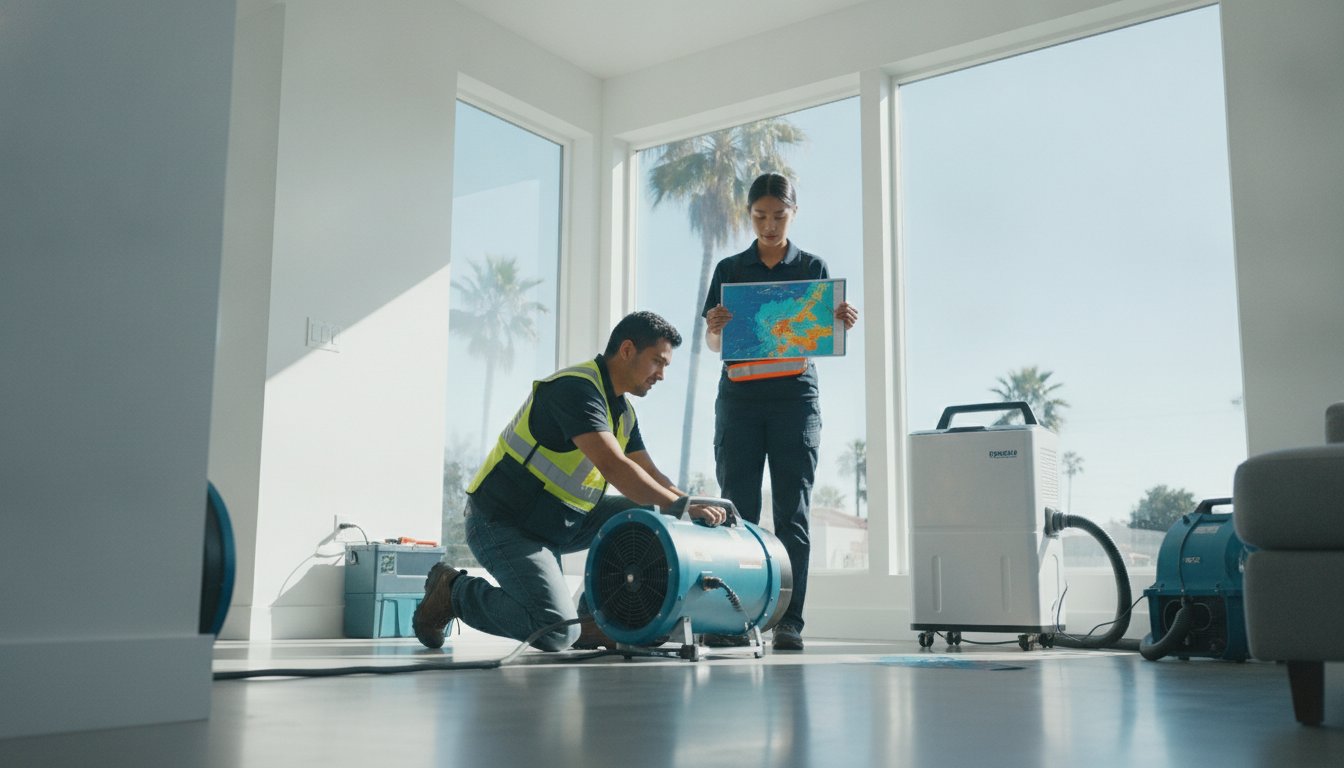
We don’t rely on guesswork to determine if your home is dry; we rely on precision instruments. Our technicians use thermal imaging cameras to identify cold spots behind walls, which often indicate pockets of hidden moisture that the human eye would miss. We complement this with two types of moisture meters: non-penetrating sensors for delicate surfaces and penetrating “pin” meters for measuring the moisture content deep inside wood studs or subfloors. This data is compiled into daily moisture logs. These logs provide the objective proof your insurance company requires to verify that the drying process was successful and that your property is safe from future mold growth.

The Step-by-Step Structural Drying Process: What to Expect
A successful recovery is never an accident. It’s the result of a disciplined, multi-stage protocol designed to stabilize the environment and protect your property’s structural integrity. When you engage professional water damage mitigation services, the process begins with an immediate transition from emergency chaos to controlled restoration. This sequence ensures that every action taken is data-driven and focused on a permanent, long-term solution.
By utilizing professional water damage mitigation services, you ensure that the recovery follows a scientific path rather than a trial-and-error approach. Our technicians act as a steady hand, moving through a series of technical checkpoints that address both visible water and the moisture you can’t see. We don’t consider the job finished until the property is verified dry by objective metrics, not just a visual inspection.
Assessment and Moisture Mapping
The first step is a comprehensive evaluation to identify the source of the intrusion and determine the “Category” of water. As established by industry standards, Category 1 involves clean water, Category 2 contains significant contamination, and Category 3, or black water, is grossly contaminated. Technicians use infrared technology and moisture probes to create a detailed map of the affected areas. By establishing baseline readings from dry, unaffected areas of your home, we define a “dry standard” that serves as our target. We also set up drying chambers using heavy-duty poly sheeting to isolate wet zones, which concentrates the power of our dehumidifiers and prevents cross-contamination.
Once the area is isolated, we perform aggressive extraction. This isn’t just about clearing puddles; it involves using weighted extractors to pull liquid from deep within carpet pads and subfloors. Physical removal is significantly more efficient than evaporation, so we prioritize this before deploying any drying equipment. Following extraction, we strategically place industrial air movers and LGR dehumidifiers to create a specific airflow pattern that maximizes the rate of evaporation from wet surfaces.
Active Drying and Daily Adjustments
Restoration is a dynamic process that requires constant oversight. Our technicians visit your property daily to monitor progress and record moisture levels in a dedicated log. As the environment changes, we may move air movers or increase the ambient temperature to push the materials toward the Point of Equilibrium. This is the stage where the material’s internal moisture is in balance with the surrounding dry air, indicating that the drying process is nearing completion. We don’t remove a single piece of equipment until final testing confirms every structural component has met its dry standard. If you’re currently dealing with a flood, you can secure your home’s future by contacting Coastline Environmental Solutions, Inc. for a professional assessment today.
Choosing Certified Structural Drying Experts in Long Beach
Selecting a restoration partner is the most critical decision a homeowner makes following a flood. It requires an expert who operates according to the rigorous S500 standards set by the IICRC. This certification isn’t just a badge; it’s a commitment to the scientific principles of evaporation and dehumidification we’ve discussed throughout this guide. When you hire professional water damage mitigation services, you’re looking for a steady hand to navigate the complexities of structural preservation. A certified technician understands that recovery is a data-driven process where success is measured by moisture percentages, not visual cues.
Navigating the specific environmental challenges of the Southern California coast requires more than standard industry knowledge. The high ambient humidity in cities like Seal Beach and Huntington Beach can stall the drying process if the technician doesn’t account for coastal air saturation. We’ve spent decades refining our water damage mitigation services to meet these local conditions, ensuring that our equipment setup is optimized for the specific atmospheric pressures of our shoreline communities. This local expertise prevents the common mistake of assuming a home is dry when the coastal air is simply masking deep-seated moisture. Homeowners who learn to recognize hidden water damage signs early are far better positioned to act before coastal humidity compounds the problem.
The Coastline Advantage in Southern California
Coastline Environmental Solutions, Inc. has been a fixture in Long Beach, Lakewood, and Cerritos since 1985. This long-standing local presence has allowed us to master the specific construction styles and building materials unique to our region. Our meticulous restorer approach means we aren’t just looking for a quick fix; we’re dedicated to a thorough, long-term solution that protects your family’s health and your property’s value. We provide the comprehensive documentation and moisture mapping data that insurance carriers require, simplifying the claims process and ensuring that every technical step is transparent and verifiable.
Your Path to a Dry, Safe Home
Once the structural elements have reached their dry standard, the focus shifts toward the final return to normalcy. This transition from drying to full restoration often involves coordinating with indoor air quality testing to verify that the environment is truly safe for occupancy. By choosing a partner who manages the entire lifecycle of the recovery, you ensure that no detail is overlooked and no secondary damage is left to fester. If you’re currently facing a water emergency, don’t wait for the damage to become permanent. Contact Coastline Environmental Solutions, Inc. for Immediate Structural Drying Services and let our experts restore your peace of mind.
Secure Your Property with Scientific Restoration
A successful recovery from a flood requires more than just removing standing water. It demands a methodical approach that addresses the moisture trapped deep within your building’s infrastructure. By choosing professional water damage mitigation services, you ensure that every wall stud and subfloor is returned to its pre-loss dry standard through the precise application of psychrometry. This data-driven strategy not only protects your home’s structural integrity but also provides the necessary documentation to streamline your insurance claims process.
For homeowners who need specialized support during this phase, Fox Claims Consultants offers professional property inspection and storm damage assessments to ensure every detail is captured for your insurance provider.
Since 1985, we’ve acted as a steady hand for homeowners throughout Long Beach and Orange County. Our IICRC certified technicians utilize state-of-the-art LGR dehumidification to manage coastal humidity and prevent the onset of secondary mold growth. Don’t leave your property’s safety to chance or inadequate DIY methods when technical precision is required. You can move forward with confidence knowing that your home is being restored by meticulous experts dedicated to a thorough, long-term solution.
Request 24/7 Emergency Structural Drying in Long Beach
Frequently Asked Questions
How long does the structural drying process typically take?
Most structural drying projects are completed within three to five days. The specific timeline depends on the saturation level and the density of the building materials involved. For instance, drywall dries faster than solid wood studs or subfloors. We use daily moisture readings to track progress and won’t remove equipment until your property reaches its pre-loss dry standard, ensuring no hidden moisture remains to cause future decay.
Can I stay in my home while structural drying equipment is running?
You can typically remain in your home, though the environment will be noisy and warmer than usual. Industrial air movers and dehumidifiers generate significant airflow and heat to accelerate evaporation. If the damage is extensive or affects essential areas like kitchens or primary bathrooms, some homeowners choose to stay elsewhere. We prioritize safety and containment to ensure that living areas remain as comfortable as possible during the recovery.
Will my insurance cover the cost of professional structural drying services?
Most standard homeowners’ insurance policies cover professional water damage mitigation services because they prevent more expensive secondary damage. Insurance carriers generally require policyholders to take immediate action to mitigate losses, and structural drying is a key part of that responsibility. We provide detailed moisture logs and psychrometric data to support your claim, making the documentation process straightforward and helping you secure the coverage you’re entitled to.
What happens if I don’t use professional drying and just let it air dry?
Allowing a property to air dry naturally often leads to systemic mold growth and structural rot. In Southern California’s coastal climate, the air is frequently too humid to pull moisture out of dense materials like wall plates or subfloors. Moisture trapped in these cavities creates a perfect breeding ground for mold within 24 to 48 hours. This can lead to permanent structural failure and significantly higher repair costs than proactive drying.
How do I know if my walls are actually dry inside?
We verify dryness using professional-grade moisture meters and thermal imaging cameras. These tools allow us to see through surfaces and detect moisture levels deep within wall cavities without unnecessary demolition. We establish a dry standard by measuring unaffected areas of your home and continue the drying process until the wet materials match that baseline. This data-driven approach ensures that your property is truly dry, not just dry to the touch.
Is structural drying noisy, and can I turn off the equipment at night?
The equipment is quite loud, but you must keep it running 24 hours a day. Structural drying relies on maintaining a consistent, thirsty environment to pull moisture out of materials. Turning off air movers or dehumidifiers at night allows the relative humidity to rise, which halts the drying process and gives mold a chance to grow. Continuous operation is the only way to ensure a fast, successful restoration and prevent long-term damage.
Does professional drying prevent the need for mold remediation later?
Rapid professional drying is the most effective way to prevent the need for mold remediation. Mold requires moisture to thrive; by removing that moisture within the first 48 hours, we eliminate the biological conditions necessary for growth. While we can’t guarantee mold won’t appear if the water was contaminated or if the response was delayed, a scientific drying protocol is your best defense against secondary environmental hazards in your home.
What is the difference between a standard dehumidifier and an LGR dehumidifier?
Standard dehumidifiers lose efficiency as the room gets drier, but Low Grain Refrigerant (LGR) units are designed for deep structural drying. LGR technology pre-cools the air, allowing it to remove significantly more water vapor even in low-humidity environments. This capability is essential for pulling bound water out of dense building materials. We use these advanced units to reach the low Grains Per Pound levels required for a complete, data-verified recovery.