22 Aug Commercial Water Damage Restoration in Long Beach: The Business Continuity Guide (2026)
If your facility faced a major flood tonight, would your recovery strategy account for the invisible environmental hazards that often keep doors closed long after the visible water is gone? You know that every hour your operations are halted represents lost revenue and a potential blow to your brand’s reputation. Finding a reliable partner for commercial water damage restoration in Long Beach isn’t just about moisture removal; it’s about protecting your long-term investment from structural failure and complex health liabilities. It’s a high-stakes situation that requires a methodical, technical response rather than a quick-fix approach.
This guide outlines how to manage the complexities of industrial-scale drying while ensuring your property remains compliant with modern safety regulations. You’ll learn the essential steps for rapid reopening, from advanced thermal imaging detection to the critical role of certified dry-out documentation for your insurance carrier. We also explore why integrating environmental abatement into your restoration workflow is the only way to guarantee a truly safe return to work for your employees and clients. By following a structured recovery plan, you can move from a state of emergency to an organized, documented resolution.
Key Takeaways
- Understand why the first 24 to 48 hours are critical for stabilizing your facility and preventing permanent loss of inventory and equipment.
- Explore the technical science of psychrometry used in professional commercial water damage restoration in Long Beach to manage humidity and protect structural integrity.
- Identify the specific environmental risks, such as asbestos and lead, common in older Long Beach commercial architecture and how to mitigate them safely.
- Learn the multi-step recovery process that moves from immediate stabilization to providing certified dry-out documentation for insurance compliance.
- Discover how an integrated approach combining plumbing, environmental abatement, and restoration minimizes business downtime and reduces long-term liability.
The High Stakes of Commercial Water Damage in Long Beach
Commercial water damage is a multi-layered threat that compromises both your building’s structural integrity and your ongoing business operations. To understand what is water damage in a professional context, you must look beyond visible puddles. It involves the deep saturation of industrial materials like structural steel, concrete slabs, and commercial-grade assemblies. In our specific coastal environment, the first 24 to 48 hours represent a critical window for intervention. If you don’t stabilize the facility within this timeframe, inventory loss often becomes permanent, and the cost of recovery begins to climb exponentially as moisture migrates into inaccessible cavities.
Long Beach’s local climate factors, particularly our high coastal humidity, act as an accelerant for secondary damage. High ambient moisture levels prevent natural evaporation, creating an environment where mold spores can colonize porous surfaces in less than two days. The complexity of the situation is further defined by the water’s source. Category 1 water comes from clean sources like a ruptured supply line, but it can quickly degrade into Category 3, or “black water,” if left standing. Effective commercial water damage restoration in Long Beach requires a precise, technical identification of these categories to ensure that the sanitization protocols and PPE used are appropriate for the specific biohazard level present.
Operational Downtime and Revenue Loss
The true cost of a facility closure often dwarfs the actual repair bill. Every hour your operations are halted is an hour of lost revenue, yet your fixed overhead costs continue to accumulate. For those in commercial real estate, water intrusion can severely damage tenant relations. If a restoration project is poorly managed, it can lead to lease disputes or even permanent tenant relocation. A rapid, methodical response is the only way to mitigate this financial bleeding. By prioritizing the stabilization of your “mission-critical” areas, a professional team helps you maintain business continuity while the deeper restoration work continues in the background.
Legal and Health Liabilities for Business Owners
Business owners carry a significant duty of care regarding the health and safety of their employees and customers. When a building isn’t dried out according to IICRC standards, it can lead to “sick building syndrome.” This condition occurs when trapped moisture fuels microbial growth behind walls or inside HVAC systems, leading to persistent indoor air quality issues. These failures can result in respiratory complaints and long-term health liabilities that far outweigh the initial cost of professional drying. Utilizing commercial water damage restoration in Long Beach ensures you receive the certified dry-out documentation necessary for OSHA compliance and insurance validation. This meticulous approach proves that you’ve taken every necessary step to return your facility to a safe, pre-loss condition.
Advanced Structural Drying for Large-Scale Commercial Facilities
Successful commercial water damage restoration in Long Beach is rooted in psychrometry, the scientific management of temperature, humidity, and airflow. Unlike residential homes built with wood framing, large-scale commercial facilities often feature dense materials like structural steel, concrete slabs, and low-pile commercial carpets. These materials possess unique vapor barriers and absorption rates. For instance, moisture trapped within a concrete subfloor won’t evaporate through simple ventilation; it requires a controlled environment where the vapor pressure of the air is lower than the vapor pressure of the wet material.
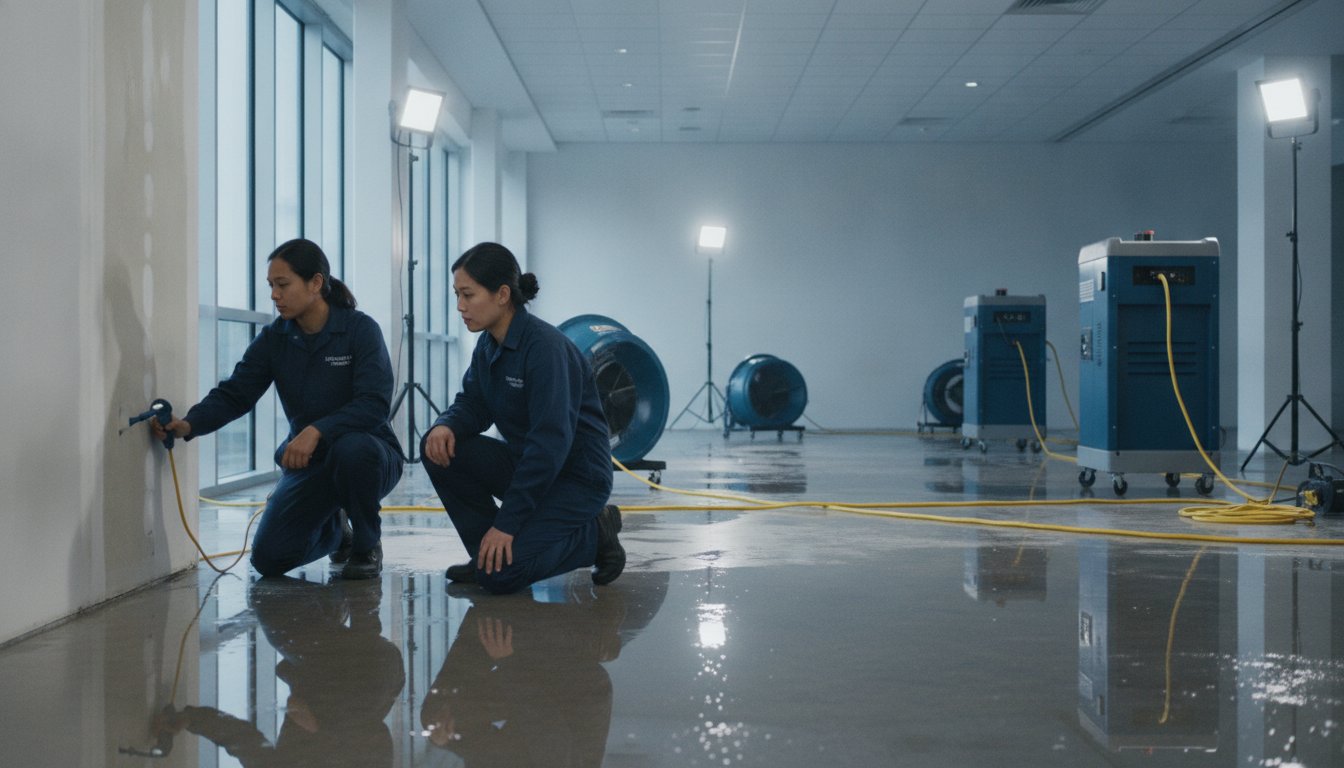
To achieve this, we deploy industrial-grade LGR (Low Grain Refrigerant) dehumidifiers. These units are designed to remove significantly more water per day than standard equipment, even in the low-humidity environments required for deep structural drying. We pair these with high-velocity air movers to break the boundary layer of air on wet surfaces. Throughout the process, we utilize remote moisture monitoring systems. These sensors provide real-time data to our technicians, allowing us to verify the dry-out’s progress without disrupting your daily operations. If you’re currently facing a property crisis, you can consult with a restoration specialist to begin the stabilization process immediately.
Moisture Mapping and Thermal Imaging
Hidden water pockets are the primary cause of long-term structural failure and mold growth. Our technicians use high-resolution infrared cameras to visualize temperature differentials that indicate moisture behind commercial-grade drywall or under resilient flooring. This non-invasive approach allows us to map the affected area with precision. We establish a “dry standard” for each material by taking readings from unaffected parts of the building. This baseline ensures we don’t stop the drying process until the structure has returned to its specific, pre-loss equilibrium. While we focus on structural integrity, we also ensure compliance with federal Asbestos Laws and Regulations when disturbing older building materials.
Managing Complex HVAC and Ductwork Systems
A building’s central air system can inadvertently become a distribution network for contaminants. When water enters a facility, the increased humidity can lead to condensation and microbial growth inside the ventilation network. It’s often necessary to perform professional air duct cleaning to prevent the spread of spores once the system is reactivated. To protect unaffected zones, we implement rigorous containment strategies. We use temporary HEPA-filtered air scrubbers and physical barriers to isolate the drying zone, ensuring that your office’s indoor air quality remains high throughout the restoration lifecycle.
Navigating Environmental Risks: Asbestos and Lead in Coastal Restoration
Long Beach is home to a vast inventory of historic and mid-century commercial architecture. These buildings offer character and prime locations. However, they often harbor legacy hazardous materials like asbestos and lead-based paint. When a pipe bursts or a storm surge occurs, the resulting water intrusion does more than just soak the drywall. It can physically disturb these stable materials. This turns them into friable inhalation hazards. For any commercial water damage restoration in Long Beach, identifying these risks early is a legal and ethical priority. You can’t simply tear out wet materials without conducting professional environmental testing first. This protects your occupants and ensures you remain compliant with local safety ordinances.
Integrating professional asbestos removal into the restoration workflow is essential for older properties. Aggressive drying techniques, such as high-velocity air movement, can inadvertently aerosolize hazardous particles if the area hasn’t been cleared. Following EPA guidelines for commercial property mold remediation and hazardous material handling ensures that your recovery doesn’t create a secondary health crisis. This methodical approach identifies every potential contaminant before it becomes a liability.
Asbestos Abatement During Water Mitigation
Asbestos is frequently found in common commercial building components that are highly susceptible to water damage. These include:
- 9×9 vinyl floor tiles and the adhesive mastic beneath them.
- Thermal system insulation on boilers and steam pipes.
- Acoustic ceiling tiles and “popcorn” textures.
- Fireproofing materials within wall cavities.
When these materials become saturated, they must be removed using strict containment protocols. Our team utilizes negative air pressure machines and HEPA-filtered air scrubbers to isolate the affected zone. This prevents the migration of microscopic fibers to other parts of the building while we stabilize the structure. It’s a precise process that requires specialized training and equipment.
Lead-Based Paint Risks in Commercial Properties
Lead-based paint remains a concern for any commercial property built before 1978. Moisture causes lead-based coatings to flake, peel, or leach into structural components. This creates toxic dust that can settle on surfaces or enter the HVAC system. We adhere to the EPA’s Renovation, Repair, and Painting (RRP) standards for lead safety during every restoration project. Once the drying and abatement are complete, we perform certified lead clearance testing. This final verification provides the documented proof you need to show that the environment is safe for re-occupancy. It protects you from future health-related legal claims while giving your staff peace of mind.

The Commercial Restoration Process: Minimizing Downtime and Liability
Minimizing the impact of a water intrusion event on your bottom line requires a strategic, multi-phased workflow. Unlike residential drying, commercial water damage restoration in Long Beach involves navigating complex building codes, high-occupancy safety standards, and intricate insurance requirements. Our approach is designed to stabilize the environment immediately while setting the stage for a full recovery with zero “quick-fix” failures. This methodical progression ensures that every technical requirement is met before your staff and clients return to the space.
- Step 1: Emergency Response and Stabilization: Our 24/7 dispatch team arrives to secure the site, shut off water sources, and prevent further structural degradation.
- Step 2: Comprehensive Hazard Assessment: We evaluate the water category and test for environmental contaminants like asbestos, lead, and microbial growth.
- Step 3: Industrial Extraction and Debris Removal: Utilizing truck-mounted vacuum systems, we remove standing water and dispose of non-salvageable materials that hinder the drying process.
- Step 4: Controlled Structural Drying: We deploy LGR dehumidifiers and high-velocity air movers to extract deep-seated moisture from the building’s core.
- Step 5: Decontamination and Build-Back: The final phase involves professional sanitization, odor removal, and the physical restoration of walls, floors, and finishes.
This focus on structural restoration can also extend to your property’s exterior surfaces; for expert help with parking areas and driveways, check out Asphalt Maintenance & Paving Co.
Business Continuity and Staged Reopening
While structural restoration is underway, ensuring your digital infrastructure remains operational is a key component of business resilience; for expert IT support, you can discover Uptime Co. and their comprehensive technology consulting services.
Protecting your revenue stream means keeping as much of your facility operational as possible. We often implement temporary containment barriers that isolate the affected zones, allowing your business to continue functioning in dry areas. During this time, we manage a “pack-out” process for high-value inventory, electronics, and sensitive documents. These items are moved to a climate-controlled environment to prevent secondary damage from high humidity. We coordinate closely with your facility managers to ensure that utility services, like electricity and HVAC, are only interrupted when absolutely necessary for safety. If your business requires an immediate stabilization plan, you should contact Coastline for emergency response today.
Documentation for Insurance and Compliance
A successful insurance claim relies on meticulous data. We maintain daily drying logs that track moisture readings, humidity levels, and temperature shifts throughout the restoration lifecycle. This documented proof confirms that the structure has reached its “dry standard” and is safe for reconstruction. Our team acts as a professional liaison with your insurance adjusters, providing the technical evidence they need to expedite your claim. For properties where microbial growth was a factor, we provide a formal toxic mold remediation certificate. This document is vital for your long-term liability protection, proving that the environment was restored according to industry safety standards.
Why Long Beach Businesses Trust Coastline Environmental Solutions
Coastline Environmental Solutions, Inc. has operated as a dependable local guardian for Southern California businesses since 1985. Over nearly four decades, we’ve refined a “meticulous restorer” approach that prioritizes long-term structural health over superficial fixes. What sets our team apart is our integrated service model. We don’t just handle the dry-out; we provide a “one-stop-shop” that combines plumbing services, environmental abatement, and commercial water damage restoration in Long Beach into a single, coordinated workflow. This integration eliminates the typical delays and communication gaps that occur when a property manager has to juggle multiple independent contractors during a crisis.
Our commitment to the region is deeply rooted in the communities we serve, from the industrial sectors of Wilmington to the commercial hubs of Lakewood and San Pedro. We understand the specific architectural challenges and regulatory requirements unique to our coastal environment. By acting as a steady hand during a property emergency, we help business owners navigate the chaos with a clear, technical roadmap toward recovery. We also encourage proactive protection through our pre-loss contingency plans. Establishing this relationship before a disaster occurs ensures that our team is already familiar with your facility’s layout and critical shut-off points, allowing for an even faster response.
Expertise Across All Commercial Sectors
Every commercial property type has a unique operational rhythm and structural requirement. We have extensive experience managing recovery projects for retail spaces, medical offices, and industrial warehouses. For property managers overseeing multi-tenant buildings, we prioritize clear communication and staged reopening strategies to minimize the impact on your tenants’ business activities. Our water damage restoration Long Beach services are never generic. We tailor our moisture mapping and containment protocols to the specific materials and layout of your site, ensuring that the restoration is both thorough and efficient.
Ready to Restore Your Business
When you face a facility emergency, you need a calm professional who can take control of the situation with precision. Our 24/7 emergency dispatch ensures that help is always available when minutes count. This rapid response, combined with our methodical, safety-first approach, provides the peace of mind you need to focus on your core operations while we handle the technical complexities of the recovery. We don’t just restore property; we restore normalcy. If you’re currently dealing with a water intrusion event or want to secure your facility’s future, contact Coastline Environmental Solutions, Inc. for an immediate emergency response and professional consultation.
Ensuring Business Resilience and Environmental Safety
Protecting your commercial asset requires more than just extracting water; it demands a technical, dual-track approach that prioritizes both structural drying and the mitigation of legacy environmental hazards. By understanding the critical 24 to 48-hour window for stabilization and the complexities of psychrometry in large-scale facilities, you can effectively minimize operational downtime and long-term liability. A successful recovery is defined by the quality of documentation and the thoroughness of the decontamination process.
When you partner with a provider of commercial water damage restoration in Long Beach, you’re investing in the future of your facility. Since 1985, Coastline Environmental Solutions has acted as a steady hand for local business owners, utilizing IICRC Certified Technicians and licensed asbestos and lead abatement experts to handle even the most complex property losses. We provide a methodical path back to normalcy without the risks of quick-fix failures.
Contact Coastline Environmental Solutions for 24/7 Emergency Commercial Restoration and let us secure your facility with the precision it deserves. Your business is a vital part of our community, and we’re here to help you protect it.
Frequently Asked Questions
How long does commercial water damage restoration usually take?
The structural drying phase of commercial water damage restoration in Long Beach typically requires three to five days to reach industry dry standards. However, the total timeline for full recovery varies based on the extent of building material saturation and the need for environmental abatement. Large-scale debris removal and the reconstruction of specialized commercial finishes can extend the process. We provide daily progress reports to help you manage your operational expectations during this period.
Is my business liable for mold growth after a water leak?
Business owners carry a legal duty of care to provide a safe environment for employees and customers. If a water leak isn’t professionally mitigated within 48 hours, microbial growth can compromise indoor air quality. This failure can lead to health-related liabilities and “sick building syndrome” claims. Utilizing certified technicians ensures you have the necessary documentation to prove that the property was returned to a sanitary, pre-loss condition according to safety standards.
Does commercial insurance cover asbestos removal during water restoration?
Most commercial insurance policies cover asbestos abatement if the material must be disturbed to facilitate the repair of a covered water loss. Since many older Long Beach buildings contain asbestos in floor tiles or pipe insulation, testing is a mandatory first step. We act as a professional liaison with your insurance adjuster, providing the technical data and environmental reports required to justify the inclusion of abatement costs in your restoration claim.
Can my business remain open during the restoration process?
Many businesses can remain partially operational by utilizing strategic containment zones. We set up physical barriers and HEPA-filtered negative air pressure systems to isolate the work area from your daily activities. This prevents the migration of dust or odors into unaffected parts of the facility. While some loud equipment like high-velocity air movers is necessary, we coordinate with facility managers to schedule the most disruptive tasks during off-peak hours whenever possible.
What is the difference between water mitigation and water restoration?
Water mitigation focuses on immediate stabilization to prevent further damage, including water extraction, moisture mapping, and the installation of drying equipment. In contrast, water restoration involves the permanent repair and “build-back” of the facility to its original state. For effective commercial water damage restoration in Long Beach, both phases must be handled methodically. Mitigation stops the bleeding, while restoration ensures the structural and aesthetic integrity of your property is fully recovered.
How do you detect water hidden behind commercial walls or under floors?
We utilize non-invasive technology like infrared thermal imaging cameras to detect temperature differentials caused by moisture pockets behind drywall or under concrete slabs. These cameras allow us to visualize the migration of water without damaging your finishes. We supplement these findings with penetrating and non-penetrating moisture meters to measure the exact saturation levels of building materials. This data-driven approach ensures that no hidden moisture is left behind to cause future structural failure or mold.
What are the most common causes of commercial water damage in Long Beach?
The most frequent causes in our coastal environment include aging plumbing infrastructure, pressurized supply line failures, and compromised HVAC condensation systems. Long Beach facilities also face risks from heavy seasonal rain and storm surges that can overwhelm local drainage systems. In high-occupancy buildings, fire sprinkler malfunctions or tenant negligence often lead to multi-floor water intrusion. Our team is familiar with these local patterns and maintains the specialized equipment needed to handle industrial-scale volumes.
Why is professional air duct cleaning necessary after a flood?
High humidity levels during a flood can cause moisture to accumulate inside your building’s central air system, creating a breeding ground for microbial growth. If the ventilation network isn’t professionally cleaned, the HVAC system will distribute spores and odors throughout the entire facility once reactivated. Professional air duct cleaning removes these contaminants and ensures that your indoor air quality remains within safe limits for occupants. It’s a critical final step in a comprehensive recovery plan.