
12 Aug Professional Asbestos Removal: A Methodical Guide to Safe Abatement (2026)
Under South Coast AQMD Rule 1403, there is no age exemption for asbestos surveys before a renovation, meaning even modern properties in Long Beach and the South Bay are subject to rigorous environmental oversight. If you’ve discovered hazardous materials during a remodel, the stress of potential health risks like mesothelioma often clashes with the confusion of complex state regulations. You need more than just a quick fix; you need a steady hand to ensure your property returns to a state of safety and total compliance. Professional asbestos removal is a precision-engineered safety process, not a simple cleanup task, and it requires a methodical approach to protect everyone involved.
We understand the urgency of getting your project back on track while keeping your family or tenants safe. This guide provides a clear, technical breakdown of the abatement process, from initial containment to the final air clearance testing required by California law. You’ll learn how to navigate the latest 2026 SCAQMD notification requirements and what to expect from a certified contractor. By following these established protocols, you can transform a high-stakes environmental crisis into a controlled, organized resolution that results in a certified asbestos-free environment.
Key Takeaways
- Learn why professional asbestos removal is the only permanent solution for Southern California properties undergoing major structural changes or demolition.
- Understand the mandatory requirements of SCAQMD Rule 1403, including the necessity of professional surveys for all buildings regardless of construction date.
- Identify the technical phases of abatement, ranging from high-integrity containment with 6-mil polyethylene to final air clearance testing.
- Compare the long-term safety of total abatement against the temporary protection of encapsulation using specialized bridging chemicals.
- Discover how a methodical, integrated approach to environmental hazards can streamline your property’s restoration and ensure full regulatory compliance.
Understanding Asbestos Removal: Risks, Identification, and Rationale
Professional asbestos abatement is the methodical process of identifying, containing, and eliminating hazardous mineral fibers from a property. It’s a high-stakes technical response that goes far beyond simple cleanup. Effective asbestos removal requires strict engineering controls to prevent the release of microscopic particles into the air. This process ensures that hazardous materials are not only removed but handled in a way that protects the long-term health of the building’s occupants and the surrounding environment.
During the post-war housing boom in Southern California, builders utilized asbestos extensively for its fire-resistant properties and extreme durability. Homes and commercial structures built before 1980 often contain these minerals in everything from roofing to floor adhesives. While these materials were once considered a gold standard for safety, we now know that their presence creates a significant liability when they begin to degrade or face disturbance during a remodel.
A critical distinction in safety protocols is whether a material is friable or non-friable. Friable asbestos is easily crumbled or reduced to powder by hand pressure, making it an immediate airborne threat. Non-friable materials, such as vinyl floor tiles, are generally stable until they are cut, sanded, or broken. When these materials are compromised, they release microscopic fibers that can lodge in the lungs or the lining of the heart, causing irreversible damage. Adhering to established Asbestos abatement procedures is the only way to manage these risks with precision.
Common Asbestos-Containing Materials (ACMs) in Local Properties
Regional construction trends often dictate where hazardous materials are found. In Lakewood tract homes, acoustic “popcorn” ceiling textures and decorative plasters are frequent culprits. Older Long Beach rental properties often feature 9×9 vinyl floor tiles and the black mastic adhesives used to secure them. Meanwhile, in Huntington Beach commercial districts, asbestos is commonly found in the insulation wrapping pipes, boilers, and HVAC ductwork. These materials require specialized handling to prevent cross-contamination during restoration. Homeowners planning structural updates should also consider whether is asbestos in my walls a concern, as plaster and drywall compounds in pre-1980s construction frequently contained hazardous mineral fibers.
When to Suspect Asbestos: Identifying Renovation Risks
Visible signs of deterioration are the first indicators of a problem. You might notice crumbling pipe wrap, brittle floor tiles, or “dusting” from textured ceilings. However, visual checks are insufficient. The age of the property is the most reliable factor; any structure built prior to the mid-1980s requires professional asbestos testing for home renovation before any work begins. Because asbestos fibers are invisible to the naked eye, technicians must use polarized light microscopy (PLM) to confirm their presence and determine the concentration of the mineral within the material.
The Professional Asbestos Abatement Process Explained
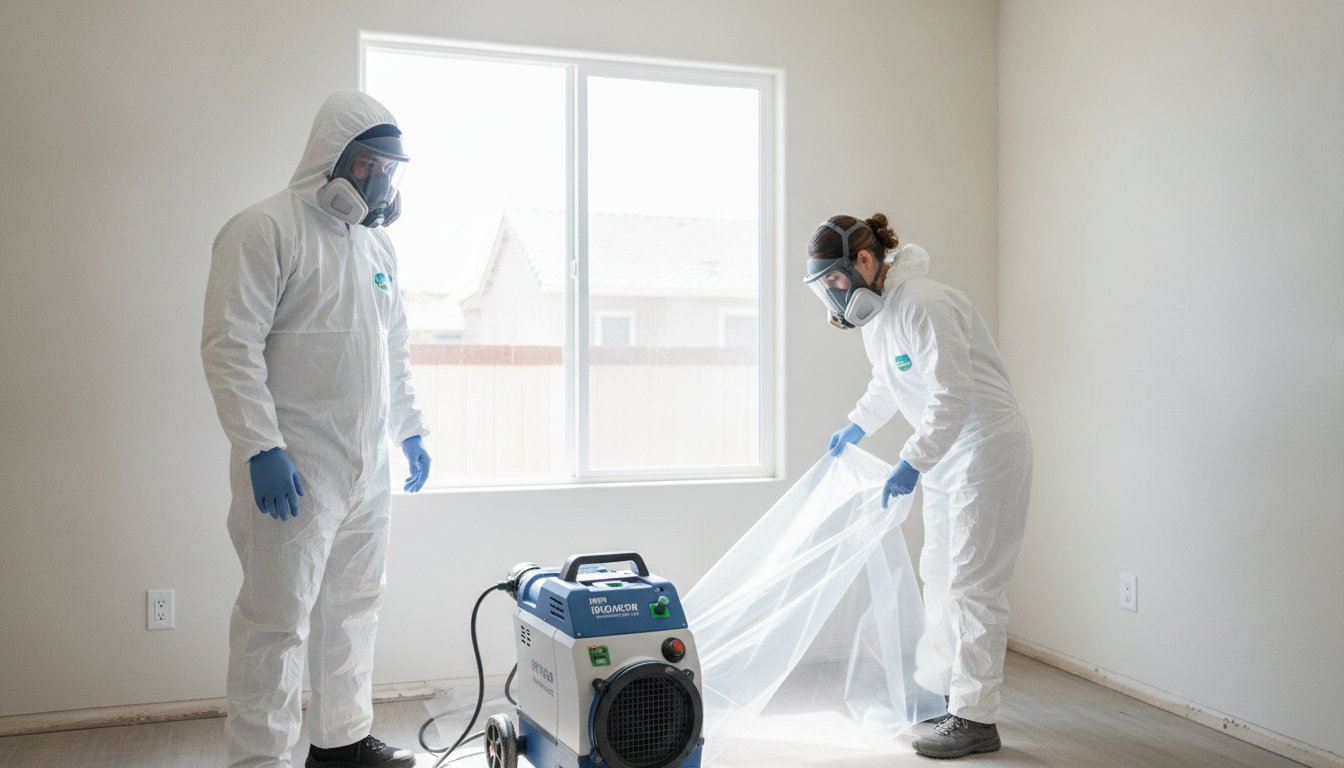
Professional asbestos removal follows a rigid, technical sequence designed to eliminate environmental risk. The process begins with a comprehensive pre-abatement inspection to establish a regulated work area. This boundary ensures that only authorized, protected personnel enter the site. Once the area is defined, we implement high-integrity containment using two layers of 6-mil polyethylene sheeting. Every seam is sealed with heavy-duty duct tape to create a physical barrier that prevents hazardous dust from migrating into unaffected parts of the property.
Containment and Negative Air Pressure Mechanics
The core of a safe abatement site is the negative air pressure system. We utilize specialized negative air machines that create a vacuum within the containment zone. This setup ensures that air only flows into the work area, never out of it. These machines are equipped with HEPA (High-Efficiency Particulate Air) filtration, which scrubs the indoor environment by capturing 99.97% of particles as small as 0.3 microns. To maintain this environment, we establish multi-stage decontamination chambers. Technicians must pass through these stages to clean their suits and equipment before exiting. This level of precision is necessary to prevent the long-term health effects of asbestos exposure, such as asbestosis or mesothelioma.
During the actual removal, technicians employ “wet methods” to keep fibers from becoming airborne. By saturating asbestos-containing materials with amended water, we suppress dust at the source. Once the materials are removed, the area undergoes a meticulous final cleaning. This involves HEPA-vacuuming and wet-wiping all surfaces. Before the containment is dismantled, an independent third-party laboratory conducts clearance air testing to verify the environment is safe for re-occupancy. If you’re preparing for a remodel, reaching out to a certified restoration specialist can help you navigate these technical requirements safely.
Safe Disposal and Environmental Compliance
Waste management is the final, critical phase of the abatement process. All asbestos-containing materials are double-bagged in 6-mil poly bags, which are then goose-neck sealed and labeled according to EPA and DOT standards. These materials cannot be sent to standard landfills. They must be transported to specialized facilities authorized to accept hazardous mineral waste. We provide every property owner with a Waste Shipment Record (WSR). This document is essential; it serves as legal proof that the hazardous waste was handled and disposed of correctly, protecting you from future liability and ensuring your project remains in full environmental compliance.
Comparing Remediation Strategies: Removal vs. Encapsulation
Choosing the right abatement strategy requires a thorough evaluation of the material’s current stability and the property owner’s long-term objectives. While asbestos removal remains the gold standard for safety by permanently eliminating the hazard, other management methods like encapsulation and enclosure exist for specific scenarios. Property owners must navigate these choices while adhering to federal requirements for asbestos removal and local Southern California standards. The decision often hinges on whether the material is likely to be disturbed by future occupancy or structural changes.
Asbestos removal is the only definitive solution for properties slated for demolition or major renovation. In contrast, encapsulation involves treating the material with specialized bridging or penetrating chemicals to seal the fibers in place and prevent them from becoming airborne. Enclosure builds a permanent, airtight barrier around the hazardous material, such as a new wall or floor layer. Each method has technical merits, but the condition of the material and your future plans for the space will dictate which path is most responsible.
When Full Removal is the Only Safe Option
If materials are already friable, water-impacted, or showing signs of visible deterioration, partial measures are rarely sufficient. Full asbestos removal is the only safe path when structural changes are planned, as you can’t disturb a wall or ceiling that contains hazardous minerals without risking widespread contamination. This is especially critical during integrated projects like toxic mold remediation. When mold growth overlaps with asbestos-containing drywall or insulation, the entire assembly must be removed under full abatement protocols to ensure the environment is truly restored to a safe state.
The Pros and Cons of Encapsulation
Encapsulation is often chosen for its lower immediate cost and minimal structural disruption, as it avoids the intensive containment and labor phases required for total extraction. It’s a viable option for materials in excellent condition that are located in low-traffic areas. However, the drawbacks include a requirement for documented, ongoing monitoring and the potential for complications during future property sales. Encapsulation is a management strategy designed to mitigate risk temporarily rather than a permanent cure for the presence of hazardous minerals. If you choose this route, you’re essentially deferring the removal costs to a later date, as any future demolition will still require full abatement of the encapsulated materials.

Navigating Regulations and Compliance in Southern California
Southern California properties fall under the jurisdiction of the South Coast Air Quality Management District (SCAQMD), an agency that enforces some of the most rigorous air quality standards in the nation. Unlike other regions where federal oversight is the primary concern, local owners must answer to specific district mandates. For any project involving asbestos removal, compliance isn’t a suggestion; it’s a legal requirement that protects you from liability and ensures public safety. The district’s oversight is comprehensive, covering everything from the initial inspection to the final disposal of hazardous materials.
The cornerstone of local regulation is SCAQMD Rule 1403. This rule dictates that a certified asbestos survey must be performed before any demolition or renovation work begins, regardless of when the building was constructed. Once hazardous materials are identified, you’re required to notify the district at least 10 working days before starting the abatement. This waiting period is mandatory, allowing regulators to review your plan and schedule potential site inspections. Failing to adhere to these timelines or proceeding without a survey can lead to stop-work orders and heavy financial penalties for both the property owner and the contractor.
SCAQMD Rule 1403 and Local Notification Requirements
In South Bay communities like San Pedro and Wilmington, residential and commercial owners face unique challenges due to the age and density of the local building stock. If a project involves non-standard removal situations, such as disturbed or fire-damaged materials, the district requires a “Procedure 5” plan. This is a custom, site-specific cleanup strategy that must be submitted and approved before any work commences. Coastline Environmental Solutions, Inc. manages these complex compliance filings and technical paperwork for our local clients, acting as a steady hand to ensure every project remains in good standing with the district.
Hiring Certified Abatement Contractors in the South Bay
Selecting the right partner in the South Bay requires looking beyond a standard general contractor’s license. You must verify that the firm holds a C-22 Asbestos Abatement contractor license and maintains an active registration with the Division of Occupational Safety and Health (DOSH). These credentials ensure the team is trained in the specialized containment and engineering controls discussed in earlier sections. Because many local properties were built before 1978, it’s also highly recommended to work with certified lead abatement contractors, as lead-based paint often accompanies asbestos in historic structures. To ensure your renovation meets all Southern California environmental mandates, contact the specialists at Coastline Environmental Solutions, Inc. for a professional consultation.
While finding local environmental specialists is crucial for safety, general contracting expertise is equally important for the restoration phase; for projects in Pennsylvania, you can discover Prestige Operations for comprehensive residential and commercial property services.
Coastline’s Methodical Approach to Safe Asbestos Remediation
Coastline Environmental Solutions, Inc. approaches every project with a “calm professional” philosophy. We act as a dependable local guardian for properties in Long Beach, Lakewood, and throughout our service areas, balancing technical precision with the empathy required to manage high-stakes environmental hazards. We recognize that discovering hazardous materials is a stressful experience for any property owner. By positioning ourselves as a steady hand during these crises, we move the narrative from emergency to organized resolution, focusing on thoroughness and a return to normalcy.
A significant advantage of our methodical approach is the ability to provide integrated restoration services. It’s common for hazardous materials to be uncovered during emergency repairs, such as water damage restoration in Long Beach. Instead of requiring you to coordinate multiple specialized vendors, we manage asbestos, lead, and water damage simultaneously. This integrated response reduces the time your property remains under containment and ensures that all safety protocols are unified under one expert team, preventing the cross-contamination that often occurs when different contractors overlap.
Our asbestos removal protocols utilize advanced technology to ensure absolute containment. We deploy industrial-grade negative air machines and high-capacity HEPA filtration systems to scrub the environment at a microscopic level. By combining this advanced equipment with rigorous industrial hygiene testing, we provide a level of specialized knowledge that builds credibility and trust. We don’t just aim for a quick fix; we’re dedicated to long-term solutions that meet the highest environmental standards.
A Comprehensive Safety Guarantee for Your Property
Once the physical abatement is complete, we provide a comprehensive safety guarantee to ensure your environment is truly restored. This includes post-abatement air clearance testing performed by independent, third-party laboratories. Utilizing an outside lab ensures there’s no conflict of interest in certifying the safety of your space. We also provide detailed documentation, including Waste Shipment Records and clearance certificates, which are essential for insurance claims and property records. Our commitment is to leave your indoor air quality at peak safety levels before we dismantle a single piece of containment.
Your Path to a Certified Asbestos-Free Environment
The journey to a safe property begins with a detailed site assessment and a transparent cost estimate. We maintain a clear “challenge-action-resolution” flow throughout the project, keeping you informed from the initial SCAQMD notification to the final air clearance. This step-by-step communication process eliminates the confusion often associated with asbestos removal regulations. We take pride in our local commitment and our ability to handle chaotic situations with professional precision. Contact Coastline Environmental Solutions, Inc. today for a professional consultation.
Securing Your Property’s Future with Professional Abatement
Identifying hazardous materials is a critical first step, but the long-term safety of your renovation depends on the precision of the technical response. We have explored the necessity of high-integrity containment and the legal complexities of local regulations. A methodical approach to asbestos removal ensures that microscopic risks are permanently eliminated, protecting both your property value and the health of your occupants. By moving from a state of uncertainty to one of organized resolution, you can proceed with your structural changes with absolute confidence.
Coastline Environmental Solutions has served Long Beach and the South Bay since 1985, acting as a steady hand for local property owners. As certified DOSH abatement specialists and SCAQMD Rule 1403 compliance experts, we manage the technical details and regulatory filings so you don’t have to. Our team is dedicated to restoring your environment to peak safety levels with the meticulous care your home or business deserves. Schedule a Certified Asbestos Assessment with Coastline Environmental Solutions today to ensure your property remains a safe, healthy space for years to come. Your return to normalcy starts with a partner you can trust.
Frequently Asked Questions
Can I remove asbestos from my own home in California?
While California law allows homeowners to perform work on their own primary residence, it’s strongly discouraged due to extreme health risks and strict disposal laws. Any project involving more than 100 square feet of material triggers mandatory Cal/OSHA and local air district regulations. Attempting DIY removal often leads to cross-contamination, making the property unsafe for occupancy and potentially leading to legal penalties for improper hazardous waste handling.
How much does professional asbestos removal cost in Long Beach?
The cost of a project depends on the volume of material, its location, and the complexity of the required containment. Factors such as the height of ceilings, the presence of water damage, and the specific type of asbestos-containing material all influence the final estimate. We recommend a professional site assessment to determine a precise scope of work that ensures full compliance with local SCAQMD standards without compromising safety.
What does asbestos look like in older Southern California homes?
Asbestos is often invisible to the naked eye because it was mixed into other building materials for durability. In local properties, it frequently appears as white or grey “popcorn” ceiling texture, 9×9 inch vinyl floor tiles, or corrugated paper-like insulation on HVAC ducts. Because microscopic fibers cannot be identified by sight alone, a certified laboratory must use polarized light microscopy to confirm the presence of hazardous minerals in a sample. Homeowners planning to update their ceilings should review a dedicated guide to popcorn ceiling asbestos removal to understand the full scope of safety and cost considerations before beginning any work.
Is it safe to stay in the house during asbestos abatement?
We generally recommend that residents relocate while the work area is under containment to ensure absolute safety. Although high-integrity polyethylene barriers and negative air machines are used to isolate the hazard, the noise of the equipment and the restricted access to certain rooms can be disruptive. Professional air clearance testing must confirm the environment is safe before the containment is dismantled and the family returns to the space.
How long does the asbestos removal process typically take?
A standard residential asbestos removal project usually requires three to five working days to complete safely. This timeframe accounts for the setup of multi-stage decontamination chambers, the meticulous removal of materials using wet methods, and the final cleaning of all surfaces. Additionally, the process includes a mandatory waiting period for independent laboratory air clearance results, which verifies that the environment is free of airborne fibers before the project is finalized.
What happens if asbestos is discovered during a water damage restoration project?
All restoration work must stop immediately to prevent the accidental disturbance of the hazardous material. The damp or damaged materials must be tested by a professional to determine if they contain asbestos before drying equipment can be placed. If the test is positive, the project transitions into an integrated abatement and restoration plan, ensuring that the water damage is addressed while maintaining strict environmental containment protocols.
Does homeowners insurance cover the cost of asbestos removal?
Standard policies typically don’t cover the removal of asbestos if the material is simply old or deteriorating. However, if the asbestos-containing material is damaged by a covered peril, such as a sudden pipe burst or fire, the insurance company may cover the cost of the abatement as part of the broader restoration claim. You should review your specific policy or consult with a restoration expert to understand your coverage limits for environmental hazards.
What is the difference between asbestos abatement and asbestos remediation?
These terms are often used interchangeably, but they describe the same methodical process of managing hazardous mineral fibers. Abatement specifically refers to the permanent removal or sealing of asbestos to eliminate the threat. Remediation is a broader term that encompasses the entire response, including the initial survey, the containment of the area, and the final air clearance testing. Both processes aim to create a certified, hazard-free environment for property owners. Once your property has been cleared and restored, maintaining a healthy indoor environment extends beyond the walls themselves — flooring textiles like rugs can also harbor allergens and microscopic particles, making professional area rug cleaning services an important consideration for comprehensive post-remediation hygiene.