02 Sep Commercial Water Damage Drying in Long Beach: The Professional Recovery Guide
In the high-humidity environment of coastal California, simply opening the windows and turning on a few fans after a flood isn’t just ineffective; it’s a recipe for structural failure. You’re likely aware that every hour your doors remain closed represents lost revenue and mounting stress over potential mold growth. This is why professional commercial water damage drying Long Beach services focus on psychrometric science rather than just surface-level cleanup. When moisture seeps into specialized flooring or behind industrial drywall, the clock starts ticking against your building’s integrity. Don’t let a temporary leak become a permanent financial burden.
We understand that a rapid, methodical response is the only way to ensure your business survives a major water intrusion. This guide reveals the advanced structural drying techniques and local expertise required to minimize downtime and protect your commercial property from secondary damage. You’ll learn about the critical 48-hour window for mold prevention, the specialized equipment needed to combat Long Beach’s unique moisture levels, and the steps required to document a successful recovery for insurance purposes. By moving from a state of emergency to a controlled, technical resolution, you can safeguard your investment and return to normal operations with confidence.
Key Takeaways
- Master the “Golden Window” of restoration and learn how Long Beach’s coastal humidity can trigger mold growth in as little as 24 hours.
- Gain insights into the science of psychrometrics and how professional commercial water damage drying Long Beach services use airflow and temperature control to protect structural integrity.
- Understand the technical advantages of LGR and desiccant dehumidification systems when treating large commercial spaces and complex building voids.
- Ensure safety compliance by learning why asbestos and lead testing are mandatory steps during the structural drying of older commercial properties.
- Discover how customized recovery plans prioritize business continuity, allowing your operations to resume safely while the restoration process continues.
Immediate Response: Why Time is the Enemy for Long Beach Businesses
Time is the most critical variable in any restoration project. Within the first 24 to 48 hours, a “Golden Window” exists where professional commercial water damage drying Long Beach services can effectively halt the progression of permanent damage. If moisture remains unaddressed beyond this threshold, microbial growth begins to colonize porous materials like drywall, ceiling tiles, and insulation. In the coastal environment of Long Beach, where ambient moisture is already elevated, this biological clock moves even faster. A steady, methodical response during these initial hours doesn’t just save your property; it saves your business from extended closures.
Before technical drying begins, safety must be the primary focus. Standing water in a commercial warehouse or retail space often hides submerged electrical outlets or compromised wiring. Additionally, heavy saturated materials can cause structural instability, leading to ceiling collapses or weakened floor joists. A professional assessment identifies these hazards early, protecting your staff and ensuring the site is stable for the heavy equipment required for The Science of Structural Drying. Taking these precautions ensures that the recovery process is safe, thorough, and legal.
The Cost of Delayed Mitigation
Delayed mitigation isn’t just a physical issue; it’s a significant financial liability. Secondary damage, such as warped subfloors, ruined inventory, and permanent staining on masonry, often costs more to replace than the initial water extraction itself. From a liability standpoint, allowing employees or customers to remain in a damp environment increases the risk of slip-and-fall accidents or respiratory complaints. Early intervention simplifies the insurance claims process by providing clear documentation of the loss and the immediate steps taken to mitigate further liability. It’s much easier to justify a drying bill to an adjuster than a total inventory replacement caused by neglect.
Local Environmental Factors in Long Beach
Long Beach presents unique challenges that national franchises often overlook. The high coastal humidity significantly slows natural evaporation rates, meaning standard fans are rarely enough to reach industrial dry standards. Salt air is another factor; it can accelerate the corrosion of sensitive commercial electronics and machinery if moisture isn’t stripped from the air quickly. Working with a local partner who has served this community since 1985 ensures these environmental variables are factored into the drying plan. For older structures in the 90802 or 90804 zip codes, we also incorporate immediate testing for asbestos and lead during the assessment. This ensures that any necessary tear-outs required for commercial water damage drying Long Beach comply with safety regulations, preventing legal delays that could further stall your reopening.
The Science of Structural Drying and Psychrometrics
Psychrometrics is the scientific foundation of all professional drying. This discipline involves the study of the thermodynamic properties of moist air and the relationship between temperature, humidity, and vapor pressure. For commercial water damage drying Long Beach, this science is vital because our coastal air often lacks the “thirst” needed to pull moisture from deep within building materials. We strictly adhere to the IICRC S500 Standards, which provide the rigorous technical framework for every step of the restoration process, ensuring that drying is a calculated operation rather than a guessing game.
Effective restoration requires the precise management of three environmental variables. Without balancing these pillars, moisture remains trapped in the building’s core, leading to long-term structural issues. We manage the environment using a specific combination of tools:
- Airflow: High-velocity air movers break the boundary layer of saturated air on surfaces to promote rapid evaporation.
- Dehumidification: Industrial units remove moisture from the air to maintain a low vapor pressure environment.
- Temperature Control: Controlled heat increases the energy of water molecules, making them easier to extract from dense materials.
Understanding Vapor Pressure and Evaporation
Evaporation is a mechanical process driven by vapor pressure. When water saturates dense materials like concrete or structural wood, it creates high vapor pressure within the material. By using high-capacity air movers to break the “boundary layer” of cool, moist air sitting on the surface, we create a pressure differential. This forces the trapped moisture to move from the material into the air. Following EPA guidelines on mold prevention, we ensure that humidity levels are dropped rapidly to stop microbial growth before it starts.
Advanced Moisture Detection Technology
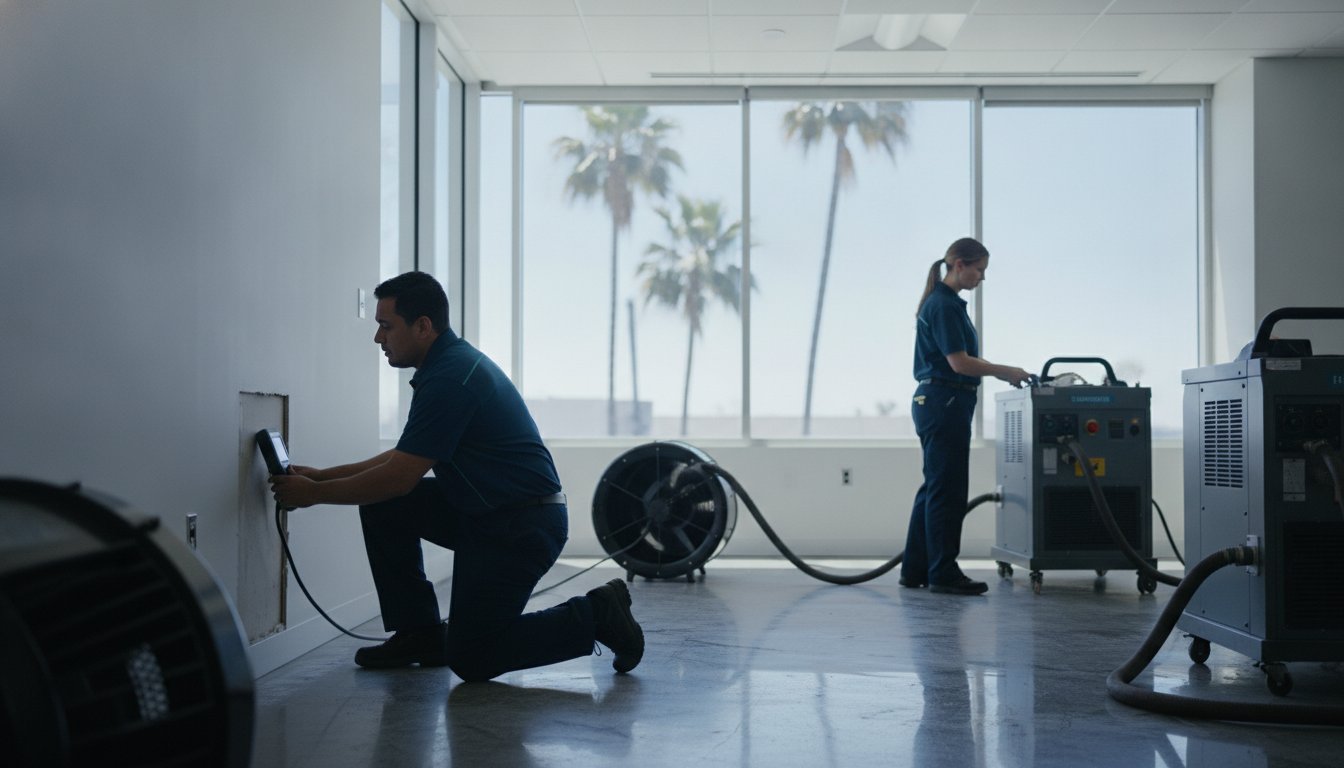
You can’t dry what you can’t see. Our technicians use thermal imaging cameras (FLIR) to detect temperature variances that indicate hidden water pockets behind commercial drywall or within insulation. These tools allow us to map the moisture without damaging your property. For flooring like luxury vinyl tile (LVT) or hardwood, non-penetrating moisture meters provide accurate readings without leaving marks. This data is used to establish a “Dry Standard” — a baseline of what the building should look like under normal conditions. This documentation is essential for insurance verification and ensures your property is truly safe for re-entry. If you suspect hidden moisture in your facility, our team at Coastline Environmental Solutions can perform a comprehensive moisture mapping assessment to protect your structural integrity.
Commercial-Grade Drying Technology vs. Standard Restoration
Commercial facilities require a different caliber of technology than residential homes. When dealing with large-scale water intrusion, standard restoration tools often fall short of the required moisture extraction rates. Effective commercial water damage drying Long Beach relies on industrial-grade hardware designed to operate in high-volume environments where structural materials like steel and concrete present unique drying challenges. We utilize a precision-engineered fleet of equipment that allows for rapid stabilization of the indoor environment, preventing the saturation of expensive assets and sensitive electronics.
The use of remote monitoring systems has revolutionized how we manage these projects. Instead of requiring a technician on-site 24/7, we install wireless sensors that track temperature, relative humidity, and moisture content in real-time. This data is transmitted to our command center, allowing us to adjust equipment settings instantly to maintain optimal drying conditions. This meticulous approach ensures that your business remains as functional as possible while we work in the background to restore safety.
Industrial Dehumidification Strategies
Standard dehumidifiers are often overwhelmed by the “grain jump” found in saturated commercial buildings. We utilize High-Grade Low Grain Refrigerant (LGR) dehumidifiers because they continue to remove moisture even in air as dry as 30 grains per pound. In environments where ultra-low humidity is non-negotiable, such as server rooms, medical labs, or libraries, we deploy desiccant drying systems. Desiccants use chemical attraction rather than condensation to strip moisture from the air, reaching humidity levels that refrigerant units simply cannot achieve. By strategically placing these units, we maximize cubic feet per minute (CFM) efficiency, ensuring that dry air reaches every corner of the facility.
Air Scrubbing and Hazardous Material Safety
Maintaining indoor air quality is a primary concern during the drying process, especially in the healthcare or food service sectors. We use HEPA-filtered air scrubbers to capture 99.97% of airborne particulates, including mold spores and dust that may be disturbed during restoration. In many older Long Beach commercial buildings, water damage can compromise materials containing regulated substances. If our initial assessment identifies a risk, we integrate professional asbestos removal protocols before proceeding with structural demolition. This ensures that the drying process doesn’t inadvertently cross-contaminate your workspace with hazardous fibers. This commitment to safety protects your employees and ensures your facility remains compliant with local environmental health standards.

Preventing Secondary Damage: Mold and Structural Integrity
Secondary damage often proves more destructive than the initial flood. When moisture remains trapped within a building’s envelope, it triggers a chain reaction of biological and structural decay. In the context of commercial water damage drying Long Beach, the 48-hour window is a non-negotiable deadline. Beyond this point, the probability of microbial colonization increases exponentially. We focus on rapid stabilization to ensure that a simple pipe burst doesn’t evolve into a complex environmental hazard that requires the total gutting of your facility.
Structural weakening occurs when water saturates load-bearing components. While steel and concrete are more resilient than wood, they aren’t immune to long-term moisture exposure. Prolonged saturation can lead to the corrosion of steel reinforcements and the degradation of masonry bonds. We also prioritize odor neutralization during the initial drying phase. By eliminating the “musty” smell before it permeates porous surfaces and HVAC systems, we ensure your building smells clean and professional once operations resume.
Mold Mitigation in a Coastal Climate
Long Beach’s moderate temperatures and high humidity create a perfect breeding ground for fungal growth. Unlike drier inland areas, our coastal air rarely provides the natural desiccation needed to stop spores from germinating. If drying is delayed even by a single day, the risk of a widespread outbreak becomes a reality. This is why we integrate antimicrobial treatments early in the process to inhibit microbial growth on porous surfaces like insulation and wood framing. If you discover that moisture has already been present for several days, it’s vital to transition into toxic mold remediation to ensure the safety of your occupants and the legality of your workspace.
Structural Integrity and Material Science
Water doesn’t just sit on the floor; it travels. Through wicking action, moisture can climb up commercial drywall and into wall cavities, often reaching heights far above the visible waterline. Identifying “non-salvageable” materials early is a hallmark of a meticulous restorer. We don’t waste time trying to dry materials that have lost their structural bond, such as heavily saturated particle board or delaminated carpet. Instead, we focus our energy on “Class 4” materials like hardwood and dense masonry that require specialized injectidry systems. These systems force dry air directly into wall cavities and under cabinetry, reaching deep-seated moisture that standard air movers can’t touch. To secure your property against these hidden risks, contact our experts at Coastline Environmental Solutions for a technical structural assessment.
Restoring Business Continuity with Coastline Environmental Solutions
The final phase of recovery isn’t just about removing water; it’s about returning your organization to its peak operational state. Every commercial water damage drying Long Beach project we undertake is designed to minimize the impact on your bottom line through a customized restoration plan. We recognize that every business has unique operational needs, so we tailor our drying schedules to work around your specific hours and departments. Our objective is to serve as a steady hand, guiding you from the initial chaos of a flood to a state of organized, technical resolution.
Our comprehensive service suite manages every variable of the recovery process. We don’t just extract water and leave; we provide a full-service environmental response. This includes initial moisture mapping, structural stabilization, and rigorous indoor air quality testing to confirm that your facility is free from airborne contaminants before staff returns. By maintaining this level of meticulous care, we ensure that your property is not only dry but also safe and healthy for long-term re-occupancy.
A Methodical Approach to Commercial Recovery
Insurance claims for commercial properties are often complex and require exhaustive proof of loss. We provide detailed documentation for insurance adjusters, including moisture readings, equipment logs, and thermal imaging reports, to help you maximize your claim. To keep your business moving, we often implement a phased restoration strategy. This allows us to isolate and dry essential departments first, so your core operations can continue while we address secondary areas. We also act as the central coordinator, working alongside plumbing and electrical contractors to ensure that all repairs are synchronized for a seamless “Fresh Start” for your facility.
Why Long Beach Trusts Coastline
Coastline Environmental Solutions has deep roots in the Southern California community, having served as a dependable local guardian since 1985. Our technicians are IICRC certified experts who understand the intersection of water restoration and hazardous material abatement. We don’t just look for a quick fix; we’re dedicated to a thorough, long-term solution that protects your investment. Before we consider a job finished, we conduct a final inspection and provide a formal “Clearance” report, giving you the confidence that your building meets the highest industry standards for safety. When your business is at stake, you need a partner who is as invested in the outcome as you are. Contact Coastline Environmental Solutions for 24/7 emergency drying and let our 40 plus years of expertise restore your peace of mind.
Securing Your Commercial Property for a Swift Recovery
Managing a flood in a commercial setting requires more than just water extraction; it demands a technical mastery of psychrometrics and rapid environmental control. By acting within the first 48 hours, you stop microbial growth and preserve the structural integrity of your building’s core materials. Utilizing advanced commercial water damage drying Long Beach techniques ensures that hidden moisture behind drywall and under industrial flooring is thoroughly addressed. This methodical approach doesn’t just dry the space; it protects your long-term investment and minimizes the financial impact of business interruption.
When every minute counts, you need a partner who understands the unique coastal challenges of Southern California. Since 1985, our team has provided a steady hand to local business owners facing property crises. We combine 24/7 emergency response with the expertise of IICRC certified professionals to deliver a controlled, safe, and efficient recovery. Don’t let a temporary disaster dictate your company’s future. Call Coastline Environmental Solutions for Emergency Commercial Drying and let us help you return to business as usual. Your facility can be restored to a safe, dry, and productive environment with the right expertise.
Frequently Asked Questions
How long does the commercial drying process typically take in Long Beach?
The average timeline for commercial water damage drying Long Beach projects is typically three to five days. This duration depends on the volume of water and the density of the structural materials involved. While coastal humidity can slow the process, we use high-capacity LGR dehumidifiers to maintain a consistent drying environment. We monitor progress daily to ensure the site is stabilized as quickly as possible without risking structural integrity.
Will my commercial insurance cover the cost of professional drying services?
Most commercial property insurance policies cover professional drying services when the damage is sudden and accidental. We provide the meticulous documentation, including moisture maps and equipment logs, that adjusters require to approve a claim. It’s important to review your specific policy for deductibles and coverage limits. Our team works directly with your provider to ensure they have the technical data needed to process your recovery efficiently.
Can my business remain open while the drying equipment is running?
Many businesses can remain partially operational while our drying equipment is running. We utilize a phased restoration approach to isolate affected zones, allowing you to keep essential departments open. While industrial air movers and dehumidifiers generate some noise, they’re necessary for rapid stabilization. We coordinate with your management team to place equipment in a way that minimizes disruption to your staff and customers during the recovery.
What is the difference between an air mover and a standard industrial fan?
High-velocity air movers are specifically engineered to break the “boundary layer” of cool, moist air that clings to wet surfaces. Unlike standard industrial fans that simply circulate air, an air mover focuses a concentrated stream of air to promote rapid evaporation from materials like concrete and drywall. This specialized equipment is essential for achieving professional dry standards and preventing the secondary damage that occurs when moisture lingers too long.
Is it necessary to test for asbestos before starting the drying process in an older building?
Yes, testing for hazardous materials like asbestos or lead is a critical safety step when restoring older Long Beach structures. If structural materials like drywall or flooring must be removed to facilitate drying, we perform testing to ensure we don’t disturb dangerous fibers. This compliance protects your employees and prevents the legal liabilities associated with improper handling of regulated materials. We handle both testing and abatement to keep your project moving.
How do you know when a building is officially ‘dry’?
We determine a building is officially “dry” by comparing current moisture readings to a predetermined “Dry Standard” baseline. Our technicians use non-penetrating moisture meters and thermal imaging cameras to verify that moisture levels in wood, masonry, and drywall have returned to normal ranges. We don’t rely on touch or visual cues. Instead, we provide a formal clearance report based on technical data to confirm your facility is safe for re-occupancy.
What happens if mold is discovered during the drying process?
If mold is discovered, we immediately transition from standard drying to professional mold remediation protocols. This includes establishing containment zones and using HEPA air scrubbers to prevent spores from spreading to unaffected areas of your commercial property. Since mold can germinate within 24 to 48 hours, our commercial water damage drying Long Beach process is designed to prevent this, but we’re fully certified to handle remediation if a pre-existing issue is found.
Does Coastline provide services in Huntington Beach and Lakewood as well?
Yes, Coastline Environmental Solutions provides full-service restoration in Huntington Beach, Lakewood, and several other surrounding communities. We’ve been a local fixture in the Southern California area since 1985, offering 24/7 emergency response to businesses throughout the region. Whether your facility is in the 90712 or 92648 zip codes, our team is equipped to handle everything from water extraction to hazardous material abatement with the same level of professional precision.