
22 Sep Professional Mold Remediation in Signal Hill, CA: Complete Structural Recovery Guide
Wiping down visible mold with grocery store bleach doesn’t solve structural contamination; it actually introduces excess moisture that drives fungal hyphae deeper into porous framing. When airborne spores threaten your family’s health or tenant safety, superficial fixes only delay the inevitable. Securing certified mold remediation in Signal Hill, CA requires precision engineering and negative air containment, not cosmetic surface treatments that leave active spore reservoirs intact.
It’s completely normal to feel anxious about airborne toxins drifting through your living spaces, intrusive demolition, or complicated property insurance claims. You shouldn’t have to guess whether your indoor environment is genuinely safe. In this guide, you’ll discover how certified IICRC containment protocols, diagnostic moisture mapping, and methodical extraction permanently eliminate fungal colonies across Signal Hill’s marine microclimate. We’ll break down the entire structural recovery progression, from resolving underlying plumbing leaks to securing verifiable third-party air clearance for lasting peace of mind.
Key Takeaways
- Understand how Signal Hill’s dense marine layer fog and coastal humidity shifts accelerate moisture entrapment and hidden fungal growth.
- Learn why certified mold remediation in Signal Hill, CA requires strict ANSI/IICRC S520 physical extraction protocols instead of cosmetic biocide spraying.
- Discover how diagnostic thermal imaging and precision moisture mapping pinpoint trapped moisture inside wall cavities before demolition begins.
- Explore how negative-pressure HEPA containment barriers safeguard uncontaminated living spaces from migrating airborne spores during structural removal.
- Identify how repairing underlying plumbing failures and securing independent air clearance ensure permanent protection against recurrent microbial colonization.
Mold Remediation in Signal Hill CA: Why Coastal Microclimates Accelerate Fungal Growth
Mold remediation is the methodical removal, containment, and environmental cleaning of fungal colonization from interior building materials. While generic restoration advice treats dampness as an isolated plumbing event, executing effective mold remediation in Signal Hill, CA requires understanding how this geographic footprint interacts with building physics. High-density coastal air combined with restricted interior airflow allows dormant fungal spores to germinate rapidly on structural timber, drywall framing, and flooring assemblies. Without systematic intervention, these colonies quietly dismantle structural integrity while releasing mycotoxins and cellular fragments that degrade indoor air quality. For a deeper breakdown of exposure benchmarks and biological hazards, consult our comprehensive toxic mold remediation guide.
The Impact of the Pacific Marine Layer on Signal Hill Properties
Rising approximately 365 feet above surrounding Long Beach, Signal Hill forms a direct topographical catchment for dense marine stratus clouds sweeping in from San Pedro Bay. During seasonal “May Gray” and “June Gloom” patterns, persistent nocturnal fog drives outdoor relative humidity to between 80% and 95%. This persistent marine layer pushes indoor ambient levels well past the critical 60% threshold where active indoor fungal colonization begins.
As strong ocean breezes force cool, moisture-laden air through soffits, attic vents, crawlspaces, and stucco weep screeds, temperature differentials between exterior hilltop walls and climate-controlled interiors generate subtle condensation inside wall cavities. This hidden dew point shift saturates fiberglass insulation and the cellulose backing of gypsum board, allowing hyphae to colonize unobserved behind finished paint.
Common Structural Moisture Traps in Local Architecture
Signal Hill features a distinct architectural mix of mid-century residential builds, multi-family complexes, and modern developments, many of which present specific moisture entrapment vulnerabilities:
- Unsealed Slab-on-Grade Foundations: Older concrete pours lack continuous sub-slab vapor retarders, permitting deep ground moisture to migrate upward through capillary action and pool beneath engineered hardwood or carpet pads.
- Multi-Story Party Walls: In multi-family communities, shared plumbing chases conceal slow pinhole pipe leaks. These minor failures stay trapped between tenant boundaries for weeks before manifesting visible surface stains.
- Architectural Flat Roofs and Recessed Windows: Contemporary coastal designs often incorporate flat roof decks and deeply recessed window frames that trap wind-driven rainwater during winter storm fronts, channeling pooled moisture directly into ceiling joists and sill plates.
The IICRC S520 Standard: Evaluating Professional Mold Remediation Protocols
Certified restoration relies on the ANSI/IICRC S520 Standard for Professional Mold Remediation, the operative benchmark governing structural microbial decontamination. Rather than masking contamination with topical biocide sprays or deceptive fogging treatments, rigorous mold remediation in Signal Hill, CA demands the physical removal of fungal ecology. Non-viable or dead mold spores retain allergenic and toxic properties; leaving them behind after applying a cosmetic spray still exposes occupants to hazardous particulate loads. Following disciplined physical extraction protocols protects structural equity, satisfies California real estate disclosure requirements, and restores indoor environments according to established EPA mold remediation guidelines.
Engineering Controls: Critical Containment and Negative Air Pressure
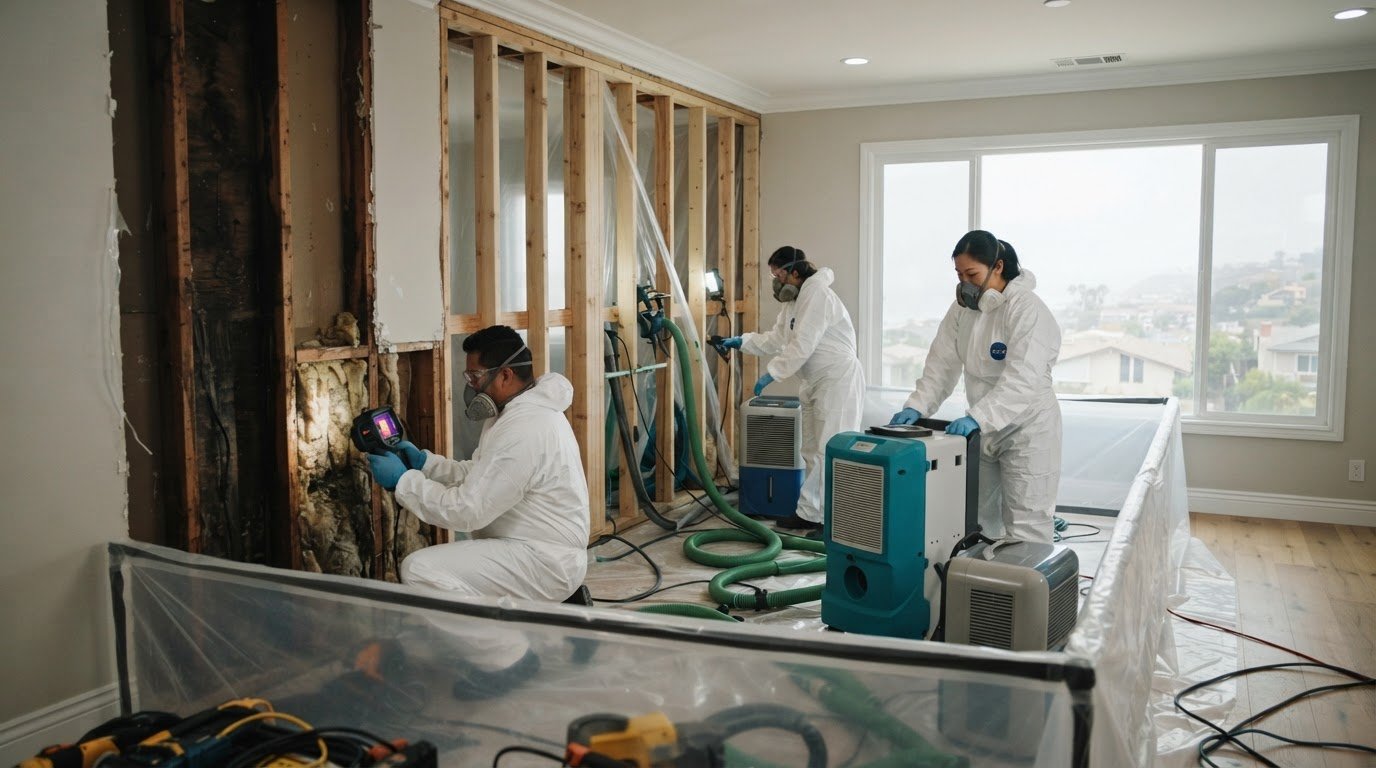
Demolishing compromised drywall or lifting moldy baseboards without isolation disperses millions of microscopic spores into uncontaminated living areas. Technicians build sealed isolation zones using heavy-duty 6-mil polyethylene sheeting, securing HVAC registers and creating zippered decontamination airlocks for entry and exit.
High-volume air scrubbers fitted with true HEPA filtration capture at least 99.97% of particulates down to 0.3 microns. By venting exhausted air outside the building, technicians establish continuous negative air pressure. This pressure differential guarantees that air currents pull inward toward the dirty work zone, preventing airborne pathogens from migrating into clean hallways or bedrooms during structural demolition.
The Dangers of DIY Bleach Treatments on Porous Substrates
Many property owners instinctively tackle surface mold with household chlorine bleach, unaware that chemical bleaching often accelerates structural rot. Sodium hypochlorite cannot penetrate porous building materials like wood studs or drywall backing. The chemical agent remains on the surface while its carrier, primarily water, soaks deep into the substrate.
Once the chlorine evaporates, that trapped moisture directly feeds the root-like fungal hyphae anchored deep in the timber. Scrubbing dry colonies without containment also triggers a massive defense sporulation, sending airborne contaminants directly into your HVAC ducting. When confronting persistent dampness, evaluating your structural assemblies with an environmental specialist avoids costly cross-contamination and ensures thorough, verifiable eradication.

Diagnostic Protocol: Moisture Mapping, Thermal Imaging, and Environmental Testing
Effective structural decontamination begins long before a single containment wall goes up. Executing professional mold remediation in Signal Hill, CA requires forensic diagnostics to delineate exact boundaries of moisture intrusion behind finished surfaces. Technicians deploy calibrated pin-type and non-destructive impedance meters to measure wood moisture equivalent (WME) within structural wall framing. Drywall reading above 16% to 17% moisture content or framing lumber exceeding 19% creates an active habitat for microbial growth. Detailed forensic mapping tracks moisture pathways back to failing supply lines or roof flashing. Property owners can learn how certified technicians execute comprehensive assessments via our dedicated indoor air quality testing resource.
Non-Invasive Diagnostic Tools for Concealed Moisture
Locating hidden moisture traps requires specialized instrumentation that evaluates structural assemblies without premature, destructive demolition:
- High-Resolution Thermal Cameras: FLIR infrared sensors detect evaporative cooling patterns across ceilings and baseboards, instantly uncovering cold spots where water travels behind drywall.
- Radio-Frequency Impedance Scanners: Non-penetrating meters assess moisture depth behind ceramic tile, stone backsplashes, and dense shower pans without cracking grout lines.
- High-Definition Articulating Borescopes: Optical probes slip through minute quarter-inch penetrations, providing direct visual inspection of enclosed ceiling plenums, subfloors, and internal air handler compartments.
Third-Party Air Quality and Clearance Testing Verification
Establishing baseline microbial counts provides an objective benchmark for structural contamination. Ambient air sampling collects calibrated volumes across micro-pore cassettes to isolate elevated concentrations of indicator molds like Aspergillus, Penicillium, or toxigenic Stachybotrys chartarum. Baseline numbers are always benchmarked against outdoor control samples taken simultaneously to assess overall indoor fungal ecology.
True accountability requires separating remediation work from post-remediation clearance. After physical extraction and HEPA vacuuming conclude under strict containment adhering to OSHA workplace mold safety and remediation protocols, an independent indoor environmental professional conducts Post-Remediation Verification (PRV). This third-party specialist collects final bioaerosol air and surface lift samples. Only when laboratory spore trap counts demonstrate that the indoor space matches or reflects outdoor baseline levels can the containment barrier be disassembled safely.
The Methodical Remediation Process: Structural Decontamination and Source Elimination
Once containment barriers are sealed and negative airflow runs continuously, systematic teardown begins. Performing thorough mold remediation in Signal Hill, CA requires immediate disposal of heavily colonized porous materials. Gypsum board, acoustic ceiling tiles, and saturated fiberglass insulation cannot be salvaged once hyphae compromise their core matrix. Technicians make precision cuts 12 to 24 inches beyond the visible water line, sealing ruined materials directly inside containment to prevent spreading airborne dust. Resolving the initial water intrusion point is non-negotiable; property owners can review our comprehensive water damage restoration protocols to see how structural moisture sources are neutralized.
Physical Removal, HEPA Vacuuming, and Substrate Cleaning
Semi-porous and non-porous building components require aggressive mechanical decontamination. Technicians double-bag all compromised building debris inside the containment envelope before routing waste through zippered decontamination airlocks. Exposed timber framing undergoes mechanical wire brushing and HEPA-shrouded sanding to extract rooted mycelium networks from the wood grain.
Following physical extraction, surfaces receive a complete HEPA vacuum pass, damp wiping with neutral detergents, and treatment using hospital-grade, EPA-registered antimicrobials. High-capacity desiccant and low-grain refrigerant (LGR) dehumidifiers run continuously until moisture meters confirm structural framing has dried below 15% wood moisture equivalent.
Managing Co-Occurring Hazards: Asbestos and Historic Plumbing
Much of Signal Hill’s residential real estate dates back to mid-century housing expansions. In structures built before 1980, disturbing acoustic textured ceilings, joint compounds, or vinyl floor tiles during demolition triggers strict Cal/OSHA compliance mandates. Before cutting into suspect wall assemblies, technicians survey building materials to avoid cross-contaminating living spaces with hazardous airborne fibers. Review these essential safety frameworks in our professional asbestos removal technical overview.
Resolving microbial contamination permanently also means fixing the mechanical failure that caused it. Hidden pinhole copper leaks, corroded waste stacks, and aging valves inside wall chases require immediate correction. If you suspect concealed leaks or active microbial growth in your building, request a professional remediation and structural inspection to protect your real estate investment from recurrent damage.
Why Signal Hill Property Owners Choose Coastline Environmental Solutions
Property contamination creates immediate stress, especially when balancing indoor health risks, structural damage, and complex insurance protocols. When property owners require mold remediation in Signal Hill, CA, they need a dedicated partner who brings calm authority and technical rigor to a chaotic event. Coastline Environmental Solutions delivers four decades of dedicated Southern California restoration expertise. Our unified operational model bridges the gap between environmental containment, structural drying, and licensed plumbing services, eliminating the delays and miscommunication common with fragmented multi-contractor projects.
Four Decades of Methodical Southern California Restoration
Serving Signal Hill and Greater Long Beach continuously since 1985 gives our team an unmatched understanding of regional architectural styles. We know firsthand how coastal marine fog, unsealed foundation slabs, and aging plumbing networks interact across local properties. Our supervisors and field technicians maintain rigorous IICRC certifications across microbial remediation, structural drying, and environmental safety standards.
Because fungal contamination frequently intersects with mid-century building materials, our dual licensing as an environmental contractor allows us to handle co-occurring asbestos and lead abatement safely. Decades of local operation have established trusted working partnerships with regional industrial hygienists, insurance adjusters, and municipal building inspectors.
Turnkey Recovery: Rapid Response to Final Clearance
Executing professional mold remediation in Signal Hill, CA requires seamless coordination from first contact to structural clearance. Our dispatch crews mobilize rapidly to stabilize moisture sources, deploy critical HEPA containment barriers, and protect unaffected living areas. Throughout the decontamination timeline, dedicated project managers provide direct oversight and comprehensive digital documentation:
- Detailed Moisture Logs: Pin-point infrared thermography and substrate moisture readings tracking progress back to baseline dry standards.
- Direct Claims Coordination: Comprehensive photographic records and line-item scope reporting formatted for transparent property insurance reviews.
- Clearance Assurance: We keep engineering containment sealed until independent third-party laboratory air sampling confirms complete environmental clearance.
Protect your living environment and structural investment with proven local professionals. Contact Coastline Environmental Solutions to schedule an inspection today.
Reclaim Clean Air and Structural Safety in Signal Hill
Permanent recovery from indoor fungal contamination doesn’t happen by wiping drywall surfaces or hoping coastal dampness dissipates on its own. Long-term protection requires an engineered strategy: precision negative-air containment, thorough physical extraction of active hyphae, and resolving concealed moisture sources before walls are sealed. When you invest in certified mold remediation in Signal Hill, CA, you safeguard your building’s equity and secure third-party verifiable air quality clearance for everyone under your roof.
Serving Signal Hill and Long Beach communities with excellence since 1985, our IICRC-certified microbial remediation specialists and licensed abatement technicians bring steady, methodical care to every project. You don’t have to face property damage or airborne health concerns alone. Take the definitive step toward total structural recovery and schedule a certified mold inspection with Coastline Environmental Solutions today.
Frequently Asked Questions
How do I know if the mold in my Signal Hill home is toxic black mold?
You cannot identify fungal species by visual inspection alone because many benign molds share dark pigmentation with toxigenic varieties like Stachybotrys chartarum. Laboratory analysis of surface tape lifts or air cassettes is the only reliable diagnostic method. If you observe dark clusters accompanied by persistent musty odors or unexplainable allergic symptoms, a professional indoor air quality assessment provides definitive species identification and airborne concentration levels.
Can I stay inside my home during professional mold remediation?
Occupants can often remain in unaffected zones if the contamination is localized to a single room with secure containment barriers and independent exterior depressurization. If the remediation zone encompasses primary HVAC ductwork, central kitchens, or sole bathrooms, temporary relocation is strongly advised. Protecting sensitive occupants, such as infants, elderly family members, or individuals with chronic respiratory conditions, remains the primary safety priority throughout the project.
Does homeowner property insurance cover mold remediation in Signal Hill, California?
Coverage depends entirely on the initial cause of loss and specific policy endorsements. Standard California homeowners policies generally cover microbial cleanup if it stems directly from a sudden, accidental covered peril, such as a ruptured pressurized pipe. Damage resulting from deferred roof maintenance, long-term groundwater seepage, or elevated coastal humidity is routinely excluded, and most California policies enforce specific sublimit caps on microbial remediation claims.
Why is bleach ineffective at killing mold on drywall and structural framing?
Household bleach contains roughly 90% water, which porous structural materials readily absorb while the chlorine compound remains trapped on the surface. Chlorine rapidly evaporates, leaving pure moisture behind within the timber grain or gypsum core. This trapped moisture acts as a direct food source for embedded fungal hyphae, often causing colonies to return more aggressively within days of surface wiping.
How long does a standard professional mold remediation project take?
A standard residential project typically spans between three and five business days from containment setup to final post-remediation verification. The physical demolition and HEPA cleaning phases are usually completed in one to two days, followed by forty-eight to seventy-two hours of active structural dehumidification. The containment envelope remains fully intact until independent third-party bioaerosol air testing confirms complete fungal clearance.
What is the difference between mold removal and environmental mold remediation?
Basic mold removal simply refers to superficial cosmetic cleaning or discarding visible surface stains without containment or environmental engineering controls. Professional mold remediation in Signal Hill, CA represents an exhaustive, standards-based process governed by the ANSI/IICRC S520. It incorporates physical source extraction, true negative-pressure containment, resolving root plumbing failures, and verifying that the structure returns to a normal, healthy fungal ecology.
How do technicians verify that all airborne mold spores are completely eliminated?
Clearance is verified through independent third-party Post-Remediation Verification testing using calibrated spore trap air cassettes and optical microscopic analysis. Because natural outdoor environments contain normal background fungal ecology, indoor spore counts are benchmarked against outdoor control samples collected simultaneously. Remediation passes clearance only when indoor air shows statistically lower spore concentrations than the exterior baseline, with zero presence of pathogenic indicator molds.