
16 Sep Professional Smoke Damage Cleaning: The Science of Restoring Your Property
Did you know that after major wildfire events, an estimated 13,000 insurance claims can be filed for properties that never saw a single flame, but were devastated by smoke alone? This highlights a difficult truth: the end of a fire is often just the beginning of a complex environmental challenge. You’re likely facing the frustration of persistent, overwhelming odors and fine soot particles covering every surface. When standard cleaning isn’t enough, professional smoke damage cleaning becomes the only way to ensure the air is truly safe. You need a solution that goes beyond the surface.
Effective restoration is a rigorous decontamination process that must neutralize acidic residues at the molecular level. At Coastline Environmental Solutions, Inc., we understand that invisible toxins can penetrate porous materials like drywall and insulation, requiring more than just a surface wipe-down. This article explains the technical methods professionals use to eliminate toxic soot and persistent odors, ensuring your property is breathable again. We’ll guide you through the latest IICRC S700 standards and explain how new California laws, such as Assembly Bills 1642 and 1795, empower property owners to secure a methodical, documented restoration that meets the highest safety requirements.
Key Takeaways
- Understand the chemical difference between dry and wet smoke residues and why their unique properties require specialized neutralization techniques.
- Identify the hidden health risks of third-hand smoke, including VOCs and dioxins that remain trapped in your property’s structure after the fire is out.
- Discover why professional smoke damage cleaning is essential for neutralizing persistent odors rather than simply masking them with household deodorizers.
- Follow a methodical five-step restoration process that includes structural stabilization, containment, and advanced air filtration to restore indoor air quality.
- Learn how to navigate California’s specific environmental regulations and insurance requirements to ensure a fully documented and safe recovery.
The Science of Smoke: Why Surface Cleaning Isn’t Enough
Smoke isn’t just a byproduct of fire; it’s a complex chemical aerosol. When property owners attempt to wipe away soot with standard household cleaners, they often find the residue smears or embeds deeper into the surface. This happens because The Science of Smoke and Soot involves acidic compounds that bond to materials on a molecular level. True professional smoke damage cleaning is not a simple wipe-down service. It’s a process of chemical neutralization designed to stop the corrosive cycle of soot before it causes permanent destruction.
Understanding the type of residue is the first step in a methodical restoration. Professionals categorize smoke into two primary types based on the fuel source and temperature of the fire:
- Dry Smoke: Resulting from high-heat, fast-burning fires like wood or paper, this residue is powdery and non-smeary. While it seems easier to clean, it penetrates deep into microscopic cracks.
- Wet Smoke: Produced by low-heat, smoldering fires involving plastics or rubber, this soot is thick, black, and oily. It carries a pungent odor and is notoriously difficult to remove without specialized solvents.
Molecular Behavior of Soot and Ash
Soot particles are incredibly small, often measuring less than 2.5 microns. Their size allows them to bypass standard filtration and settle into the smallest pores of building materials. Because smoke is ionized, it carries a charge that causes it to cling to surfaces like a magnet, particularly in cool areas or behind walls. During the fire, intense heat causes the pores in wood and drywall to expand. As these materials cool, they contract, effectively locking the smoke particles and odors deep within the structural cavities where standard cleaning can’t reach.
The Danger of Secondary Damage
Time is your greatest enemy after a fire. Within minutes, acidic soot begins to yellow plastics and stain highly porous materials like marble or granite. Within hours, it can cause permanent etching on glass, chrome, and porcelain. Professional smoke damage cleaning must address these chemical reactions immediately to prevent total loss. Delaying the process often turns a restorable item into a total replacement.
Electronics are especially vulnerable to this environment. The conductive nature of soot can create bridge circuits on sensitive motherboards, leading to immediate failure or long-term corrosion. One of the biggest mistakes a property owner can make is attempting to clean soot with water-based solutions. Without the correct neutralizing agents, water can cause the soot to soak deeper into the substrate, setting the stain permanently and making restoration nearly impossible. Coastline Environmental Solutions, Inc. uses specific chemical countermeasures to break these bonds safely and effectively.
Health Risks of Inadequate Smoke Decontamination
The visible soot left behind after a fire is only part of the problem. In reality, the most significant health threats are often invisible, consisting of volatile organic compounds (VOCs), dioxins, and furans. These environmental contaminants from a fire result from the combustion of modern building materials like plastics, synthetic fabrics, and treated woods. If you don’t perform thorough professional smoke damage cleaning, these toxins remain embedded in your walls and furniture, creating a persistent health hazard known as “third-hand smoke.”
This residue doesn’t just sit there. It off-gasses over time, directly impacting your indoor air quality. For individuals with existing respiratory conditions, this environment can lead to severe asthma attacks or chronic allergy symptoms. In Southern California, many older homes built before the late 1970s contain lead paint or asbestos. When a fire occurs or during the subsequent cleanup, these hazardous materials can be disturbed, releasing toxic fibers and dust into the air. Coastline Environmental Solutions, Inc. specializes in identifying these overlaps to ensure the restoration process doesn’t inadvertently create a new environmental crisis.
Indoor Air Quality and HVAC Contamination
Your HVAC system often acts as a hidden reservoir for smoke particles. During a fire, the return air ducts pull in smoke, which then settles inside the ductwork and on the evaporator coils. This creates a “re-circulation” effect. You might think the smell is gone, but the moment the air conditioning kicks in, it pushes concentrated odors and fine soot back into every room. Addressing this requires more than a simple filter change. It often necessitates comprehensive indoor air quality testing to verify that the ventilation system is no longer a source of contamination.
The Threat of Carcinogenic Residues
Charred materials frequently contain Polycyclic Aromatic Hydrocarbons (PAHs), which are known carcinogens. These substances bond tightly to surfaces and pose a risk through both inhalation and skin contact. Because of these risks, professional smoke damage cleaning protocols mandate the use of industrial-grade HEPA filtration and specialized personal protective equipment (PPE). Our team focuses on total containment and source removal to prevent these residues from migrating into unaffected areas of your property. If you’re concerned about lingering toxins, reaching out to Coastline Environmental Solutions can help you establish a safe, breathable environment again.
Professional Smoke Damage Cleaning vs. DIY Methods
The instinct to grab a bucket and sponge after a fire is natural, but it’s often the most damaging choice a property owner can make. In the context of professional smoke damage cleaning, we call this the “Smear Factor.” When you wipe a soot-covered wall with standard household cleaners, you aren’t removing the particles; you’re pushing acidic residue deeper into the paint and drywall pores. This creates a permanent stain and locks in odors that might have otherwise been removable. Household sprays merely mask these smells with heavy perfumes, while the underlying chemical compounds continue to off-gas and corrode your belongings.
Attempting a DIY cleanup also carries a high cost of failure. When amateur methods set a stain or spread soot into unaffected areas, the subsequent professional restoration becomes significantly more complex and expensive. Safety is another critical concern. While many people believe an N95 mask provides enough protection, it isn’t designed to filter out the microscopic, toxic VOCs and carcinogenic particles found in post-fire environments. Professionals use full-face respirators and specialized PPE to ensure long-term health isn’t sacrificed for a quick fix.
Specialized Equipment Used by Professionals
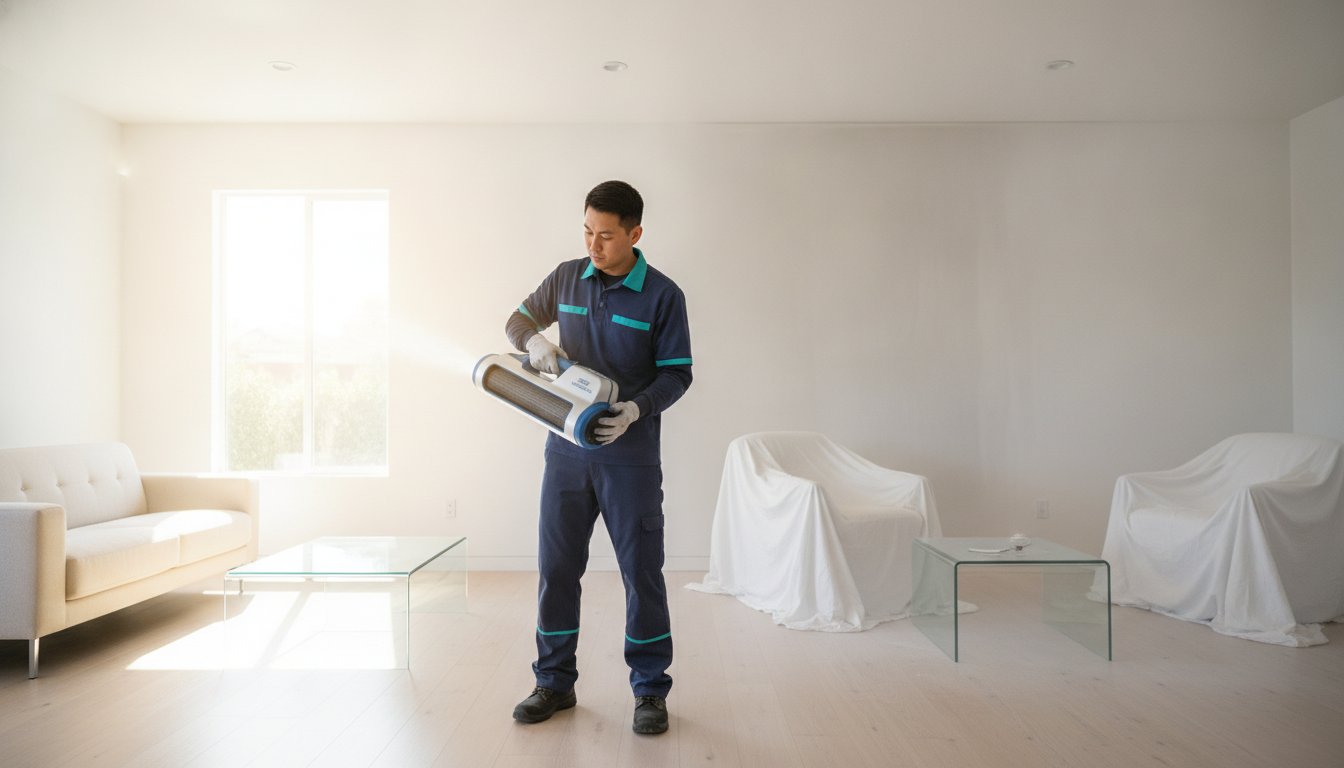
Coastline utilizes industrial-grade technology to achieve results that consumer products can’t match. Hydroxyl generators are often used in occupied spaces to break down odor molecules safely using UV light. In contrast, ozone machines are highly effective but require the property to be vacated due to the powerful oxidizing gas they produce. To prevent cross-contamination, we deploy air scrubbers with HEPA filtration to create a negative pressure environment. This ensures that soot particles dislodged during cleaning are captured immediately rather than drifting into clean rooms.
We also utilize thermal fogging for deep-penetration odor neutralization. This process creates a fog with particle sizes similar to smoke, allowing the neutralizing agent to follow the same path the smoke took into wall cavities and insulation. This ensures that the root cause of the odor is addressed rather than just the surface symptoms.
Chemical Neutralizers and Encapsulants
The chemistry of restoration is precise. Because soot is typically acidic, we use specialized alkaline cleaners to neutralize the residue on contact, stopping the corrosion of metals and plastics. For surfaces that cannot be fully cleaned, we apply industrial encapsulants. These are specialized sealants that trap odor-causing particles permanently, preventing them from off-gassing into your living space. Before any wet cleaning begins, we use vulcanized natural rubber “dry sponges.” These are the industry standard for soot removal because they lift particles through capillary action without moisture, preventing the smearing that ruins surfaces during DIY attempts.

The 5-Step Professional Smoke Restoration Process
Restoring a property after a fire requires more than a simple cleanup. It demands a technical, multi-stage sequence to ensure every trace of contamination is removed. At Coastline Environmental Solutions, Inc., we follow a rigorous protocol that transitions your property from a hazardous environment back to a safe, breathable space. This methodical approach ensures that the professional smoke damage cleaning we provide is both thorough and verifiable for insurance purposes.
- Step 1: Emergency Inspection and Structural Stabilization: We begin by assessing the extent of the damage and securing the property to prevent further structural degradation.
- Step 2: Containment and Air Filtration Setup: To prevent cross-contamination, we establish physical barriers and deploy HEPA air scrubbers to capture airborne soot particles.
- Step 3: Precision Soot and Residue Removal: This involves distinct dry and wet phases, using specialized sponges and alkaline cleaners to neutralize acidic residues.
- Step 4: Advanced Deodorization and Molecular Neutralization: We use hydroxyl generators or thermal foggers to break down odor-causing molecules at their source.
- Step 5: Final Testing and Quality Assurance: The process concludes with a rigorous inspection to confirm that all residues and odors have been eliminated.
Detailed Assessment and Documentation
Our technicians map smoke travel patterns throughout the building, identifying where heat-driven particles have migrated into hidden cavities. This phase is vital for insurance claim fulfillment. We provide comprehensive documentation that distinguishes between “restorable” items and “non-restorable” materials that have suffered irreversible heat damage. This level of detail ensures you aren’t paying to clean items that should be replaced, while protecting the value of your salvageable belongings. Our “meticulous restorer” mindset means we don’t overlook the soot trapped behind baseboards or inside attic insulation.
Deep Cleaning and Odor Eradication
For delicate contents and electronics, we utilize ultrasonic cleaning technology. This process uses high-frequency sound waves in a chemical bath to dislodge microscopic soot without damaging sensitive circuit boards. When dealing with structural wood and framing, we apply an “un-smoke” approach, using specialized sealants to encapsulate any deep-seated odors that cleaning alone cannot reach. This phase is often the final step before completing comprehensive fire and smoke damage repair. If you’re ready to begin the recovery process with a team you can trust, contact Coastline Environmental Solutions for a detailed professional assessment today.
Choosing a Restoration Partner in Southern California
Selecting the right contractor isn’t just about finding someone with a truck and a vacuum. In Southern California, the effectiveness of professional smoke damage cleaning depends heavily on a provider’s understanding of local environmental factors and strict state regulations. Coastal humidity in areas like Seal Beach can cause soot to become sticky, bonding more aggressively to surfaces than it would in the drier heat of Lakewood or Long Beach. A rapid local response is essential for emergency board-ups and stabilization in Huntington Beach or San Pedro; every hour of delay allows acidic residues to cause deeper structural etching.
Coastline Environmental Solutions, Inc. has served this community since 1985. We act as a steady hand during your recovery, providing a methodical approach that balances technical precision with local commitment. Because we hold specialized certifications in asbestos and lead abatement, we can handle the complex environmental factors often triggered by fire damage in older Southern California properties. Choosing a partner who integrates indoor air quality testing with the restoration process ensures that your home isn’t just clean on the surface but is safe at a molecular level.
Navigating California Regulations and Licensing
California has some of the nation’s strictest standards for hazardous waste disposal and environmental safety. It’s vital to verify that your restoration partner holds current IICRC certifications and the necessary state licenses for environmental abatement. These credentials guarantee that the cleaning process follows the ANSI/IICRC S700 standards for professional fire and smoke damage restoration. A meticulous restorer ensures that all soot-laden materials are disposed of according to Department of Toxic Substances Control mandates, protecting you from future liability and ensuring the long-term safety of your property.
Working with Insurance Adjusters
A seasoned professional contractor simplifies the often-stressful “Proof of Loss” process. We provide the detailed documentation and mapping of smoke travel patterns that adjusters require to approve a claim. By ensuring all hidden damages are accounted for in the initial estimate, we help prevent the supplemental claim delays that can stall your return to normalcy. Coastline offers direct insurance billing, allowing you to focus on your family or business while we handle the technical and administrative complexities of the restoration. This integrated approach moves you from a state of emergency to an organized, documented resolution.
Secure Your Property’s Future with Scientific Restoration
Recovering from a fire is a journey from chaos back to a controlled, healthy environment. The residues left behind are acidic and toxic, requiring more than a simple surface clean to neutralize. Effective professional smoke damage cleaning is a scientific process that addresses microscopic soot and volatile organic compounds trapped deep within your building’s structure. By following a methodical restoration plan, you can protect your property from permanent corrosion and safeguard your long-term respiratory health.
Coastline Environmental Solutions, Inc. has been a steady hand for Southern California property owners since 1985. Our IICRC Certified Technicians bring specialized knowledge in asbestos and lead abatement, ensuring that even complex restoration projects are handled with meticulous precision. We provide 24/7 emergency response throughout Long Beach and the surrounding areas to stop damage before it becomes permanent. Don’t let persistent odors and hidden toxins compromise your indoor air quality or your peace of mind.
Request a Professional Smoke Damage Assessment from Coastline to ensure your recovery is thorough, documented, and safe. We’re ready to help you return to normalcy with confidence and care.
Frequently Asked Questions
Is it safe to stay in a house with smoke damage?
It is generally not safe to remain in a property with significant smoke damage until a professional assessment is completed. Smoke residues contain volatile organic compounds (VOCs) and fine particulates that cause immediate respiratory irritation and long term health issues. In older Long Beach homes, fire can also disturb lead or asbestos, creating additional hazards. We recommend vacating the premises until air scrubbers and HEPA filtration have restored safe indoor air quality levels.
How long does professional smoke damage cleaning take?
The duration of the restoration process varies depending on the severity of the fire and the size of the structure. A standard professional smoke damage cleaning project for a residential property in Lakewood typically takes between three to seven days. However, if smoke has penetrated deep into structural cavities or if hazardous material abatement is required, the timeline may extend. Our team provides a detailed schedule during the initial inspection to ensure an organized return to normalcy.
Will the smoke smell ever completely go away?
Yes, persistent smoke odors can be completely eliminated through molecular neutralization rather than simple masking. Coastline uses industrial grade technology like hydroxyl generators and thermal foggers that follow the same path as the smoke, breaking down odor molecules at their source. For properties in coastal areas like Huntington Beach, where humidity can lock in smells, our methodical approach ensures that even deep seated odors are neutralized, leaving your indoor air fresh and breathable once again.
Can smoke damage be cleaned from clothes and upholstery?
Many soft goods, including clothes and upholstery, can be successfully restored using specialized cleaning techniques. While standard laundry often fails to remove fine soot particles and deep seated odors, professional grade methods like ultrasonic cleaning and specialized chemical baths are highly effective. We assess each item to determine if it is restorable or non restorable. For valuable area rugs or heirloom upholstery in San Pedro, our meticulous cleaning process can often save items that initially appear ruined.
Does insurance cover professional smoke odor removal?
Most homeowners insurance policies cover professional smoke damage cleaning and odor removal as part of fire damage restoration. In California, new regulations like Assembly Bills 1642 and 1795 have further clarified insurance obligations for smoke testing and remediation. Coastline works directly with adjusters in Cerritos and surrounding cities, providing the detailed documentation and Proof of Loss reports necessary to ensure your claim is processed accurately and all hidden damages are fully accounted for.
What is the difference between soot and smoke damage?
Smoke is a complex aerosol consisting of gases and fine particles, while soot is the solid, carbon based residue that settles on surfaces after combustion. Smoke can penetrate porous materials and travel through HVAC systems, leaving invisible chemical toxins behind. Soot is often acidic and can cause immediate etching on glass, metals, and plastics. Understanding this distinction is vital for effective restoration, as gases require molecular neutralization while soot requires precise physical and chemical removal.
Why do my walls feel sticky after a fire?
A sticky or oily residue on your walls is typically the result of wet smoke, which occurs during low heat, smoldering fires involving plastics, rubber, or synthetic materials. This residue is notoriously difficult to remove because it smears when touched with standard cleaners. In coastal cities like Seal Beach, humidity can exacerbate this stickiness, making it bond more aggressively to paint. Professional restoration involves using alkaline neutralizing agents to break these oily bonds without damaging the underlying structure.
Can I use a regular vacuum to clean up soot?
You should never use a standard household vacuum to clean up soot. Regular vacuums lack the filtration necessary to trap microscopic soot particles, meaning they will simply blow the toxic dust back into the air and spread contamination throughout your Wilmington home. Professionals use industrial grade vacuums equipped with HEPA filters that capture particles as small as 0.3 microns. Using the wrong equipment can drive soot deeper into carpets and upholstery, making professional restoration more difficult and expensive.