
12 Sep Residential Asbestos Removal in Long Beach: The 2026 Homeowner’s Safety Guide
Did you know that in Long Beach, every residential renovation or demolition project requires a professional asbestos survey, regardless of your home’s age? Under SCAQMD Rule 1403, there’s no such thing as a “new enough” building to skip this step. If you’ve recently uncovered suspicious materials during a remodel, it’s natural to feel a surge of anxiety regarding your family’s health and the potential for high abatement costs. We recognize that residential asbestos removal Long Beach is a high-stakes undertaking, but it doesn’t have to be a source of chaos. When handled with a methodical, technical approach, hazardous material abatement becomes a controlled step toward a healthier home.
You’re right to feel that the safety of your property is a top priority. This 2026 guide is designed to replace your uncertainty with expert insights and a clear path to resolution. We’ll explore the essential protocols for identification, the importance of integrated indoor air quality testing, and the specific containment standards required by local regulators. From understanding initial surveys to achieving final clearance, you’ll learn how to manage these technical complexities while ensuring your living space remains a secure sanctuary for your family.
Key Takeaways
- Identify why mid-century Long Beach architecture frequently contains legacy materials and why a professional survey is the first step toward property safety.
- Understand the difference between visual suspicion and laboratory confirmation, emphasizing why bulk sampling is essential for accurate fiber detection.
- Compare the permanent solution of residential asbestos removal Long Beach with encapsulation strategies to determine which approach best suits your home’s structural needs.
- Explore the technical rigors of the abatement process, from heavy-duty containment to the deployment of HEPA-filtered negative air machines.
- Learn how professional air quality testing serves as the final verification, confirming that your living environment has been successfully restored to health standards.
The Reality of Asbestos in Long Beach Residential Properties
Long Beach’s residential landscape is a tapestry of historic eras, from the iconic Craftsman bungalows of Bluff Heights to the mid-century modern masterpieces in Park Estates. While these properties offer immense character, most homes built before the 1980s harbor legacy building materials that contain hazardous fibers. During these decades, manufacturers integrated mineral additives into thousands of products to enhance fire resistance and structural durability. This historical context makes residential asbestos removal Long Beach a standard requirement for homeowners looking to modernize or repair older structures safely.
To address the risk effectively, one must first understand the substance itself. What is Asbestos? It refers to a group of six naturally occurring silicate minerals composed of microscopic, needle-like fibers. These fibers are prized for their heat resistance and tensile strength, yet they represent a significant health hazard if inhaled. In a stable, “non-friable” state, the material is typically safe because the fibers are locked within a solid binder. However, the situation changes when the material becomes “friable,” meaning it can be crumbled or reduced to powder by hand pressure, releasing toxic dust into the air.
Common Asbestos-Containing Materials (ACMs) in Local Homes
Identification begins with a methodical assessment of the most likely locations for ACMs. In many Long Beach residences, these materials are hidden in plain sight. Common examples include:
- Acoustic “Popcorn” Ceilings: These textured finishes, popular in 1960s and 70s builds, often contain high concentrations of chrysotile asbestos.
- Vinyl Floor Tiles: Older 9×9 inch tiles and the associated black mastic adhesive are notorious for asbestos content.
- Thermal Insulation: White, chalky insulation found on basement pipes or HVAC ductwork in older bungalows often requires professional residential asbestos removal Long Beach protocols.
When Does Asbestos Become an Immediate Concern?
Asbestos usually remains dormant until an external force disturbs the material’s matrix. Planned renovations are the primary catalyst for exposure, as sanding, cutting, or demolition activities pulverize the fibers. Structural shifts or aging can also cause materials to deteriorate over time, leading to spontaneous fiber release. Environmental stressors are equally dangerous. If you detect hidden water damage signs like peeling paint or soft drywall, the moisture may be compromising the stability of ACMs. In these scenarios, a methodical response is required to prevent cross-contamination throughout the rest of your home.
Professional Assessment: Testing vs. DIY Identification
You can’t identify asbestos fibers with the naked eye. Even if a ceiling or floor tile appears identical to modern, safe alternatives, it may contain legacy binders that are hazardous when disturbed. This technical uncertainty makes professional testing the only reliable precursor to residential asbestos removal Long Beach. A certified consultant uses specialized tools to extract bulk samples without contaminating the surrounding air. These samples then undergo laboratory analysis using Polarized Light Microscopy (PLM) or Transmission Electron Microscopy (TEM) to provide definitive proof of asbestos concentration and fiber type, allowing for a precise and targeted abatement plan.
Beyond safety, testing is a strict legal mandate. In Long Beach, the South Coast Air Quality Management District (SCAQMD) enforces Rule 1403, which requires a mandatory asbestos survey before any renovation or demolition project. This requirement applies regardless of the building’s age, meaning even homes built recently aren’t exempt from compliance. Adhering to California’s Asbestos Abatement Regulations ensures your project remains compliant and avoids fines that can reach $20,000 per day. A professional survey creates a technical roadmap for residential asbestos removal Long Beach, often reducing overall costs by identifying exactly which materials require abatement and which can be safely left alone during the restoration process.
The Dangers of DIY Asbestos Sampling
Homeowners often consider “home test kits” to save money, but this approach introduces significant risks to your family. Disturbing a material without professional containment can release millions of microscopic fibers into your air. These fibers easily enter the HVAC system, leading to cross-contamination in every room. Without industrial-grade Personal Protective Equipment (PPE) and wet-sampling techniques, you risk immediate inhalation. Professional consultants use HEPA-filtered vacuums to ensure that the act of testing doesn’t create a secondary hazardous event.
Indoor Air Quality (IAQ) Baseline Testing
A meticulous restorer always begins with a baseline. Establishing the current fiber count in your air before work starts provides a technical snapshot that protects your liability. This step ensures that any existing contamination is documented and that the final clearance testing has a clear, measurable standard to meet. For a deeper look at how we measure these environmental factors, consult our complete guide to IAQ assessment. If you suspect your home contains hazardous materials, requesting a certified inspection is the most responsible first step.
Comparing Abatement Strategies: Removal vs. Encapsulation
Once laboratory results confirm the presence of hazardous fibers, the next phase involves selecting a technical response tailored to your property’s specific needs. Homeowners often assume that residential asbestos removal Long Beach is the only path forward, but professional protocols actually offer three primary strategies: removal, encapsulation, and enclosure. The right choice depends on the stability of the material, its location within your living space, and your long-term goals for the property. Following the EPA Asbestos Safety for Homeowners guidelines, it’s often safer to leave undisturbed materials alone or seal them rather than risking fiber release through aggressive extraction.
A meticulous restorer evaluates several factors before recommending a strategy. We analyze the material’s current condition, the likelihood of future disturbance, and the specific regulatory requirements of the SCAQMD. If a material is in good condition and tucked away in an attic, a manage-in-place strategy might be the most prudent. Conversely, if the material is in a high-traffic hallway, the risk of accidental damage is too high to ignore. We prioritize technical precision to ensure your home remains a safe environment.
When is Full Removal the Best Option?
Full abatement is the “gold standard” for long-term property safety. It permanently eliminates the hazard. This approach is essential for materials that are already friable, such as crumbling pipe wrap or water-damaged popcorn ceilings. If you plan on a major remodel that involves structural changes, removal is the only logical choice. Additionally, homeowners looking to sell their property often choose full residential asbestos removal Long Beach to provide a “clean” environmental report. This increases marketability and reduces future legal liability. It’s a definitive resolution that offers the highest level of reassurance for your family’s health.
The Pros and Cons of Encapsulation
Encapsulation involves treating the material with a specialized liquid sealant. This sealant binds the fibers together, creating a tough, protective skin that prevents dust from becoming airborne. This method is significantly less invasive and more cost-effective than full removal. It’s particularly useful for thermal insulation on pipes in low-access crawlspaces. However, encapsulation isn’t a permanent fix. Because the asbestos remains on-site, you’ll need to conduct ongoing monitoring. Sealants can crack or peel over time. California law also requires you to disclose the presence of encapsulated asbestos to future buyers, which can complicate real estate transactions.
Enclosure acts as a similar “manage-in-place” strategy. An airtight, permanent barrier is built around the material. For example, installing new drywall directly over a popcorn ceiling is a common enclosure technique. While effective, this leaves the hazard within the structure. We help you weigh these options against your budget and safety requirements to ensure the most stable outcome for your household.

The Methodical Abatement Process: What to Expect
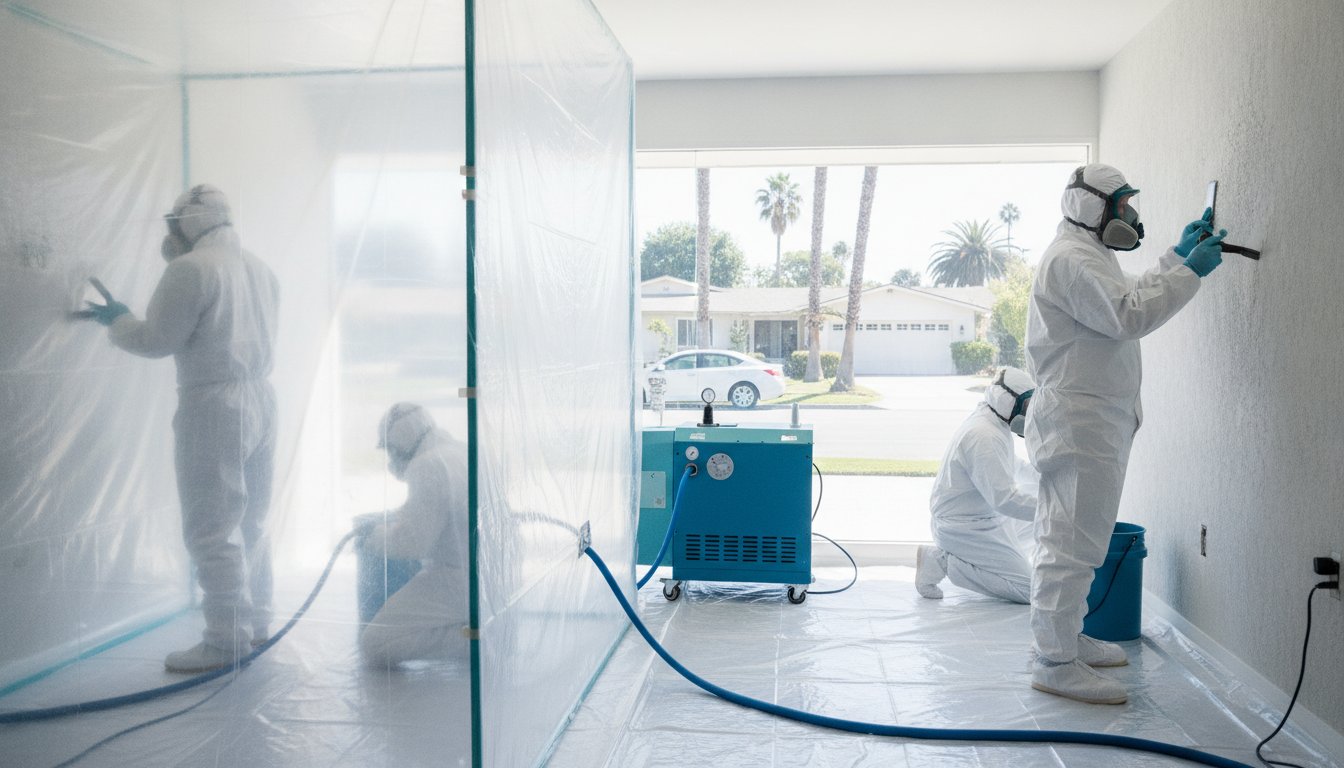
Execution is where the meticulous restorer philosophy transforms from a technical concept into a physical reality. When performing residential asbestos removal Long Beach, we don’t simply tear out materials; we engineer a controlled environment that isolates the hazard from the rest of your home. This process follows a rigorous five-step sequence designed to eliminate the risk of fiber migration. First, we establish a primary containment zone by sealing all openings, vents, and doorways with heavy-duty 6-mil plastic sheeting. This physical barrier serves as the first line of defense in protecting your family’s living space.
Once the area is sealed, we implement negative air dynamics. This involves using high-efficiency particulate air (HEPA) machines to pull air out of the containment zone, creating a vacuum effect. This ensures that if a leak were to occur, air would pull into the work area rather than pushing dust out. The actual extraction uses wet removal techniques. By keeping materials saturated with amended water, we keep fibers heavy and grounded, preventing them from becoming airborne. After the bulk material is gone, we perform a detailed decontamination of all surfaces using HEPA-filtered vacuums and wet wiping. The process concludes with independent clearance testing, providing technical proof that the air is safe for re-entry.
Containment and Negative Air Dynamics
Maintaining air quality during residential asbestos removal Long Beach requires specialized equipment that runs 24/7. Our HEPA air scrubbers are capable of filtering 99.97% of particles as small as 0.3 microns. To ensure no fibers escape on technicians, we utilize multi-stage decontamination chambers, or airlocks, where workers transition between the work zone and the clean environment. We also take the extra precaution of physically isolating your home’s HVAC system, sealing supply and return vents to prevent any potential circulation of microscopic dust through your ductwork.
Safe Disposal and Compliance
Responsibility doesn’t end when the material leaves your house. All hazardous waste is double-bagged in 6-mil poly bags, sealed with duct tape, and labeled according to state standards. We transport these materials directly to certified hazardous waste landfills in California, ensuring full compliance with environmental laws. At the conclusion of the project, we provide you with a comprehensive Close-out Packet. This document includes disposal manifests and air clearance results, serving as your legal record of a safe resolution. If you’re ready to secure your property, you can schedule a professional abatement consultation today.
Why Coastline is the Trusted Choice for Long Beach Homeowners
Coastline Environmental Solutions operates as a steady hand during property crises. Since 1985, we’ve served the Long Beach and Signal Hill communities with a focus on technical precision and local commitment. We don’t subscribe to the high-volume demolition model used by many regional providers. Instead, we embrace the ‘meticulous restorer’ philosophy, where thoroughness and safety take precedence over speed. This approach ensures that every project involving residential asbestos removal Long Beach is treated as a critical restoration of your family’s health and safety. Our long history in the area means we understand the specific architectural challenges of local homes, from historic bungalows to mid-century estates.
Our team acts as a calm professional guardian. We guide you through the complexities of environmental hazards with a structured, transparent workflow. By integrating indoor air quality testing with our abatement protocols, we provide a single point of accountability. This seamless transition from identification to final clearance reduces the administrative burden on homeowners and ensures that no technical detail is overlooked during the recovery process. We understand the stress that follows a positive asbestos test. Our methodical communication keeps you informed at every stage, moving your property from a state of emergency to a feeling of organized resolution.
Certified Expertise and Local Compliance
Maintaining compliance with local regulations is a cornerstone of our service. We strictly adhere to SCAQMD Rule 1403 and Cal/OSHA residential safety standards to protect both our clients and the community. Our technicians undergo continuous training in the latest remediation technologies to maintain our high standards of care. For a deeper look at our technical standards, you can review our methodical guide to safe abatement.
Beyond Asbestos: Comprehensive Home Health
Environmental issues rarely exist in isolation. During the removal process, it’s common to discover secondary concerns like toxic mold remediation needs caused by hidden leaks or poor ventilation. Our comprehensive capabilities allow us to address these hazards simultaneously, ensuring your property is returned to a ‘better than before’ condition. We are invested in your home’s long-term health and structural integrity. If you suspect your property contains legacy hazards, contact Coastline for a professional assessment to begin your journey back to a safe, healthy environment.
Securing Your Home’s Environmental Future
Safeguarding your property from the legacy of hazardous building materials requires a technical, methodical approach that prioritizes your family’s long-term health. We’ve explored how identifying risks in older structures and adhering to SCAQMD Rule 1403 through professional testing are essential first steps toward a stable resolution. Whether you choose full removal or a manage-in-place strategy, the success of the project depends on the precision of the containment and the thoroughness of final air quality verification.
Choosing a partner for residential asbestos removal Long Beach shouldn’t be a source of anxiety. Coastline Environmental Solutions has been serving Long Beach and Signal Hill since 1985, providing certified environmental remediation experts with a 5-star local reputation for safety. Our commitment to the meticulous restorer philosophy ensures that we return your home to a healthy, better-than-before condition with total technical transparency.
Schedule Your Residential Asbestos Assessment with Coastline
Taking proactive steps today protects your home’s value and ensures your living space remains a safe sanctuary for your family for years to come.
Frequently Asked Questions
How much does residential asbestos removal cost in Long Beach?
The cost of residential asbestos removal Long Beach is determined by the scope of the project and the specific materials involved. Factors such as the square footage of the containment area, the difficulty of access, and the total volume of hazardous waste requiring disposal all influence the final budget. Because every property has a unique structural layout, a site-specific assessment is necessary to provide an accurate technical estimate for your home.
Can I stay in my home during the asbestos abatement process?
Whether you can remain in your home depends on the scale of the abatement and the location of the work zone. Small, localized projects with isolated containment may allow you to stay in other parts of the house. However, whole-home projects or those involving the HVAC system typically require temporary relocation to prevent accidental exposure. A methodical provider will prioritize your safety and outline a clear timeline for re-entry.
Is it legal to remove asbestos from my own home in California?
While California law allows homeowners to perform their own abatement on single-family residences, it’s rarely advisable due to the extreme health risks and technical complexity. You are still legally required to comply with SCAQMD Rule 1403 regarding notification and hazardous waste disposal. Most homeowners find that the specialized equipment and rigorous containment standards required for safe removal make hiring a certified professional the most responsible and effective choice for their family.
How long does a typical residential asbestos removal project take?
A typical residential project usually spans between two and five business days. The first phase focuses on establishing airtight containment and negative air dynamics. The subsequent days involve the technical extraction of the materials using wet removal methods and HEPA-filtered decontamination. The process concludes only after independent air quality testing confirms that the environment is safe for your family. Larger historic properties in Long Beach may require a more extended schedule for thorough restoration.
What should I do if I suspect there is asbestos in my popcorn ceiling?
If you suspect your popcorn ceiling contains hazardous fibers, the most important step is to leave it undisturbed. Avoid activities like drilling into the ceiling or using a vacuum on any fallen debris, as this can release microscopic dust. You should contact a certified professional to perform bulk sampling and laboratory analysis. This technical verification is the only way to confirm the presence of asbestos and determine the safest path for remediation or encapsulation.
Will my homeowners insurance cover the cost of asbestos removal?
Homeowners insurance policies generally don’t cover the cost of removing asbestos if it’s discovered during a routine renovation or home inspection. However, if the material is disturbed by a sudden, covered event like a major water leak or fire, your policy might include environmental remediation as part of the restoration. It’s best to consult your insurance agent and review your specific policy exclusions to understand how hazardous material management is handled in your coverage.
How do I know if an asbestos removal company is properly certified?
Verify that the company holds a valid C-22 Asbestos Abatement license and is registered with the California Division of Occupational Safety and Health. A reputable local guardian will also demonstrate deep knowledge of SCAQMD Rule 1403 requirements. Don’t hesitate to ask for their certification numbers and proof of insurance. Checking local references in the Long Beach area can also provide peace of mind regarding their commitment to meticulous safety and thorough property restoration.
What is the difference between friable and non-friable asbestos?
Friable asbestos describes materials that can be easily crumbled or pulverized by hand, such as spray-on insulation or acoustic ceiling textures. These materials pose the highest risk because they release fibers with minimal disturbance. Non-friable asbestos, like vinyl floor tiles, contains a binder that keeps fibers locked in place. However, non-friable materials become a significant concern if they are cut, sanded, or broken during a renovation, at which point they are treated with the same technical rigors.