06 Aug Southern California Business Flood Recovery Guide (2026)
Did you know that California currently maintains the second-largest population in FEMA-designated flood zones in the United States? For a business owner in Long Beach or Huntington Beach, this statistic represents a constant operational risk that demands a precise, proactive response. When water breaches your facility, the clock starts ticking against both your structural integrity and your bottom line. You likely feel the immediate weight of potential revenue loss and the looming complexity of navigating insurance documentation.
Professional flood restoration for businesses in 2026 is a dual-track process that requires technical water extraction and a strategic focus on business continuity. This guide explains how to protect your commercial property and minimize downtime using professional restoration strategies tailored specifically for the Southern California landscape. We will walk through the critical 48-hour window for decontamination, the impact of the latest Los Angeles Flood Hazard Management Ordinance, and the methodical documentation needed to ensure a successful recovery. By following this structured approach, you can move from a state of emergency to a safe, fully operational environment with confidence.
Key Takeaways
- Identify the specific geographical flood risks facing commercial properties in Long Beach and Huntington Beach.
- Learn why professional flood restoration for businesses must integrate moisture mapping and high-volume extraction to prevent hidden structural damage.
- Understand the role of IICRC-certified standards and in-house environmental testing in ensuring a safe return to operations.
- Explore business continuity strategies, such as area phasing and IT protection, that minimize revenue loss during recovery.
- Recognize how a 24-hour emergency response and specialized local expertise streamline the path from crisis to normalcy.
Navigating the Risks of Commercial Flooding in Southern California
Southern California coastal businesses face a unique set of environmental challenges that complicate standard recovery efforts. In cities like Long Beach and Huntington Beach, the combination of high ambient humidity and corrosive salt air accelerates the degradation of building materials once they’re saturated. Unlike inland flooding, coastal moisture often carries microscopic salt particles that can penetrate porous surfaces, leading to rapid oxidation of metal fixtures and electrical components. Effective flood restoration for businesses in these regions must account for these aggressive environmental factors to prevent long-term structural failure.
Timing is the most critical factor in mitigating loss. When standing water remains in a commercial facility, it begins a process of “wicking” where moisture climbs up drywall and into insulation, often reaching heights far above the initial flood line. This delay doesn’t just increase repair costs; it threatens the very foundation of your business. A 24-hour response is essential to stabilize the environment before irreversible swelling and warping occur in specialized flooring or cabinetry. Beyond the physical damage, a prolonged closure ripples through the local community, affecting employee livelihoods and disrupting established supply chains that depend on your daily operations.
Immediate Threats to Operations and Infrastructure
The influx of water into a commercial space introduces immediate safety hazards, primarily through the electrical system. Water contacting floor-mounted outlets or heavy machinery creates a high risk of electrical shorting and fire. Furthermore, floodwater is frequently classified as “black water” due to potential sewage backups or chemical runoff from industrial areas. This contamination requires a methodical approach to the water damage restoration process to ensure the space is biologically safe for occupancy. In older districts like San Pedro, many commercial buildings feature aging masonry and timber frames that are particularly susceptible to structural instability when saturated, requiring precise moisture mapping to identify hidden pockets of trapped water.
The Hidden Environmental Risks: Mold, Lead, and Asbestos
For businesses operating in structures built before 1980, flooding often uncovers legacy hazardous materials. Disturbed floor tiles, thermal insulation, or wall coatings may contain asbestos or lead, which become airborne or friable during the drying process. Utilizing specialized environmental remediation services is a regulatory necessity in these cases to protect both workers and future occupants. The clock is especially unforgiving regarding microbial growth. Mold spores begin colonizing damp surfaces within 24 to 48 hours of initial contact. Under California SB 655, visible mold is legally recognized as a substandard building condition, making rapid flood restoration for businesses a matter of both safety and legal compliance. Professional intervention within this first 48-hour window is the only reliable way to prevent an localized leak from turning into a full-scale remediation project.
Evaluating Flood Restoration Partners for Your Business
Selecting a partner for flood restoration for businesses requires more than a cursory search for the nearest provider. In a high-stakes commercial environment, the technical proficiency of your restorer directly dictates your recovery timeline. The industry gold standard is the IICRC S500 standard, which provides a rigorous framework for professional water damage restoration. Choosing a firm that strictly adheres to these protocols ensures that every action, from initial extraction to final verification, is backed by scientific drying principles rather than guesswork.
Beyond basic water removal, you must evaluate a firm’s ability to manage complex environmental variables in-house. Commercial properties often contain hazardous materials like asbestos or lead that require immediate containment when wet. If a restorer subcontracts these services, your project faces administrative delays and increased costs. A partner with integrated capabilities can transition seamlessly from water mitigation to hazardous material abatement. Before a crisis occurs, Navigating the Risks of Commercial Flooding through a formal assessment helps you identify which providers have the industrial desiccant dehumidifiers and high-capacity equipment necessary for your specific square footage.
Key Certifications and Technical Capabilities
Technical expertise must be supported by advanced diagnostic tools. Professional restorers use infrared cameras to detect moisture hidden behind structural columns or under subflooring that traditional meters might miss. This precision prevents secondary damage like structural rot or persistent odors. It’s also vital to ensure you are working with a properly licensed contractor for water damage restoration in Long Beach. Proper licensing isn’t just a legal formality; it’s your assurance that the provider understands local building codes and maintains the necessary insurance to protect your property during the restoration process.
Response Time and Scalability for Commercial Losses
In the restoration industry, local agility often outweighs national reach. While large franchises have significant resources, their centralized dispatch systems can lead to delays during regional storm events. A local specialist understands the unique logistical challenges of the San Pedro and Huntington Beach corridors and can mobilize teams faster. Rapid deployment for 24 hour water damage repair is the only way to salvage expensive electronics and inventory before they’re ruined by high humidity. For a methodical assessment of your facility’s current condition, consulting with a seasoned restoration specialist can provide the steady hand and technical clarity you need to move forward.
The 5-Step Commercial Water Mitigation and Restoration Process
A successful recovery from a flood event isn’t a matter of simple cleanup; it’s a disciplined application of psychrometric science. For commercial properties, the complexity increases significantly due to the scale of the structure and the variety of materials involved. Effective flood restoration for businesses follows a rigorous five-step protocol designed to stabilize the environment and prevent secondary damage:
- Comprehensive Assessment: Using moisture mapping to identify the full extent of water intrusion.
- Bulk Water Extraction: Removing standing water to stop the wicking process immediately.
- Stabilization and Antimicrobial Treatment: Applying EPA-registered solutions to prevent microbial growth.
- Scientific Drying: Utilizing industrial LGR dehumidifiers and air movers to reach specific dry goals.
- Verification: Documenting that materials have returned to their pre-loss moisture content.
While the technical work proceeds, business owners should also investigate options for financial assistance for flood recovery to support their long-term continuity. By aligning technical restoration with strategic financial planning, a business can navigate the crisis with minimal disruption.
Industrial Water Extraction and Moisture Mapping
Removing bulk water is the first priority to halt the wicking process. We utilize high-volume extraction via truck-mounted units and submersible pumps capable of handling large-scale inundation. This isn’t just about the water you can see. Our teams use advanced moisture mapping, employing infrared cameras and penetrating meters to locate water trapped behind drywall or under commercial cabinetry. This level of detail is crucial for insurance compliance, as it provides the objective data required to justify specific restoration actions. In the humid coastal environments of Southern California, where salt-laden air can retard natural evaporation, this initial extraction must be aggressive and thorough.
Structural Drying and Decontamination Protocols
Once bulk water is removed, the focus shifts to precision structural drying. This stage uses Low Grain Refrigerant (LGR) dehumidifiers and high-velocity air movers to create an environment that pulls moisture from deep within building materials. We pay particular attention to dense substrates common in Long Beach commercial buildings, such as concrete and masonry, which require specialized drying cycles. Throughout this phase, we monitor indoor air quality to protect your employees and customers from airborne contaminants. We also sanitize HVAC systems to prevent the cross-contamination of mold spores or bacteria. This meticulous decontamination ensures the facility is safe for a rapid return to normal operations.

Minimizing Downtime: Business Continuity During Restoration
The financial survival of a Southern California enterprise often hinges on how quickly it can resume operations after a disaster. Every hour of closure represents lost revenue and potential customer churn. Effective flood restoration for businesses must be more than a technical cleanup; it’s a tactical operation designed to maintain your presence in the market. By integrating restoration efforts with your business continuity plan, you can protect your brand’s reputation while the physical structure recovers. This requires a partner who understands the high stakes of commercial downtime and can work within the constraints of an active business environment.
Communication is the cornerstone of this process. You need to keep employees, customers, and stakeholders informed about your status and expected timelines. Clear, methodical updates reduce anxiety and demonstrate that the situation is under professional control. Simultaneously, your restoration team should coordinate with your IT and facilities departments. Sensitive electronics and server rooms are highly vulnerable to the post-flood humidity spikes common in coastal areas like Long Beach. Protecting these assets ensures that your digital infrastructure is ready the moment the physical space is cleared for occupancy.
Strategic Phasing of Restoration Works
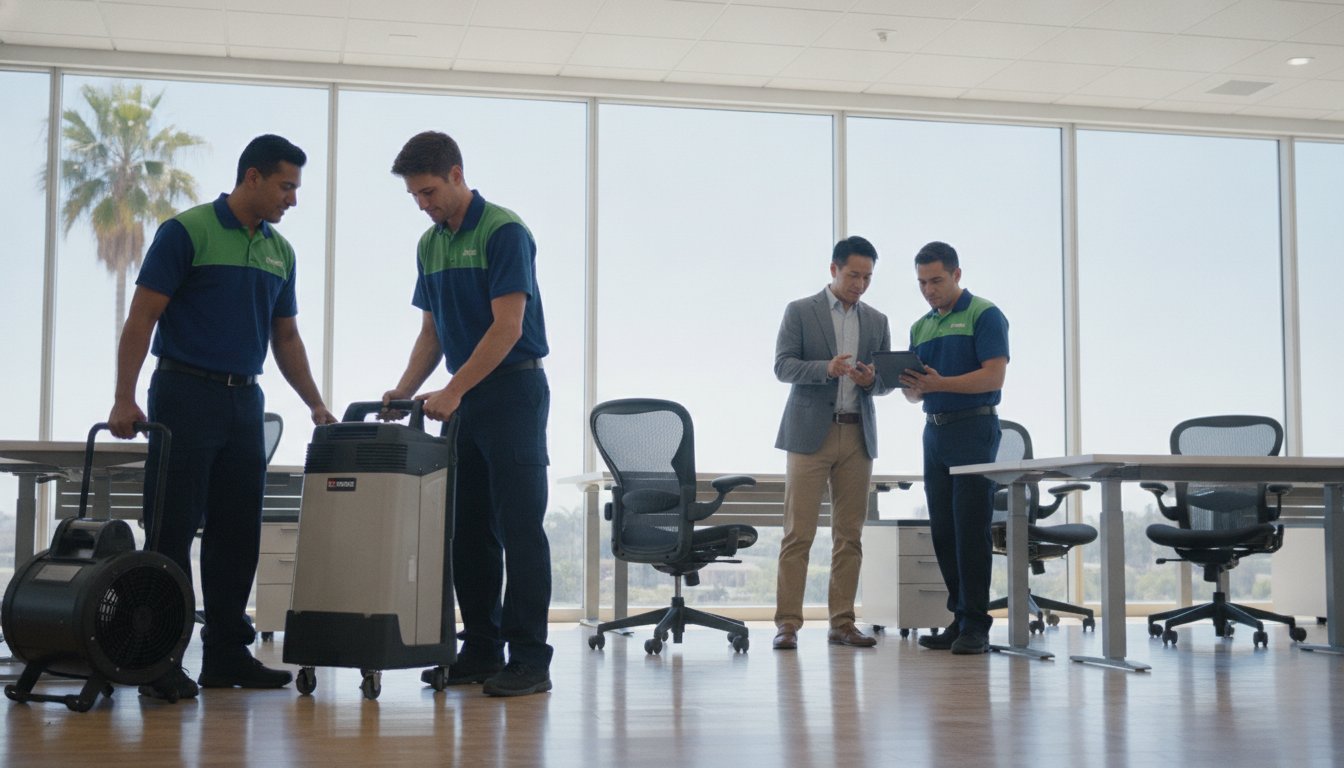
Strategic phasing allows a facility to remain partially functional even while industrial drying equipment is active. We achieve this by establishing “clean zones,” which are operational areas physically isolated from the restoration site. This isolation doesn’t just involve plastic sheeting; it requires the use of negative air pressure and HEPA filtration to prevent the migration of dust or microbial spores into active workspaces. To further clear the floor for high-volume extraction, we utilize off-site content storage and pack-out services. This moves your inventory and furniture to climate-controlled environments, protecting them from secondary damage. We also schedule the most disruptive or loud tasks during your off-peak hours to minimize the impact on your daily workflow.
Insurance Coordination and Documentation
The speed of your financial recovery depends heavily on the quality of your documentation. Detailed restoration logs serve as the primary evidence for your insurance claims, providing a day-by-day account of moisture levels, equipment usage, and labor. A professional partner helps you work with adjusters to ensure all “unseen” damages, such as moisture trapped within wall cavities, are fully accounted for. Because commercial policies often have complex clauses regarding business interruption and hazardous material discovery, having a partner who understands these nuances is vital. If your facility has sustained water damage, you need a partner who understands that every minute counts. Contact Coastline Environmental Solutions for professional commercial restoration services that prioritize your business continuity.
Coastline Environmental Solutions, Inc.: Your Partner in Commercial Recovery
Since 1985, Coastline Environmental Solutions, Inc. has acted as a steady hand for the Long Beach, Seal Beach, and Lakewood business communities. We understand that a flood event is a high-stakes emergency that requires more than just industrial equipment; it demands a partner who can manage chaos with methodical precision. Our approach to flood restoration for businesses is grounded in science-based protocols that prioritize the safety of your employees and the long-term stability of your structure. By combining professional authority with a reassuring presence, we move your property from a state of crisis back to full operational status with minimal friction.
Our team projects the personality of a seasoned expert who acts as a dependable local guardian. We don’t just respond to water intrusion; we provide a comprehensive technical response that addresses the root cause and prevents secondary degradation. This meticulous restoration philosophy ensures that your recovery isn’t just fast, but thorough enough to withstand the scrutiny of insurance adjusters and health inspectors alike. As a community-oriented partner, we’re as invested in the outcome as you are, treating your business continuity as our primary metric of success.
Specialized Expertise in the Long Beach Coastal Zone
Navigating the specific environmental regulations of the Southern California coast requires deep local knowledge. Coastline Environmental Solutions, Inc. has decades of experience working alongside local property managers and commercial landlords, ensuring that every project meets stringent building codes and hazardous material ordinances. This established presence allows for faster project approvals and direct coordination with local decision-makers. Because we’ve served this region for over 40 years, we’re intimately familiar with the unique structural challenges of coastal architecture, from the historic masonry found in San Pedro to the modern commercial complexes in Huntington Beach. This local expertise translates into a more efficient mobilization and a more accurate drying plan tailored to our specific climate.
Comprehensive Environmental Safety and Restoration
Efficiency in restoration comes from having a single, accountable partner who can handle every variable of a loss. We maintain dual-certification in water restoration and hazardous material abatement, which allows us to manage asbestos, lead, and mold remediation in-house without the administrative delays of third-party subcontractors. This integrated model is especially valuable when a property has suffered complex or multi-faceted losses. For example, our expertise extends to fire and smoke damage repair, ensuring that your facility is decontaminated to the highest standards regardless of the disaster’s origin.
Protecting your brand reputation is just as important as protecting your physical assets. We conduct meticulous site decontamination and indoor air quality testing to ensure your environment is safe for occupancy the moment we hand back the keys. Our commitment to thoroughness means we don’t look for a quick fix; we provide long-term solutions that prevent secondary damage and future legal liabilities. When you face the uncertainty of a commercial flood, you need the technical clarity of a meticulous restorer. Reach out to the team at Coastline Environmental Solutions, Inc. today for an immediate, professional assessment of your commercial property.
Restoring Your Operational Stability
The path to recovery after a commercial flood requires a balance of rapid technical response and strategic operational planning. By prioritizing high-volume extraction and utilizing the precision drying techniques discussed in this guide, you can mitigate the risk of long-term structural degradation and hidden microbial growth. Successful recovery isn’t just about removing water; it’s about documenting the process for insurance compliance and ensuring your facility is biologically safe for your employees and customers.
Choosing a partner with specialized local knowledge and industrial-grade equipment is the most effective way to manage flood restoration for businesses in Southern California. Coastline Environmental Solutions, Inc. has been a steady guardian for the local community since 1985, providing the technical clarity needed to resolve complex property emergencies. With our 24/7 emergency response and IICRC-certified technicians, we ensure that your transition from crisis back to normalcy is handled with meticulous care.
Don’t let water damage dictate your business’s future. Secure Your Business with Professional Flood Restoration and take the first step toward a complete, safe recovery. Your facility’s resilience is our priority, and we’re ready to help you rebuild with confidence.
Frequently Asked Questions
How quickly should a business start flood restoration?
Restoration efforts should begin as soon as the site is safe to enter, ideally within the first 24 hours of water intrusion. Rapid response is critical because microbial growth can colonize damp surfaces in as little as 24 to 48 hours. Early intervention also prevents secondary structural damage, such as the warping of subfloors or the saturation of wall cavities, which significantly increases long term recovery costs.
Will my business insurance cover the full cost of flood restoration?
Coverage depends on your specific commercial policy and whether you have a separate flood insurance rider. Standard commercial property insurance often excludes rising groundwater or storm surges, requiring a policy through the NFIP or a private carrier. You should review your “Substantial Improvement” thresholds under local ordinances, as valuations over 50% of the building’s market value may trigger mandatory code upgrades that impact total reimbursement.
Can we stay open while flood restoration is being performed?
Yes, many businesses can remain partially operational by utilizing strategic phasing and “clean zones.” Restorers use plastic containment barriers and negative air pressure to isolate the affected areas from your daily operations. This approach allows employees to continue working in dry, safe sections of the building while industrial drying equipment runs in the background. However, high-traffic retail or medical spaces may require temporary closure for safety.
What is the difference between water mitigation and water restoration?
Water mitigation focuses on preventing further damage by extracting standing water and stabilizing the environment, while water restoration involves the actual repair or replacement of damaged materials. Mitigation is the emergency phase that includes drying and decontamination. Restoration is the final phase where flooring, drywall, and cabinetry are rebuilt to return the property to its pre-loss condition. Both are essential components of comprehensive flood restoration for businesses.
How do you check for mold after a commercial flood?
Checking for mold involves a combination of visual inspections, moisture mapping, and professional indoor air quality testing. Technicians use penetrating moisture meters and infrared cameras to find trapped dampness where mold is likely to grow. If microbial growth is suspected, surface or air samples are collected and analyzed by a laboratory to identify the specific species and concentration of spores present in the environment.
Do I need to test for asbestos before flood-related demolition?
Yes, California regulations generally require an asbestos survey before any demolition or disturbance of building materials in structures built before 1980. Even if the building is newer, testing is often recommended to ensure worker safety during the removal of wet drywall or floor tiles. Identifying these hazardous materials early prevents the accidental release of toxic fibers into your ventilation system, protecting both your staff and the long term air quality of the facility.
What specialized equipment is used for commercial flood drying?
Commercial drying relies on industrial-grade Low Grain Refrigerant (LGR) dehumidifiers and high-velocity air movers to manage large square footages. For extremely dense materials like concrete or masonry, technicians may deploy desiccant dehumidifiers, which use chemical attraction to pull moisture from the air more aggressively than standard units. Truck-mounted extraction systems are also used to remove bulk water quickly, providing the high-volume suction needed for flood restoration for businesses with significant inundation.
How long does the typical commercial flood restoration process take?
The initial drying phase typically takes between three to five days depending on the class of water intrusion and the materials involved. Once the structure reaches its “dry goals,” the reconstruction phase can take anywhere from a week to several months. Factors such as the scale of the damage, the availability of replacement materials, and the complexity of insurance approvals will ultimately determine your total timeline to full occupancy.