28 Jul 24-Hour Water Damage Repair: Emergency Restoration for Southern California Properties
Imagine waking up at 2 AM to the sound of rushing water, only to find your hallway submerged under several inches of a burst pipe’s contents. In that moment, the clock starts ticking on your property’s structural integrity. You’re likely feeling a mix of panic over ruined flooring and deep anxiety about whether your insurance will cover the damage if you don’t act immediately. Securing professional 24 hour water damage repair isn’t just about convenience; it’s a critical environmental intervention that prevents a temporary mess from becoming a permanent health hazard for your family.
We understand the stress of watching your home soak. Since 1985, we’ve seen how the first 24 hours determine if a Southern California property remains a safe living space or requires extensive remediation for mold and asbestos. This guide explains how immediate water extraction and technical drying protocols protect your investment and your health. You’ll learn how a methodical response ensures successful insurance coverage and prevents secondary issues like indoor air quality degradation. By following a structured restoration plan, you can move from the chaos of a flood to a fully restored, dry property within just a few days.
Key Takeaways
- Learn how to halt structural decay by intervening before clean water degrades into hazardous gray water within the critical 24-hour window.
- Discover why local proximity is essential for effective 24 hour water damage repair and fulfilling your insurance policy’s loss mitigation requirements.
- Identify the specific environmental hazards, including asbestos and lead, that often complicate restoration in older Lakewood and Long Beach homes.
- Understand how advanced infrared moisture mapping detects hidden saturation to prevent secondary mold growth and ensure a thoroughly dry property.
- Gain insight into specialized dehumidification techniques required to combat coastal humidity in Southern California’s beach communities.
The Critical 24-Hour Window: Why Emergency Water Repair Cannot Wait
Water is often called the universal solvent because of its ability to dissolve more substances than any other liquid. When a pipe bursts or a water heater fails, this chemical property becomes a significant threat to your property. Within minutes, water begins to break down the molecular bonds of adhesives in flooring, soften the gypsum in drywall, and permeate the cellular structure of structural timber. Because of this rapid degradation, immediate access to 24 hour water damage repair is a fundamental requirement for property preservation, not a luxury service. Waiting even a single day can escalate a simple extraction project into a complex, multi-week reconstruction.
The 24-hour mark represents a critical threshold in restoration science. During this window, water is typically classified as Category 1, or “clean water,” which poses the least risk to occupants. However, as water sits, it reacts with building materials and environmental contaminants. Within 24 to 48 hours, standing water often degrades into Category 2, or “gray water,” which contains significant contamination and has the potential to cause discomfort or sickness if consumed or contacted. Professional restorers use the science of psychrometry to prevent this degradation. By precisely manipulating air pressure, temperature, and relative humidity, technicians create an environment where moisture is forced out of dense materials before permanent rot or bacterial colonies can take hold.
The Water Damage Timeline: Minutes vs. Hours
The progression of water damage is relentless. Within the first 60 minutes, moisture wicks up drywall, swells the base of wooden furniture, and can cause permanent staining on delicate textiles. Between 1 and 24 hours, the damage deepens. Metal surfaces begin to tarnish; musty odors emerge as microbial activity spikes; and the structural integrity of subflooring begins to fail as the wood fibers saturate. This initial period is the “Golden Hour” for high-value items. If professional intervention occurs within this window, electronics, antiques, and specialized flooring can often be salvaged through technical drying rather than being discarded; to ensure your facility’s long-term electrical resilience, check out Energy Control Systems for specialized infrastructure protection.
Preventing Secondary Damage and Biohazards
In the coastal climate of Southern California, high ambient humidity can accelerate the “wicking effect,” where moisture travels vertically through wall cavities far above the initial flood line. This trapped moisture triggers rapid bacterial growth and sets the stage for mold colonization. While a residential shop-vac might remove surface puddles, it lacks the “lift” and CFM (cubic feet per minute) capacity required to pull water from deep within carpet padding or structural gaps. Professional truck-mounted extraction systems are exponentially more effective, removing hundreds of gallons of water in a fraction of the time, which is the only way to successfully lower the vapor pressure in the room and stop secondary damage before it starts.
The Coastline Restoration Protocol: Our 24/7 Emergency Process
Speed is the most significant factor in property recovery. Because our teams are strategically stationed near Long Beach and Lakewood, we can respond to calls within the hour. This proximity allows us to begin 24 hour water damage repair while the moisture is still on the surface, before it has the chance to deeply penetrate structural members. We don’t just mop up the visible mess; we follow a rigorous, multi-step scientific protocol designed to stabilize the environment and protect your investment.
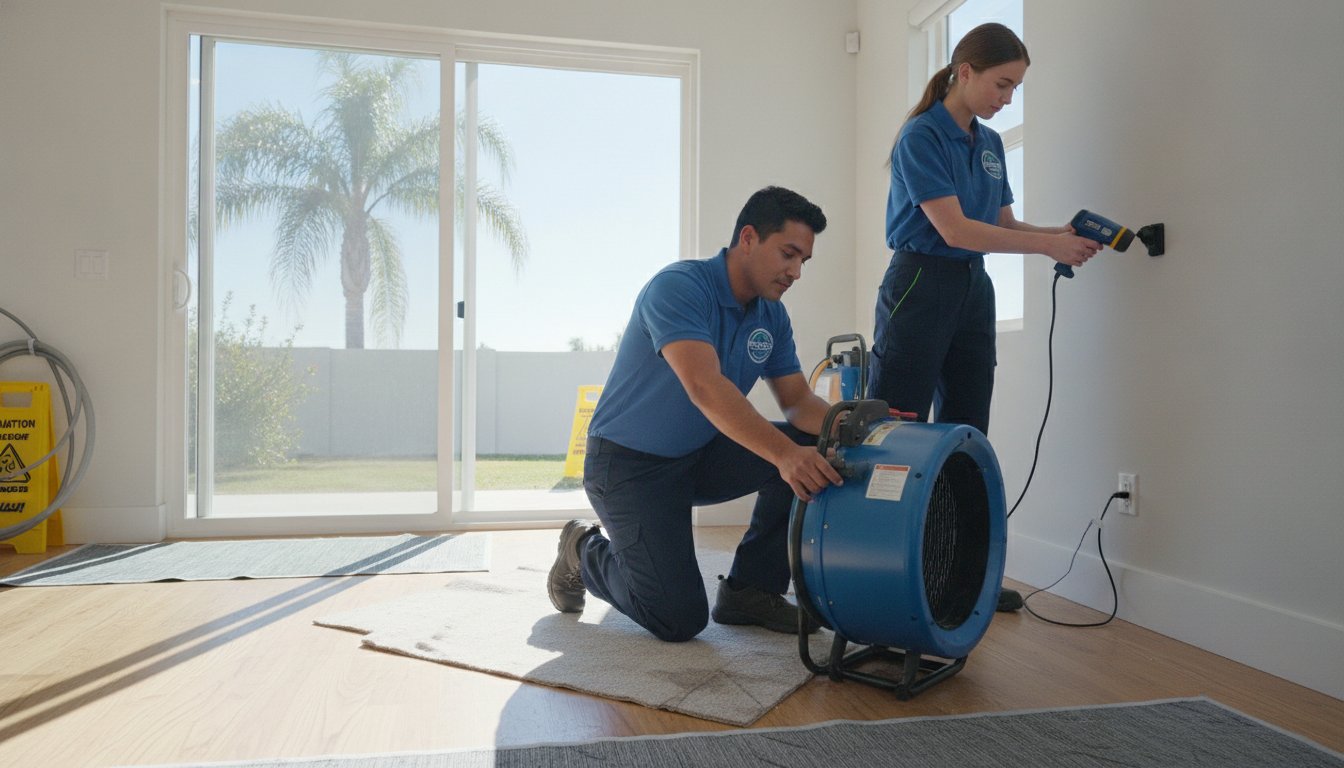
We utilize advanced moisture mapping to guide our efforts. Using infrared thermal imaging, our technicians identify temperature variations that indicate hidden moisture pockets behind tiles, cabinetry, and baseboards. This technology ensures we don’t miss “blind spots” that could later lead to mold growth or structural rot. By visualizing what the naked eye cannot see, we create a precision drying plan tailored to your property’s specific layout.
Step 1: Emergency Assessment and Containment
Our first priority is identifying the water source. If the leak is still active, we execute emergency plumbing shut-offs to prevent further flooding. We then categorize the water into Category 1, 2, or 3 to establish the appropriate safety and PPE protocols. To protect the rest of your home, we set up physical containment zones using heavy-duty plastic sheeting and tension poles. These barriers prevent humid, contaminated air from migrating into unaffected rooms, effectively “boxing in” the damage and preventing cross-contamination.
Step 2: Rapid Extraction and Dehumidification
Once the area is contained, we deploy industrial-grade, truck-mounted extraction units. These machines are designed for high-volume water removal, pulling liquid from deep within carpet fibers and subflooring. By removing the bulk of the water physically, we can reduce the subsequent drying time by up to 50%. This is much more effective than residential equipment which often leaves behind significant moisture in the padding.
The final phase involves structural drying using high-velocity air movers and Low Grain Refrigerant (LGR) dehumidifiers. These units pull moisture from the air and the building materials simultaneously. Our technicians perform daily moisture monitoring, taking readings to ensure that every material reaches its “dry goal” according to IICRC standards. To maintain healthy indoor air quality, we use HEPA air scrubbers and antimicrobial treatments to neutralize odors and airborne particles. If you’re currently facing a flood, reaching out for emergency water restoration is the best way to ensure your property returns to its pre-loss condition quickly and safely.
Addressing Hidden Risks: Mold, Asbestos, and Lead Hazards
In Southern California, water intrusion is often more than a plumbing crisis; it’s an environmental one. Many residential properties in Lakewood and Long Beach were constructed during eras when asbestos and lead-based paint were industry standards. When water saturates these materials, it can disturb fibers and lead particles, turning a simple flood into a hazardous site. This is why 24 hour water damage repair must involve more than just extraction. It requires a meticulous understanding of environmental safety to ensure that the restoration process doesn’t inadvertently contaminate your living space. Engaging professional environmental remediation services is often essential when water damage disturbs these hidden hazardous materials in older Southern California properties.
The 48-hour rule is the absolute deadline for preventing a full-scale toxic mold remediation project. After two days, microbial spores begin to colonize damp organic materials like drywall and wood studs. If lead-based paint is present, the constant moisture causes it to peel and flake, creating toxic lead dust that settles into carpets and upholstery. Attempting a DIY cleanup in these conditions is often a major health violation. Without proper containment or HEPA filtration systems, you risk aerosolizing dangerous particles that can linger in your HVAC system long after the water is gone.
Environmental Testing During Water Emergencies
Local regulations, specifically those from the South Coast Air Quality Management District (SCAQMD), often require certified asbestos testing before any structural drying or demolition can begin in older homes. We provide an integrated response that addresses these legal and safety requirements simultaneously. Because we are certified for both water restoration and hazardous material abatement, we can transition seamlessly from extraction to containment. Our process concludes with professional indoor air quality testing to verify that your home is safe for re-entry, providing you with documented proof of a healthy environment.
Preventing Post-Water Mold Outbreaks
A common mistake property owners make is using bleach to treat visible mold. Bleach is largely ineffective on porous materials because its chemical structure prevents it from reaching the “roots” of the mold embedded in the wood or drywall. Our mold remediation experts use EPA-registered antimicrobials that penetrate deep into the substrate to sanitize the area completely. This methodical approach ensures that once the property is dry, the microbial threat is permanently neutralized. By securing 24 hour water damage repair that includes environmental testing, you protect both the physical structure of your home and the health of everyone inside it.

Navigating Insurance and Documentation in a Crisis
Managing an insurance claim while standing in a flooded living room is an overwhelming experience. Most homeowners are unaware that their insurance policy is a legal contract containing a “Loss Mitigation” clause. This provision requires you to take immediate, reasonable action to prevent further damage to your property. If you fail to secure 24 hour water damage repair and allow moisture to sit for several days, your carrier may deny coverage for secondary issues like mold or structural rot. Taking swift action isn’t just about saving your floors; it’s about protecting your right to a successful claim.
Adjusters typically categorize water events into two groups: “sudden and accidental” or “gradual.” A burst pipe or a failed water heater is usually covered because it’s a sudden event. However, a slow, neglected leak that has caused damage over several months is often excluded. Because the timeline is so critical, we provide detailed digital documentation that proves the nature of the loss. This includes moisture logs, infrared thermal images, and time-stamped photos that establish the exact conditions when we arrived. This technical evidence is the most powerful tool you have when negotiating with an adjuster.
How to Document Damage for Your Adjuster
Before our team begins the extraction process, it’s vital to capture the scene in its original state. Take clear photos of the water source, the standing water in every room, and all affected personal property. If materials like carpet or drywall must be removed immediately for safety or environmental reasons, keep a small sample (such as a one-foot square of carpet) to show the adjuster the quality of the material being replaced. Most importantly, you should never sign a final settlement or “certificate of satisfaction” until the structural drying is 100% complete and verified by moisture meters.
Coastline’s Role in Your Insurance Claim
We act as a technical bridge between you and your insurance carrier. Our team works with all major insurance providers in the Long Beach and Orange County areas, providing the precise data they need to approve comprehensive drying protocols. We utilize industry-standard software to ensure our estimates are transparent and easily processed by adjusters. By adhering to the highest water damage restoration Long Beach standards, we ensure that every step of our process is defensible and necessary for your home’s recovery. To simplify the financial burden during an emergency, we offer direct insurance billing, allowing us to coordinate payments directly with your carrier. If you are currently dealing with a flood and need help navigating the claims process, contact our emergency response team for immediate assistance.
Why Local Expertise Matters for Long Beach and Coastal Cities
Southern California’s microclimates dictate the success of a restoration project. In coastal cities like Huntington Beach and Seal Beach, high ambient humidity and salt air significantly impact how building materials release moisture. A generic approach to drying often fails here because it doesn’t account for the localized vapor pressure. Our technicians adjust dehumidification protocols specifically for these coastal variables, ensuring that deep-seated moisture is actually removed rather than just circulated. When you require 24 hour water damage repair, having a partner who understands these environmental nuances is the difference between a dry home and a recurring mold problem.
Response time is purely a matter of geography. A national franchise may have a recognizable logo, but their dispatch center could be miles away from the crisis. Because we are based locally, a technician can often arrive at a Long Beach or Lakewood property faster than a regional provider could even process the service request. This speed is vital for meeting the loss mitigation requirements discussed in previous sections. Since our founding in 1985, we’ve developed a deep familiarity with local building codes and the specific environmental regulations set by the South Coast Air Quality Management District (SCAQMD). This ensures your project is compliant from the first hour of extraction.
Serving Long Beach, Lakewood, and Beyond
We provide tailored restoration solutions across a diverse range of property types. Our experience spans from industrial sites in San Pedro to mid-century residential homes in Cerritos and Lakewood. Each project is handled with a commitment to environmental responsibility, utilizing advanced moisture mapping and eco-friendly antimicrobials. If you’re facing a water emergency, our 24-hour emergency line connects you directly to a local dispatcher who can initiate immediate team deployment. We understand the unique architectural challenges of older Lakewood homes and the specific moisture issues inherent to coastal Huntington Beach properties. Proper water management also involves exterior structures; for example, if you are looking to improve drainage in the Midwest, working with a retaining wall contractor Johnson County KS can help stabilize soil and direct runoff away from your foundation.
The Coastline Difference: Authority and Empathy
A property emergency is inherently chaotic, but your restoration partner shouldn’t be. We project a “calm professional” presence, taking over the technical complexities so you can focus on your family’s safety. Our expertise isn’t limited to water; we provide a comprehensive suite of services including fire and smoke damage repair, asbestos abatement, and plumbing. For properties that have experienced both water and fire events, understanding the full scope of restoration also means knowing how to approach soot damage cleaning with the same technical precision we apply to water extraction. This “one-stop-shop” model eliminates the need for multiple contractors and ensures a more cohesive recovery process. By integrating technical precision with local commitment, we move your property from a state of emergency to a fully restored, safe environment. Securing 24 hour water damage repair from a seasoned local guardian is the most reliable way to bring your home back to normalcy.
Take the First Step Toward a Fully Restored Home
The first 24 hours of a water emergency represent a critical race against structural decay and environmental contamination. By acting quickly, you prevent clean water from degrading into a hazardous biohazard and ensure that hidden risks like asbestos are managed according to strict Southern California regulations. Our team brings over 40 years of local experience to every crisis, utilizing IICRC-certified technicians who specialize in both extraction and certified asbestos and lead abatement. This comprehensive approach doesn’t just dry your floors; it preserves the long-term health and value of your property.
To learn more about the standards of professional recovery beyond California, you can check out DK Production for a comprehensive guide on residential water damage restoration.
If you’re currently facing a flood, don’t wait for the damage to escalate. Call Coastline Environmental Solutions, Inc. Now for 24/7 Emergency Water Damage Repair to stabilize your home and begin a methodical recovery process. We’re here to act as your dependable local guardian, guiding you from the initial panic of a leak to the final peace of mind that comes with a safe, dry environment. You don’t have to navigate this recovery alone; we’re ready to help you return your property to its pre-loss condition.
Frequently Asked Questions
How fast can you respond to a water damage emergency in Long Beach?
We typically arrive at properties in Long Beach, Lakewood, and Signal Hill within 60 minutes of your call. Because our teams are based locally, we avoid the dispatch delays common with national franchises. This rapid response is essential for effective 24 hour water damage repair, as it allows us to begin extraction before moisture can penetrate deep into the structural subflooring.
Will my homeowners insurance cover 24-hour water damage repair?
Most homeowners policies cover professional restoration if the damage is “sudden and accidental,” such as a burst pipe or water heater failure. Most policies actually require you to take immediate action to mitigate the loss. We provide the detailed moisture mapping and digital photos your adjuster needs to approve the claim, and we offer direct insurance billing to simplify the process.
Can I stay in my house during the water restoration process?
Your ability to stay depends on the category of the water and the extent of the damage. If the loss involves Category 1 clean water and we can establish effective containment zones, you can often remain in unaffected parts of the home. However, if the water is contaminated or if the noise from industrial air movers is disruptive, temporary relocation might be recommended for your safety and comfort.
How long does it typically take to dry out a house after a flood?
A standard drying project typically takes between three and five days to reach IICRC drying goals. The exact duration depends on the density of the affected materials and the ambient humidity levels. We perform daily moisture monitoring to track the progress of structural wood and drywall, ensuring that the environment is completely stabilized before we remove our specialized equipment.
Is it necessary to test for mold after the water has been extracted?
Testing is highly recommended if the water has been present for more than 24 hours or if moisture has seeped into wall cavities. Extraction only removes standing liquid; it doesn’t eliminate the microbial spores that thrive in damp, dark spaces. We provide indoor air quality testing to ensure that the environment is safe and that no secondary mold outbreaks are occurring behind the scenes.
What should I do immediately after discovering a major leak or flood?
Your first priority is safety, so turn off the electricity to the affected areas at the breaker box if it’s safe to do so. Stop the water at its source and then contact a professional for 24 hour water damage repair. Take clear photos of the damage for your insurance records, but avoid moving heavy furniture or disturbing wet building materials that might contain asbestos.
Do you handle the plumbing repairs as well as the water cleanup?
Yes, we provide a “one-stop-shop” service that includes professional plumbing repairs. Our team can identify the source of the leak, execute the necessary plumbing fixes, and then immediately transition into the water extraction and restoration phase. This integrated approach saves you the stress of coordinating between multiple contractors and ensures the restoration process begins as quickly as possible. For property owners who need specialized support with fire suppression systems and sprinklers, you can visit Firemex Solutions Inc. to ensure your safety infrastructure is handled by experts.
Why shouldn’t I just use a shop-vac and fans to dry the area myself?
Residential shop-vacs and standard fans lack the power to remove moisture trapped deep within carpet padding, subfloors, and wall studs. While the surface might feel dry to the touch, hidden moisture often remains, leading to structural rot and toxic mold growth within days. Our industrial LGR dehumidifiers and high-velocity air movers are designed to pull moisture out of dense materials and the air simultaneously. Properties that have experienced both fire and water damage from firefighting efforts may also need specialized soot and smoke odor removal alongside standard water extraction to fully restore indoor air quality.