
29 Jul Asbestos Testing: Homeowner’s Renovation Guide (2026)
That dream kitchen remodel in your 1970s Long Beach home shouldn’t begin with a sledgehammer. Instead, it should start with a lab report. Even with the EPA’s recent efforts to finalize bans on specific asbestos types, homes built or renovated between 1930 and 1990 remain high-risk environments for these hazardous minerals. Investing in professional asbestos testing for home renovation is the only way to confirm your family isn’t breathing in microscopic fibers that lead to life-altering respiratory diseases.
It’s natural to feel overwhelmed by the complex web of Southern California building codes or the fear of unexpected project delays. You want a beautiful home, but you also need to ensure the process remains legal and safe for everyone involved. This guide clarifies the 2026 regulatory landscape, including South Coast AQMD Rule 1403 requirements, so you can identify high-risk materials before they become a liability. We’ll walk through the specific steps to secure a certified inspection, helping you move from project anxiety to a methodical, organized resolution.
Key Takeaways
- Identify high-risk structural elements common in older builds, such as acoustic textures and specific vinyl tiles, that require professional verification.
- Learn why professional asbestos testing for home renovation is the only way to secure the legal documentation required by Southern California building inspectors.
- Evaluate the technical limitations of DIY kits compared to certified laboratory analysis to prevent accidental exposure to microscopic fibers.
- Discover the precise containment and wetting protocols used during the inspection process to maintain superior indoor air quality.
- Determine the most appropriate safety response for your project by distinguishing between material encapsulation and full asbestos abatement.
Why Asbestos Testing is Mandatory for Your Home Renovation
Asbestos testing for home renovation is a methodical assessment designed to identify Asbestos-Containing Materials (ACM) before any physical work begins. This process involves a certified professional collecting bulk samples from various structural elements to determine if hazardous minerals are present. In Southern California, this isn’t just a safety recommendation; it’s a foundational step in property management. For comprehensive oversight, Lin Inspects provides professional property inspection services that offer precision and peace of mind for real estate investments. When you disturb materials like old drywall, insulation, or floor backing, you risk releasing microscopic fibers that are small enough to bypass the body’s natural filters and settle deep within the lungs.
The health imperative centers on containment. Once these fibers become airborne, they easily enter your home’s HVAC system, which then distributes the hazard to every room in the house. This cross-contamination can turn a simple bathroom update into a whole-home environmental crisis. For homeowners in the Long Beach area, the primary legal driver is South Coast Air Quality Management District (SCAQMD) Rule 1403. This regulation requires that a thorough survey be conducted by a certified asbestos consultant before any demolition or renovation activity. Understanding that “disturbing” a material is the critical legal threshold helps you avoid the severe consequences of non-compliance.
The Risks of Unchecked Asbestos Exposure
The danger of asbestos depends largely on whether the material is friable or non-friable. Friable asbestos, such as old pipe insulation, crumbles easily under hand pressure and releases fibers instantly. Non-friable materials, like vinyl floor tiles, are more stable but become dangerous the moment they are sanded, sawed, or shattered during demolition. Because these fibers are invisible to the naked eye, you won’t know you’ve been exposed until decades later. Long-term health implications like mesothelioma and asbestosis often have a latency period of 20 to 50 years, making early detection through testing your only true defense.
Local Regulations in Long Beach and Lakewood
Building departments in Long Beach and Lakewood are increasingly stringent regarding permit approvals. You’ll likely find that your renovation permit is contingent upon providing a certified asbestos survey. Local inspectors look for this documentation to ensure that contractors and residents are protected from environmental hazards. Skipping this step often leads to “red-tagging,” where the city halts all work on your property. This results in significant project delays and potential fines that far exceed the cost of an initial inspection. By partnering with a certified local expert, you ensure your project remains on schedule and meets all Southern California environmental standards.
Identifying High-Risk Areas: Where Asbestos Hides in Your Home
Southern California’s architectural history, particularly homes built between 1930 and 1990, presents a unique challenge for modern renovators. During this era, asbestos was prized for its fire resistance and durability, leading to its integration into thousands of common building products. Identifying these materials by sight alone is impossible. This is why professional asbestos testing for home renovation is the standard safety protocol before any demolition begins. The EPA estimates that approximately 733,000 public and commercial buildings contain these minerals, and residential properties from the mid-century era follow a similar pattern of risk.
This risk is particularly prevalent in historic districts where preserving original architectural features is a priority. For property owners looking to maintain the integrity of historic facades during renovations, resources like progressivecontractingny.com offer insights into specialized masonry and restoration techniques that prioritize both safety and structural heritage.
Several specific materials act as red flags during a pre-renovation walkthrough. Popcorn ceilings and acoustic textures, common in 1960s through 1980s builds, are notorious for their high friability. When these surfaces are scraped or disturbed, they release a significant volume of microscopic fibers into the air. Similarly, vintage vinyl floor tiles, specifically those manufactured in a 9×9 inch format, almost always indicate the presence of asbestos in either the tile itself or the black adhesive mastic used to secure it. Drywall joint compound and textured wall finishes also present a hidden hazard, as the asbestos was often added to the “mud” rather than the gypsum board itself.
Interior Surfaces and Textures
Scraping a popcorn ceiling without prior testing is one of the highest-risk activities a homeowner can perform. Beyond ceilings, many vintage SoCal homes utilize lath and plaster systems where asbestos was used as a reinforcing binder. Decorative elements aren’t exempt from scrutiny either. Original fireplace materials, including artificial embers and gas log components, frequently contain heat-resistant asbestos fibers. If you suspect these materials are present, scheduling asbestos testing for home renovation provides the technical clarity needed to proceed safely.
While addressing hazardous materials like asbestos, it is also important to maintain the safety of your home’s exhaust systems; you can discover Absolute Chimney Pros for professional chimney cleaning and inspections to ensure your fireplace is ready for safe operation after your remodel.
Structural and Mechanical Components
The risk extends into the hidden cavities and exterior of the home. Asbestos-cement siding, often referred to as Transite, was a popular choice for its weather resistance but becomes hazardous if shattered or drilled. In crawlspaces and attics, you may find “mummy wrap” insulation around water heaters and original HVAC ducting. This white, corrugated paper or cloth-like wrap is often nearly pure asbestos. Even the window glazing and caulking compounds found in original steel frames were formulated with these minerals to prevent cracking over time. A methodical inspection ensures these mechanical components are identified and managed before they are accidentally disturbed by a contractor. For those planning to replace aging infrastructure, you can discover Underline Energy Concepts to learn about energy-efficient roofing and electrical upgrades that meet modern safety standards.
Once these hazardous materials are safely identified and removed, homeowners can focus on improving their home’s energy performance with modern solutions. For readers interested in the benefits of high-performance materials like those provided by Third Coast Spray Foam, you can read more about how modern insulation services can transform indoor comfort and efficiency in this comprehensive guide.
DIY Test Kits vs. Professional Asbestos Inspections
The allure of a quick, retail-grade solution is understandable when you’re managing a tight renovation budget. However, hardware store DIY kits often lead to a dangerous false sense of security. These kits typically have a high rate of false negatives because they rely on the homeowner to identify and collect the correct material. If you only sample the top layer of a textured wall and miss the contaminated joint compound beneath, the lab result will be dangerously inaccurate. Professional asbestos testing for home renovation eliminates this guesswork by utilizing a comprehensive survey approach rather than a single-point sample.
Safety is the primary concern during the collection process. When an untrained individual scrapes a sample from a dry popcorn ceiling or breaks a piece of vinyl tile, they are actively aerosolizing the very fibers they are trying to identify. Professionals use specialized wet-sampling techniques and localized containment to ensure no fibers escape into your living space during the assessment. Beyond physical safety, there’s the issue of legal documentation. A DIY test lacks a verified “chain of custody,” meaning it’s rarely accepted by Southern California building departments for permit approval or by contractors who require proof of a safe work environment.
The Hidden Costs of DIY Testing
While the initial kit might cost very little, the total expense quickly escalates. Most kits do not include the necessary laboratory analysis fees, which can range from $25 to $80 per sample. Furthermore, a DIY result doesn’t provide a formal, signed report from a certified inspector. This lack of professional documentation can become a major liability if you sell your home later. If a buyer’s inspector finds asbestos that your DIY kit missed, you could face legal claims for non-disclosure or be forced to pay for emergency abatement to save the sale.
Why Professional Certification Matters
Certified inspectors utilize advanced laboratory methods like Polarized Light Microscopy (PLM) and Transmission Electron Microscopy (TEM). These technologies can detect fibers that are far too small for standard retail analysis to identify. Precision is vital, especially when dealing with multiple environmental hazards. Many homeowners find that a comprehensive survey for asbestos often overlaps with the need for Toxic Mold Remediation, as both require similar containment and air quality protocols. Additionally, most homeowner insurance policies demand professional testing and certified abatement to maintain coverage. Using a certified expert ensures that your results are legally binding, scientifically accurate, and compliant with all local safety standards.

How to Perform Asbestos Testing: The Professional Process
Professional asbestos testing for home renovation follows a rigorous five-step protocol to ensure every hazardous material is accounted for before a single wall is opened. The process begins with a comprehensive visual inspection and mapping of all suspect materials. A certified inspector doesn’t just look for obvious pipe wrap; they examine the layers of your home’s history, from the drywall mud in the guest room to the window glazing in the garage. This systematic approach ensures that no “hidden” asbestos remains to surprise your contractor mid-project.
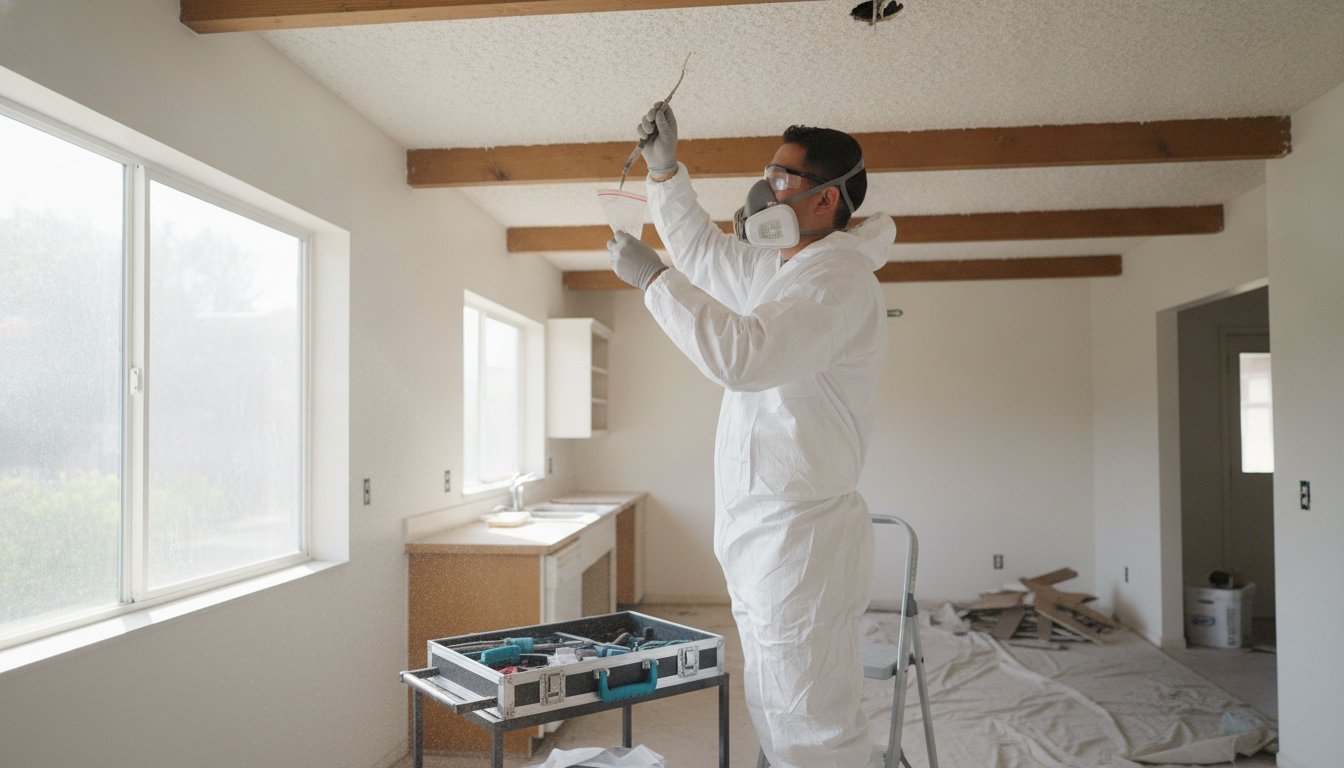
Once suspect areas are identified, the inspector employs a “wet sampling” technique. By saturating the material with a surfactant solution, they prevent the release of microscopic fibers during the collection process. Each physical sample is then placed into a secure, double-bagged container and labeled for a strict chain of custody. These samples are sent to a NVLAP-accredited laboratory for analysis using EPA-approved Polarized Light Microscopy (PLM). The final result is a certified report that provides a clear, actionable path for your renovation. If you are ready to secure your property’s safety, you can schedule a professional asbestos inspection to begin this methodical process.
Preparing Your Home for the Inspector
To facilitate a thorough survey, you should ensure the inspector has unobstructed access to all attics, crawlspaces, and utility rooms. It is vital to turn off your HVAC system at least thirty minutes before the appointment to eliminate air movement that could inadvertently spread fibers during sampling. For the safety of your family, please keep children and pets in a separate area or out of the house during the visit. These simple steps allow the technician to focus on the technical precision required for an accurate assessment of your indoor environment.
Understanding Your Asbestos Survey Report
Your report will categorize materials into three primary results: “Non-Detected,” “Trace,” or “Greater than 1%.” Under federal and Southern California regulations, any material containing more than 1% asbestos is legally classified as an Asbestos-Containing Material (ACM) and requires specific handling. If “Trace” amounts are found, the material still poses a risk but may fall under different regulatory thresholds depending on the scope of your work. This document acts as the blueprint for your general contractor, outlining exactly which areas require abatement and which are safe for standard demolition. To prepare for the construction phase, you can visit Coastal Contracting and learn how professional remodeling services handle the transition from safety clearance to final build. The clearance process is the final verification step where air samples are tested after abatement to prove the environment is safe for re-occupancy.
From Results to Abatement: Moving Forward Safely
Positive results from asbestos testing for home renovation don’t have to stall your project indefinitely. Instead, they provide the technical roadmap needed to proceed without compromising the health of your household. Once a material is identified as hazardous, you must decide between encapsulation and full abatement. Encapsulation involves treating the material with a specialized sealant that binds the fibers together, preventing them from becoming airborne. While this is a viable solution for materials in good condition that won’t be disturbed, full asbestos abatement is the only way to permanently remove the liability from your property during a major remodel.
Coastline Environmental Solutions, Inc. manages this transition with the same methodical precision used during the initial inspection. Our team establishes high-standard containment zones using HEPA-filtered air scrubbers and negative pressure systems. This specialized setup ensures that every fiber is captured at the source and cannot migrate to “clean” areas of your home. After the physical removal is complete, we conduct final air clearance testing. This scientific verification proves the environment is free of microscopic particulates, providing the documented proof you need to safely re-occupy the space.
Selecting a Certified Abatement Contractor
Choosing the right professional is a critical safety decision that impacts your project’s legality and safety. You should always verify that a contractor holds the specific California C-22 Asbestos Abatement license and carries comprehensive pollution liability insurance. Local Southern California references are also vital for confirming their familiarity with SCAQMD Rule 1403 procedures. You should never rely on a general contractor for this specialized work. They often lack the negative-pressure equipment and decontamination showers required for legal hazardous material handling. If your home has faced other environmental challenges, such as Fire and Smoke Damage Repair, you already know that managing hazardous particulates requires a dedicated, certified specialist. Similarly, if your older Long Beach property may also contain lead-based paint, working with certified lead abatement contractors who understand the latest 2026 CDPH requirements is equally essential for a fully compliant renovation.
The Peace of Mind in a Safe Renovation
A “clean” environmental report is a powerful asset for any property owner. It serves as permanent proof that your renovation was handled according to the highest safety standards, which can be a significant advantage during future real estate transactions. Most importantly, it allows you to return to your design plans with absolute confidence. You no longer have to worry about hidden toxins in the walls or microscopic dust in the vents. By following a methodical path from testing to clearance, you ensure your home remains a sanctuary rather than a health risk. Trust the experts at Coastline Environmental Solutions, Inc. for precise asbestos abatement and testing.
Following the safe removal of contaminants, the focus often shifts to revitalizing the home’s original charm. For those restoring period properties, understanding the techniques used by specialists like Surfprep for masonry and wood beam cleaning can provide valuable insight into preserving structural beauty while maintaining a clean, healthy environment.
Securing Your Southern California Home for the Future
Successful renovations are built on a foundation of safety and technical precision. By identifying high-risk materials like vintage floor tiles and acoustic textures, you protect both your family’s health and your property’s long-term value. Professional asbestos testing for home renovation provides the certified documentation needed to navigate Southern California’s strict building codes without stress or unexpected delays. This methodical approach transforms a potential environmental crisis into a controlled, manageable step in your home improvement journey, especially if you are planning accessibility modifications with HomeSafe Living Solutions.
Coastline Environmental Solutions, Inc. has served Long Beach and the South Bay since 1985, acting as a dependable local guardian for homeowners facing environmental hazards. Our team specializes in SCAQMD Rule 1403 compliance, ensuring your project meets all regulatory standards from the initial survey to the final air clearance. Schedule your professional asbestos testing with Coastline Environmental Solutions, Inc. today. Taking this proactive step allows you to focus on your design goals with the peace of mind that your home remains a safe sanctuary for your family. You’ve worked hard to plan your dream space; now ensure it’s built on a safe, clean foundation.
Frequently Asked Questions
How much does asbestos testing for home renovation typically cost?
The cost of a professional assessment depends on several factors, including the square footage of your property and the total number of samples required for a comprehensive survey. Older homes with multiple layers of flooring or complex HVAC insulation may require more extensive sampling to ensure safety. You should contact a local certified professional to receive a project-specific estimate that accounts for the specific materials in your Southern California home.
Can I stay in my home while asbestos testing is being performed?
Yes, you can typically remain in the home, but you must stay clear of the immediate area where the inspector is working. Technicians use methodical wet-sampling techniques to prevent fibers from becoming airborne during the process. While the professional collects samples from a specific room or crawlspace, that area is temporarily restricted. Once the samples are secured and the workspace is cleaned, the room is safe for normal use.
Is asbestos testing required for homes built after 1980?
Testing is often required regardless of the construction date because asbestos was used in some building materials well into the late 1980s. In Southern California, SCAQMD Rule 1403 requires a thorough survey before any demolition or renovation activity; to see how these 2026 safety standards compare to other regions, you can learn more about TSIAC International and their guide to South Carolina regulations. This ensures that no stockpiled inventory or “legacy” materials containing hazardous minerals are accidentally disturbed during your project, regardless of when the house was built.
How long does it take to get asbestos test results back?
Standard laboratory analysis typically takes between 24 and 72 hours once the samples reach a NVLAP-accredited facility. Technicians use Polarized Light Microscopy to identify the specific type and concentration of any fibers present. If your renovation timeline is tight, expedited processing is often an option. Once the analysis is complete, you’ll receive a certified report that serves as the legal documentation required for your building permits.
What happens if I start my renovation and find asbestos unexpectedly?
You must stop all work immediately and restrict access to the affected area to prevent further fiber disturbance. Shut off your HVAC system to keep microscopic particulates from circulating through the rest of the house. At this point, you’ll need to schedule professional asbestos testing for home renovation for the newly uncovered material. This prevents accidental exposure and ensures your project can resume safely once the material is correctly identified and managed.
Does every popcorn ceiling contain asbestos?
Not every acoustic ceiling contains asbestos, but the material was a primary ingredient in these textures until the late 1970s. Even ceilings installed in the early 1980s may contain “old stock” materials that were still in the supply chain. Because these surfaces are highly friable and crumble easily, they represent a high risk during a remodel. The only way to confirm if your ceiling is safe is through professional laboratory analysis.
Is it legal to remove asbestos myself in Southern California?
While some regulations allow homeowners to handle small amounts of material, it’s highly discouraged due to the extreme health risks and strict disposal laws. Southern California authorities impose rigorous standards for the containment and transport of hazardous waste. Improper removal can lead to permanent contamination of your home’s air ducts and significant legal fines. Hiring a licensed C-22 abatement contractor ensures the work is performed safely, legally, and with proper insurance coverage.
How often should I test the air quality in my home during a renovation?
You should perform indoor air quality testing before the project starts and again after any abatement work is finished. Initial testing establishes a baseline, while the final “clearance” test proves that the environment is safe for your family to return. If you’re performing a multi-phase renovation, periodic testing provides ongoing assurance that your containment systems are functioning correctly. This methodical approach ensures your home remains a healthy environment throughout the construction process.