21 Sep Professional Structural Drying Services in Long Beach: The Science of Property Recovery
Why does opening your windows after a pipe burst often make your Long Beach home wetter instead of drier? In our coastal environment, where morning humidity regularly peaks above 78% during the “June Gloom” season, relying on the ocean breeze is a dangerous gamble. While your flooring might feel dry to the touch, moisture often remains trapped deep within wall cavities and structural timber. You’re likely facing the anxiety of hidden mold growth or the gradual degradation of your building’s integrity. We understand that water intrusion creates a state of emergency, and you need a steady, methodical hand to restore order.
This article explores how advanced structural drying services long beach professionals provide can protect your investment from secondary damage. We’ll explain how we meet strict ANSI/IICRC S500 standards through psychrometric moisture mapping and industrial LGR dehumidification. You’ll discover the specific science required to achieve a true dry standard, ensuring your property remains safe, habitable, and fully documented for insurance purposes. By moving beyond surface-level fixes, you can prevent the 24 to 48 hour window where mold begins to colonize organic building materials.
Key Takeaways
- Learn why “dry to the touch” surfaces often hide dangerous moisture levels within wall cavities and subfloors that lead to hidden mold growth.
- Understand the science of psychrometry and how professional manipulation of air, temperature, and humidity creates the ideal environment for rapid structural recovery.
- Discover how professional structural drying services long beach experts utilize IICRC-certified techniques to reach deep-seated moisture that standard fans cannot address.
- Prevent permanent secondary damage such as hardwood cupping or structural rot by identifying and removing moisture before it compromises load-bearing materials.
- Explore the meticulous restoration process, including the use of thermal imaging for moisture mapping and strategic containment to ensure a safe, mold-free environment.
Structural Drying: Why Long Beach Properties Need It
Structural drying is the scientific process of removing absorbed moisture from building materials like floor sills, wall studs, and subfloors. It’s a critical distinction from simple water removal. While you might see the standing water disappear after a pipe burst, the porous materials in your home have already “wicked” that moisture deep into their fibers. Professional structural drying services long beach technicians focus on these hidden areas because they represent the greatest risk to your property’s long-term health.
Many homeowners fall into the “surface dry” trap. They touch their drywall, find it feels dry, and assume the danger has passed. However, moisture often remains trapped inside the wall cavity, where there’s zero airflow. Without intervention, this trapped water triggers microbial growth within a 24 to 48 hour window. In our coastal environment, the challenge is amplified. Long Beach experiences an annual average relative humidity between 65% and 69%. During “June Gloom,” these levels often exceed 78%, making it physically impossible for materials to dry naturally through open windows. Saturated coastal air simply cannot absorb more moisture from your walls.
Structural Drying vs. Simple Water Extraction
Extraction is the physical removal of standing liquid, usually performed with pumps or vacuums. While essential, it only addresses the “free” water. Structural drying involves the science of psychrometrics to remove the “bound” moisture that has soaked into wood and masonry. Standard household fans or shop-vacs lack the power to manipulate vapor pressure effectively. We utilize industrial-grade equipment to reach Equilibrium Moisture Content (EMC), the point where building materials are no longer holding excess water that could cause rot or mold.
The Local Impact: Southern California’s Humid Microclimates
Coastal properties in areas like Huntington Beach and San Pedro face unique challenges compared to inland neighborhoods. Salt-laden air is hygroscopic, meaning it naturally attracts and retains moisture. This coastal dampness requires a more aggressive drying profile to ensure that porous materials don’t remain in a “wet state” for too long. Effective water damage restoration Long Beach relies on understanding these local microclimates. By deploying structural drying services long beach experts who know these architectural nuances, you ensure that your property is recovered to professional standards rather than just being “mostly dry.”
The Science of Psychrometry: How Professionals Dry Your Home
Psychrometry is the thermodynamic study of air, moisture, and temperature. It’s the foundation of every successful restoration project. When you hire structural drying services long beach experts, you’re investing in a technical recovery rather than a simple cleanup. This process follows the ANSI/IICRC S500 standard, which serves as the professional “bible” for water damage restoration. By adhering to these protocols, we ensure that every step of the drying cycle is measurable, scientific, and repeatable.
Successful drying relies on the precise relationship between air movement, dehumidification, and temperature. We manipulate these variables to create a specific vapor pressure differential. Vapor pressure is the invisible force that drives moisture out of materials like wood and concrete and into the air. This migration is not instantaneous; it requires a sustained imbalance between the material’s internal moisture and the room’s humidity. To keep this process efficient, we follow EPA guidelines on moisture control to prevent secondary issues while the structure recovers. Professional structural drying services long beach providers monitor these levels daily to ensure the environment remains optimal for moisture release.
Managing Air Movement and Evaporation
High-velocity air movers are the first line of defense in the evaporation process. We don’t just point them at a wall; we position them at a 45-degree angle to create a vortex. This technique is essential for breaking the “boundary layer,” which is a thin pocket of saturated air that clings to wet surfaces and stalls evaporation. By shearing off this layer, we allow dry air to reach the material continuously. CFM, or Cubic Feet per Minute, is the metric we use to calculate the exact volume of air movement required for your specific space.
The Role of LGR Dehumidifiers
Standard residential dehumidifiers often fail in coastal humidity because they can’t lower the “grains per pound” (GPP) enough to be effective. We utilize Low Grain Refrigerant (LGR) technology instead. These units are designed to pull moisture out of the air even when humidity levels are already low. This creates a “drying chamber” where the air is thirsty enough to extract deep-seated water from structural studs and subfloors. If you’re dealing with a sudden leak, our team at Coastline Environmental Solutions can deploy this advanced technology immediately to stabilize your home.
Hidden Dangers of Incomplete Structural Drying
When water intrusion occurs, the most significant threats are often those you can’t see. Incomplete drying leads to secondary damage, which is the physical degradation of materials that weren’t initially wet but absorbed moisture from the air or through wicking. Hardwood floors are particularly vulnerable; they may experience cupping, where edges become higher than the center, or crowning as they struggle to reach equilibrium. Without professional structural drying services long beach, these aesthetic issues quickly become permanent structural failures that require total floor replacement.
Load-bearing wood studs can lose their integrity when moisture content remains high for extended periods. This isn’t just about wood rot; it’s about the safety of the entire building envelope. Professional restoration follows the ANSI/IICRC S500 standard for professional water damage restoration, which provides the technical framework to ensure materials are dried back to their pre-loss condition. Failing to meet these standards leaves your property at risk for long-term instability and compromised indoor air quality as spores and allergens circulate from damp wall cavities into your living space.
Preventing Toxic Mold Growth
Microbial colonization begins within a strict 24 to 48 hour window. Once mold takes hold in porous materials like insulation or drywall, the scope of work shifts dramatically. Proactive drying is a controlled, technical process, whereas toxic mold remediation is a more invasive and expensive undertaking involving full containment and specialized removal. Professional structural drying services long beach utilize calibrated moisture meters to identify “pockets of saturation” behind baseboards or inside wall voids that the human eye simply cannot detect, stopping mold before it starts.
Structural Degradation of Building Materials
Drywall is especially susceptible to delamination, a process where the paper backing separates from the gypsum core, causing it to lose its structural “skin” strength. This effectively ruins the wall’s integrity. Even more concerning is sill plate rot. The sill plate is the horizontal wood member that rests directly on your foundation. If moisture settles here, it leads to decay that compromises the very base of your walls. This trapped moisture also generates persistent odors that don’t go away with air fresheners. These smells are a chemical signal that organic material is breaking down, a problem that won’t resolve until the structure reaches its dry standard.

The Professional Structural Drying Process: What to Expect
When a restoration team arrives, the transition from chaos to a controlled recovery begins with a systematic assessment. Professional structural drying services long beach technicians don’t guess where the water went; they use calibrated instruments to visualize the invisible. This methodical approach ensures that every saturated material is accounted for before any equipment is even plugged in. By establishing a baseline of the damage, we create a roadmap for the entire restoration cycle.
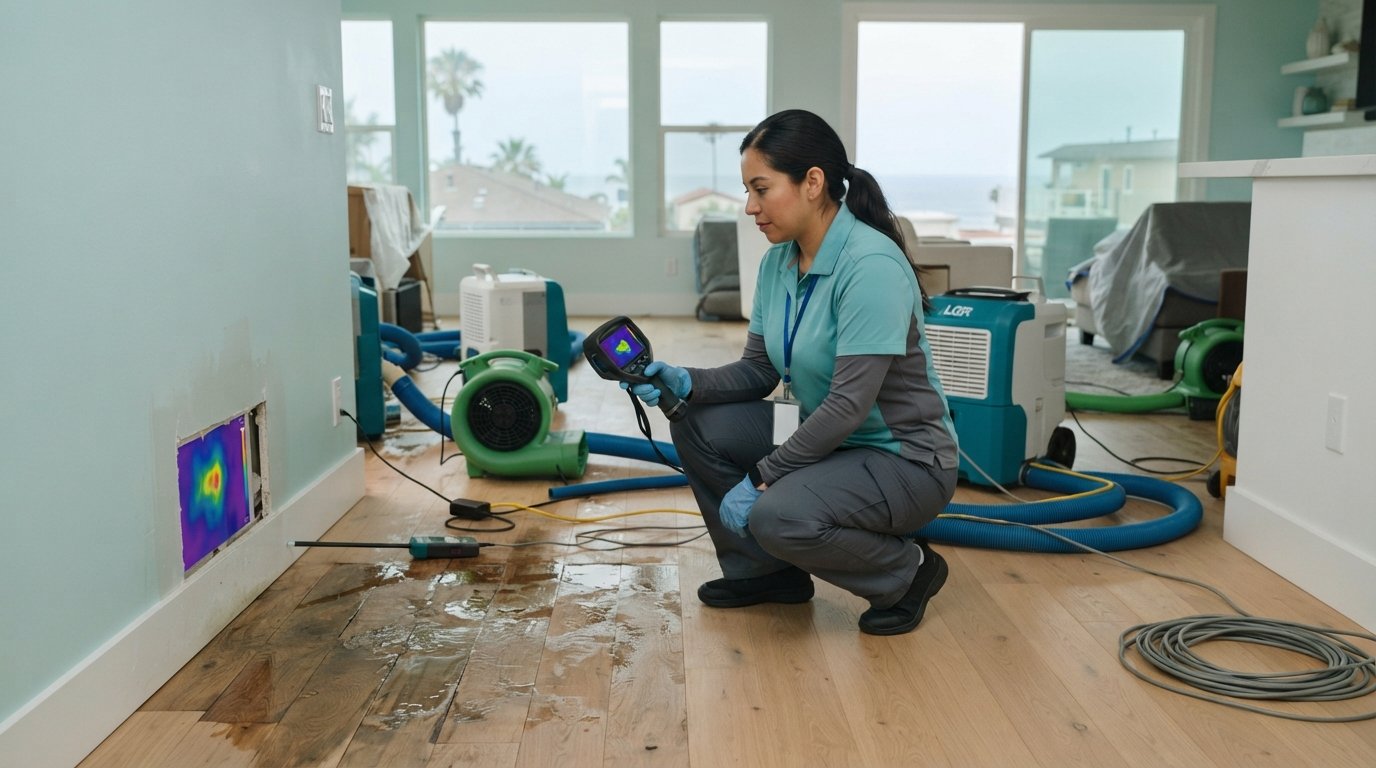
The process begins with moisture mapping to establish a “wet line,” which defines the exact boundary of the affected area. Once identified, we implement a containment strategy using heavy-duty plastic barriers. This isolation serves two purposes: it prevents potential contaminants from migrating to dry areas of the home and creates a smaller “drying chamber” that maximizes the efficiency of our dehumidifiers. By controlling the environment in this specific zone, we can achieve dry standards much faster than treating the entire house at once.
Equipment deployment is a strategic exercise. We place high-velocity air movers and LGR dehumidifiers in a configuration that promotes continuous evaporation across all surfaces. This isn’t a “set it and forget it” operation. Daily monitoring by structural drying services long beach specialists is the only way to ensure the equipment is actually removing water rather than just moving humid air around. We check moisture points every 24 hours and adjust the setup as materials release their bound water. The final phase is verification, where we document that every building component has returned to its specific dry standard.
Thermal Imaging and Moisture Detection
Our technicians utilize forward-looking infrared (FLIR) cameras to detect temperature differentials that indicate moisture trapped behind drywall or under flooring without the need for immediate demolition. To confirm these findings, we use two types of moisture meters: non-penetrating meters for delicate surfaces like tile and penetrating pin-meters for structural wood. Moisture mapping provides the critical data needed for insurance claim approval by proving the exact extent of the damage with scientific evidence.
Daily Documentation for Insurance
Insurance adjusters require a detailed “Drying Log” to approve mitigation payouts and close a claim. This log includes daily atmospheric readings—temperature, relative humidity, and grains per pound (GPP)—alongside moisture content levels from the affected materials. This documentation proves a professional standard of care was met throughout the project and protects you from future liability. At Coastline, we handle this administrative burden for Long Beach homeowners, ensuring all technical data is ready for your adjuster’s review. If you need immediate assistance with a water loss, contact our recovery team to begin the mapping process.
Why Coastline is the Trusted Choice for Long Beach Structural Drying
Coastline Environmental Solutions has served the Long Beach community since 1985. This longevity is vital because Southern California properties, from historical 1920s Spanish Revivals to postwar mid-century homes, each react differently to water intrusion. Our team understands the specific thermal properties and construction materials of these local building styles. We don’t just provide structural drying services long beach; we act as a meticulous guardian for your property’s long-term health and structural integrity.
Our approach is grounded in environmental safety. In many Long Beach homes built before the late 1970s, water damage can disturb hidden hazardous materials. We integrate necessary screenings for asbestos removal and lead risks into our drying protocols. This ensures that the process of recovering your home doesn’t inadvertently compromise the air your family breathes or create new environmental hazards during necessary demolition or drying phases.
A Community-Focused Recovery Partner
Coastline operates with the “Long Beach Guardian” personality, offering a steady, reliable presence in the middle of a property crisis. We handle the complex logistics of recovery, including high-stakes situations where you might need fire and smoke damage repair alongside water mitigation. Our technicians maintain direct communication and total transparency throughout the restoration journey. We serve Long Beach, Lakewood, and Huntington Beach with rapid local response times to stabilize your environment before microbial damage escalates.
Advanced Technology for Precision Results
Our commitment to excellence is reflected in our investment in modern LGR dehumidification and remote monitoring tools. These systems allow us to track drying progress with surgical precision, ensuring that the moisture mapping discussed earlier leads to a verifiable dry standard. We prioritize your family’s health by ensuring every project meets the highest indoor air quality testing standards. This technical thoroughness transforms a chaotic emergency into a methodical, safe return to normalcy.
Contact Coastline for Immediate Structural Drying in Long Beach
Secure Your Property with Scientific Recovery
Effective recovery from water damage is a race against the clock and the persistent coastal humidity of Southern California. We’ve explored how the science of psychrometry and advanced LGR dehumidification are essential to reach moisture trapped deep within your home’s structural framing. Relying on “surface dry” appearances often leads to hidden mold growth and compromised building integrity. By choosing professional structural drying services long beach, you ensure that every saturated material is documented and dried to strict ANSI/IICRC S500 standards.
Since 1985, Coastline Environmental Solutions has acted as a steady hand for local property owners during their most stressful moments. Our IICRC-certified technicians provide a 24/7 emergency response to stabilize your environment and prevent secondary damage before it becomes permanent. We prioritize a meticulous, long-term solution that protects your family’s safety and your property’s value. Don’t leave your home’s health to chance in our humid marine layer. Our team is ready to guide you through a controlled and thorough restoration process.
Schedule an Emergency Structural Drying Assessment with Coastline today and begin your methodical path back to normalcy.
Frequently Asked Questions
How long does the structural drying process typically take?
Structural drying typically takes between three and five days to complete. The exact duration depends on the volume of water and the porosity of affected materials. Dense hardwoods or lath-and-plaster walls in older Long Beach homes may require additional time to reach a dry standard. Our technicians monitor progress daily to ensure the process remains efficient. Turning off equipment prematurely can extend this timeline and risk permanent structural damage.
Can I stay in my home while structural drying equipment is running?
You can generally stay in your home, although the environment will be significantly different. The industrial air movers and LGR dehumidifiers are loud and generate heat as they remove moisture. If the damage is in a primary living space or bedroom, the noise might be disruptive. Our team uses containment barriers to isolate the drying zone, which helps maintain a level of privacy and comfort in the rest of your property.
Will my insurance cover the cost of professional structural drying?
Most homeowners’ insurance policies cover structural drying services long beach when the damage results from a sudden or accidental discharge of water. We provide the comprehensive documentation, including moisture maps and daily drying logs, that adjusters need to process your claim. It’s important to review your specific policy details. Our team assists by providing the technical evidence required to prove that a professional standard of care was met during the recovery.
Why are the fans so loud, and can I turn them off at night?
The fans are high-velocity air movers designed to shear off the saturated boundary layer of air from wet surfaces. You must never turn this equipment off, even at night. Continuous airflow is required to keep the evaporation process active. If the fans stop, the humidity in the room will quickly rise, creating a “greenhouse effect” that allows mold to colonize building materials within 24 to 48 hours.
What happens if my floor still feels wet after the equipment is removed?
Surface sensations can be deceiving, which is why we rely on calibrated moisture meters rather than touch. If a material still feels damp, it likely hasn’t reached its dry standard yet. We don’t remove equipment until our instruments confirm that moisture levels have returned to pre-loss conditions. If you have concerns, our technicians will show you the meter readings to verify that the structural components are technically dry and safe.
Can I just use my home’s AC system to dry out a room?
A residential AC system is not a substitute for professional drying equipment. While air conditioning does remove some moisture, it isn’t designed to handle the high vapor pressure loads found in a water-damaged structure. In coastal areas like Huntington Beach, the ambient humidity is often too high for a standard HVAC unit to manage. Professional LGR dehumidifiers are specifically engineered to pull deep-seated water out of structural studs and subfloors.
How do you know when the drying process is officially finished?
We determine the end of the process using moisture meters and thermal imaging cameras. The goal is to reach a “dry standard,” which we establish by measuring unaffected materials in a dry part of your home. Once the wet materials match these baseline readings, the structure is officially dry. This data-driven approach ensures we don’t remove equipment too early, protecting your property from hidden rot or long-term structural weakness.
Does structural drying prevent mold from ever coming back?
Professional structural drying prevents mold growth associated with the current water intrusion event. By removing the moisture source within the critical 48-hour window, we stop mold from colonizing your drywall and studs. However, it doesn’t prevent mold from returning if a new leak occurs in the future. Maintaining your plumbing and roof is essential. Our structural drying services long beach focus on returning your indoor environment to a safe, dry, and mold-free state.