14 Sep Water Damage Insurance Claims in Long Beach: The Homeowner’s Guide to Full Recovery
The success of your recovery doesn’t depend on the insurance adjuster’s initial visit, but on the technical precision of the documentation provided within the first 48 hours of an incident. For homeowners managing water damage insurance claims in Long Beach, the stakes have never been higher following the impact of Tropical Storm Marie in September 2026. It’s completely normal to feel overwhelmed by the sheer volume of paperwork required or the fear that a “gradual damage” clause will lead to an unfair denial. You’ve worked hard for your home, and you deserve a restoration process that prioritizes your property’s safety and your financial recovery.
This guide will help you master the complexities of the claims process by providing expert advice on documentation, coverage limits, and the critical role of professional restoration. We’ll explore how California’s Senate Bill 876 provides new protections for policyholders and explain the vital difference between restoration contractors and insurance adjusters. By the end of this article, you’ll have a clear roadmap to achieving a maximum payout and a fully restored home, backed by the local expertise that Long Beach residents have trusted since 1985.
Key Takeaways
- Understand the critical distinction between “sudden and accidental” damage and gradual leaks to protect your coverage eligibility from common insurance exclusions.
- Discover how to build a robust evidence file for water damage insurance claims in Long Beach using technical drying logs and specialized moisture detection data.
- Identify the specific restoration challenges unique to Long Beach homes, including older Lakewood plumbing systems and the persistent effects of coastal humidity.
- Avoid the “inadequate mitigation” trap by learning why professional structural drying is essential for both your family’s safety and successful claim approval.
- Learn how to leverage over 40 years of local expertise to navigate the high-stakes documentation requirements and building codes specific to the Southern California coast.
The Reality of Water Damage Insurance Claims in Long Beach
A water damage claim is more than just a request for reimbursement; it’s a formal process where a homeowner seeks financial recovery for property losses caused by water intrusion. In our local market, water damage insurance claims in Long Beach often involve complexities that national providers might overlook. Since 1985, we’ve observed that the unique architectural history of our area, particularly the older plumbing systems found in Lakewood tracts and the persistent coastal humidity, creates specific challenges for structural drying and material preservation.
The first 24 to 48 hours following an incident represents the “Golden Hour” of restoration. This window dictates both the physical integrity of your home and the eventual financial outcome of your claim. While an insurance adjuster evaluates the scope of loss from the carrier’s perspective, a restoration contractor acts as your technical advocate. We provide the moisture maps and thermal imaging data that adjusters require to justify a full payout. Without this specialized documentation, your claim may be undervalued based on surface-level observations alone.
Common Water Intrusions in Southern California
Southern California properties face specific environmental stressors that lead to significant property loss. In areas like the Long Beach Peninsula and older Lakewood neighborhoods, slab leaks are a frequent occurrence as foundations settle. These leaks are often hidden, requiring a deep understanding water damage detection technology to locate before they compromise the structural slab. Beyond foundation issues, standard appliance failures and pipe bursts remain common in residential neighborhoods. More recently, the high surf and storm surges from Tropical Storm Marie in September 2026 demonstrated how quickly coastal environmental factors can overwhelm local drainage systems and flood living spaces in Seal Beach and Wilmington.
Why Immediate Mitigation is a Policy Requirement
Successfully managing water damage insurance claims in Long Beach requires a proactive stance on mitigation. Most insurance policies include a “Duty to Mitigate” clause. This legal obligation requires you to take immediate action to stop further damage once a leak is discovered. If you fail to act quickly, the insurance company may deny the claim or reduce the payout, citing your negligence as the cause of secondary damage. This is particularly critical because standing water quickly leads to the need for toxic mold remediation. By initiating professional water extraction and structural drying immediately, you fulfill your policy requirements and protect the long-term health of your living environment.
Navigating Coverage: What Long Beach Policies Actually Include
Understanding the specific language of your policy is the first step toward a successful recovery. Most homeowners in our area carry a standard HO-3 policy, which provides broad protection but includes nuanced exclusions that frequently complicate water damage insurance claims in Long Beach. The most critical factor for any carrier is the timeline of the event. To ensure you’re treated fairly, it’s helpful to reference the California Residential Property Claims Guide, which outlines the standards insurers must follow when evaluating your loss.
The distinction between sudden and gradual damage is often the primary reason for claim denials. While sudden events are typically covered, gradual issues like “seepage and leakage” are often excluded under the premise that they fall under routine home maintenance. Additionally, many residents don’t realize that standard policies often exclude sewer backups or sump pump overflows unless a specific endorsement was added to the policy prior to the incident. Reviewing these details before a crisis occurs is essential for full financial protection.
Sudden and Accidental Losses
Carriers prioritize events that are “sudden and accidental,” meaning the damage occurred instantly and without warning. A burst supply line under a kitchen sink, a water heater explosion, or a sudden roof failure during a Southern California storm are clear examples. These claims are generally easier to process because the cause is undeniable and the timeline is easily verified through moisture mapping. Because the damage happens all at once, there’s less room for the insurer to argue that the homeowner was negligent in their maintenance duties. If you’ve experienced one of these events, it’s vital to begin professional drying immediately to prevent secondary issues.
The Challenge of Gradual Damage
The difficulty arises when damage occurs over an extended period. If a pinhole leak exists behind a shower wall for months before a stain appears on the ceiling, an adjuster may cite “wear and tear” to deny the claim. They argue that the damage was preventable. In older Long Beach neighborhoods, these repairs often become more complex when hazardous materials are discovered. If your home was built before 1980, the restoration process will likely require specialized asbestos removal before structural drying can even begin. To overcome a “gradual damage” denial, you must provide technical evidence that the leak was hidden and could not have been detected through reasonable inspection. Having a professional assess your property damage early can help you build the technical case needed to secure coverage for these hidden failures.
The Essential Documentation Checklist for a Successful Claim
The success of water damage insurance claims in Long Beach relies on the quality of the technical data submitted to the carrier. While many homeowners believe a few smartphone photos are sufficient, adjusters require a comprehensive evidence package to justify a maximum payout. This is especially true following events like Tropical Storm Marie in September 2026, where the volume of claims can lead to administrative oversight. Under California Senate Bill 876, insurers are now required to provide status reports within 5 days of a new adjuster being assigned. Having your documentation ready immediately ensures you’re prepared for this accelerated timeline. You must document the source of the water, the path of migration, and the exact moisture levels of affected building materials.
Start by capturing high-resolution photos and video of the intrusion source before any repairs begin. Simultaneously, create an inventory of non-salvageable personal property. This list should include the age, condition, and estimated replacement cost for each item. It’s important to understand that standard policies differ from the National Flood Insurance Program, so your documentation must clearly demonstrate whether the damage was caused by internal plumbing failures or external rising water. Clear, categorized evidence prevents the carrier from misclassifying the loss type.
Advanced Detection Technology
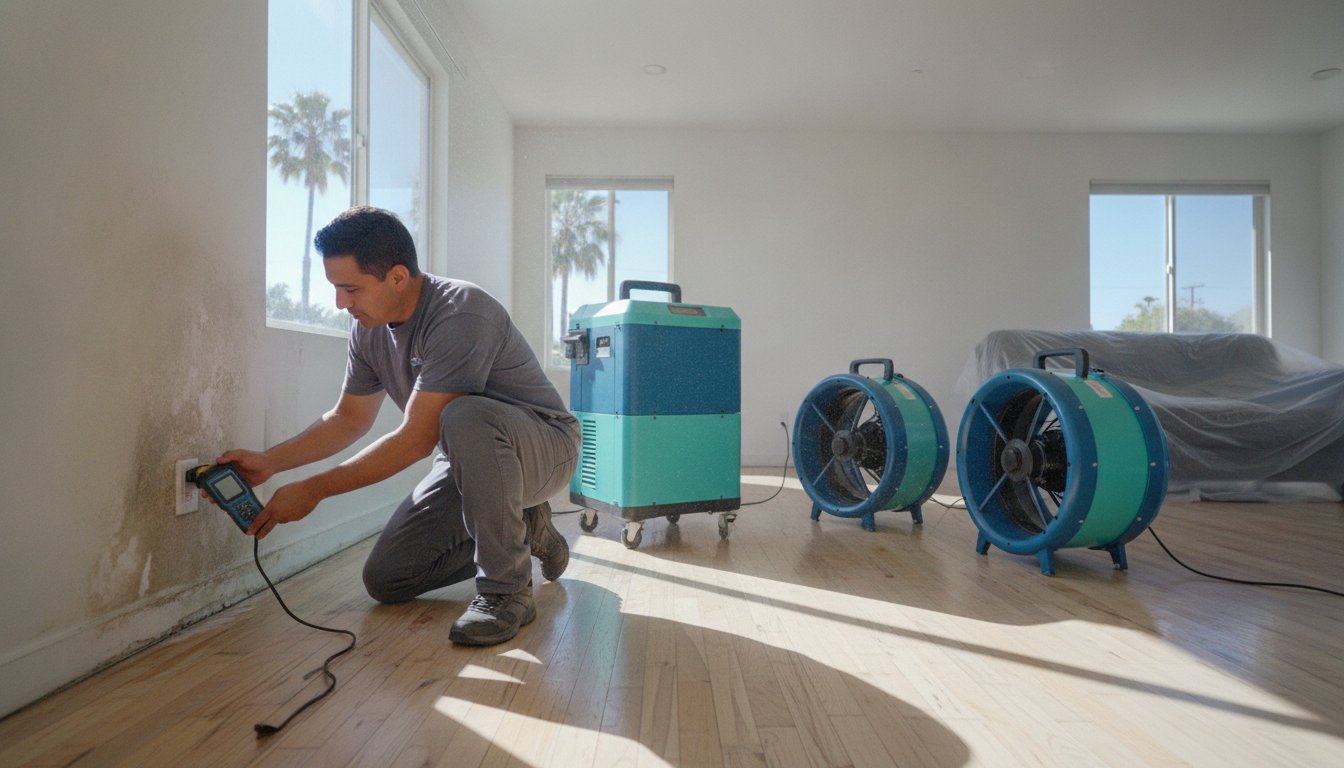
We use infrared thermography and digital moisture meters to provide the objective proof adjusters demand. Thermal imaging cameras detect temperature variations that indicate water hidden behind drywall or trapped under flooring, which is often invisible to the eye. Digital moisture meters then quantify the exact saturation levels in wood studs, subfloors, and plaster. These reports transform subjective observations into undeniable technical data. It’s difficult for an insurer to argue that a room is dry before it has reached its specific dry standard when presented with moisture maps and infrared scans.
The Paper Trail: Restoration Records
The final component of a successful claim is a detailed record of the mitigation process. This includes daily psychrometric readings, which track the temperature and relative humidity inside the containment area to prove the environment was conducive to drying. We also maintain equipment logs that justify the number of air movers and dehumidifiers used on-site. All water damage restoration Long Beach services should be itemized using Xactimate, the industry-standard software that adjusters use to calculate costs. This alignment ensures that your water damage insurance claims in Long Beach are presented in a language the insurance company understands, reducing friction during the approval process.

Common Pitfalls and Denials in Long Beach Water Claims
Even with robust technical evidence, water damage insurance claims in Long Beach frequently encounter resistance from carriers looking to minimize their liability. One of the most common obstacles is the “Pre-existing Condition” trap. Adjusters may look at the older copper piping common in Lakewood or Signal Hill and argue that a failure resulted from years of corrosion rather than a sudden event. Similarly, a failure to report the claim immediately can lead to an “Inadequate Mitigation” denial. If you attempt to dry a saturated subfloor with residential fans instead of professional-grade dehumidifiers, the carrier may refuse to pay for the resulting mold, claiming you didn’t fulfill your duty to protect the property.
Understanding the difference between Actual Cash Value (ACV) and Replacement Cost Value (RCV) is also vital. An ACV policy only pays the depreciated value of your items, which can leave you with a significant financial gap during reconstruction. Always verify which coverage type you have before settling. Prompt reporting and professional intervention are the only ways to ensure these technicalities don’t derail your recovery.
Addressing the ‘Wear and Tear’ Objection
In coastal environments, salt air and high humidity levels accelerate the degradation of building materials. Carriers often use this environmental reality to label sudden failures as “wear and tear.” A professional assessment is your best defense against this objection. By documenting the specific point of failure and the immediate moisture migration, we can prove the leak was not preventable. In cases where the carrier disputes the timeline of secondary damage, utilizing indoor air quality testing provides scientific proof. This testing identifies whether elevated spore counts are a direct result of the current intrusion, effectively neutralizing the “old damage” argument.
Navigating the Repair Phase
Once a claim is approved, you’ll likely be pressured to use “preferred vendors” recommended by the insurance company. While these contractors have pre-existing relationships with carriers, you have the legal right to choose your own local expert. Preferred vendors often prioritize the insurance company’s bottom line over the thoroughness of the restoration. It’s also important to distinguish between mitigation and reconstruction checks. Mitigation funds are intended to stop the damage, while reconstruction funds cover the actual repairs. Never sign a full release of liability for your water damage insurance claims in Long Beach until all work is finished and the structural drying is verified as complete. If you’re navigating a complex claim, contact us for a professional documentation review of your property’s restoration needs.
Why Coastline Environmental Solutions, Inc. is Your Claim Documentation Partner
Since 1985, Coastline Environmental Solutions, Inc. has acted as a steady hand for Southern California homeowners facing high-stakes property crises. We’ve managed thousands of water damage insurance claims in Long Beach, navigating the complexities of the local insurance landscape with technical precision and methodical care. Our professional approach extends across all our emergency services, including fire and smoke damage repair and hazardous material abatement. We don’t just provide a quick fix; we’re dedicated to a thorough, long-term solution that returns your home to a safe, pre-loss condition.
We recognize that the success of your claim depends on the technical evidence provided to your adjuster within the first 48 hours. Our technicians utilize specialized moisture detection technology to generate the objective reports carriers require for approval. By speaking the language of insurance adjusters and using industry-standard software like Xactimate, we reduce administrative friction and help you justify the full scope of your repairs. We maintain direct lines of communication with carriers to ensure your documentation is processed efficiently, allowing you to focus on your family’s safety while we manage the technical recovery.
Our Local Commitment to Long Beach
Our roots in the community run deep. Being based in the Long Beach area allows us to offer a rapid response to neighborhoods from the Peninsula to the Lakewood tracts. We possess a comprehensive understanding of local building codes and environmental regulations, which is essential for older homes requiring lead or asbestos abatement during the restoration process. Our “calm professional” personality is designed to reduce your stress. We provide a clear, step-by-step path from the initial emergency to an organized resolution, acting as a dependable local guardian for your property.
Ready to Start Your Recovery?
When water enters your home, every minute counts. We are available 24/7 to provide immediate water extraction, structural drying, and the assessment data your insurance company demands. Our team ensures that every aspect of the mitigation is documented to the highest standards, fulfilling your policy’s legal duty to mitigate while protecting your financial interests. Don’t let a poorly documented claim lead to an unfair denial or a reduced payout. Get Professional Help with Your Long Beach Water Damage Claim Now and let our four decades of expertise work for you.
Secure Your Property’s Future with Technical Precision
Recovering from water intrusion requires more than just physical repairs; it demands a methodical approach to documentation and a deep understanding of policy language. By prioritizing immediate mitigation and capturing high-resolution evidence, you fulfill your legal duty to the carrier while protecting your home’s structural integrity. Successfully managing water damage insurance claims in Long Beach often hinges on the quality of technical reports provided in the first 48 hours, ensuring that “gradual damage” traps don’t undermine your financial recovery.
Since 1985, our team of IICRC Certified Technicians has acted as a dependable local guardian for homeowners across the coast. We provide the specialized moisture detection data and itemized reporting that adjusters require to approve your claim without unnecessary delays. With our 24/7 emergency response, you never have to face a property crisis alone. Contact Coastline Environmental Solutions, Inc. for Expert Water Damage Restoration and let us guide you back to normalcy with the precision your home deserves. You have the tools to achieve a full recovery; we’re here to ensure the process is seamless and safe.
Frequently Asked Questions
Does homeowners insurance cover water damage in Long Beach?
Homeowners insurance typically covers water damage that is sudden and accidental, such as a burst pipe or a water heater failure. However, it does not cover damage caused by lack of maintenance or external flooding. When managing water damage insurance claims in Long Beach, it’s important to distinguish between standard coverage and flood insurance. For properties in coastal areas like Seal Beach or the Peninsula, separate flood insurance through the National Flood Insurance Program is usually required.
What is the difference between a restoration company and a public adjuster?
A restoration company focuses on the physical recovery of your property, including water extraction, structural drying, and hazardous material removal. We provide the technical moisture maps and documentation that justify the claim’s scope. In contrast, a public adjuster is a licensed professional you hire to negotiate the financial settlement with your insurance carrier. While we act as technical advocates through precise reporting, we don’t provide legal or financial adjustment services.
How long do I have to file a water damage claim in California?
Policyholders generally have one year from the date of discovery to file a formal lawsuit for a property claim in California, though individual policies often require immediate notification. If you are filing a claim against the City of Long Beach for damage caused by municipal infrastructure, you must file within six months for personal property or one year for real property. Prompt reporting is essential to avoid “denial due to late notice” clauses in your contract.
Will my insurance rates go up if I file a water damage claim?
Filing a claim can lead to a premium increase, but this depends on your claims history and the specific cause of the damage. Insurance carriers evaluate risk based on whether the incident was a one-time “act of God” or the result of poor property maintenance. In some cases, multiple claims within a short period may lead to policy non-renewal. You should weigh the cost of your deductible against the total restoration expense before filing a claim.
What should I do if my water damage claim is denied?
You should first request a formal denial letter that cites the specific policy exclusion used by the adjuster. Once you have this, secure a secondary technical assessment to determine if the damage was mischaracterized as “gradual” rather than “sudden.” You can then submit a formal appeal to the insurance company’s internal review board. If the dispute remains unresolved, you have the right to contact the California Department of Insurance for assistance.
Can I choose my own restoration company, or do I have to use the insurance company’s vendor?
You have the legal right to choose any licensed restoration contractor to handle your water damage insurance claims in Long Beach. While insurance companies often suggest “preferred vendors” who have pre-negotiated rates, these contractors may prioritize the carrier’s costs over your home’s thorough restoration. Selecting an independent local expert ensures that the documentation and drying protocols are focused entirely on your property’s long-term safety and structural integrity.
Does insurance pay for mold removal after a water leak?
Most standard policies cover mold remediation only if it is a direct result of a covered “sudden and accidental” water loss. If the mold developed because you failed to take immediate action to dry the property, the carrier might deny the claim based on a failure to mitigate. Some policies also include a specific “mold cap,” which limits the total payout for remediation services regardless of the actual cost required for safe removal.
What is structural drying and is it covered by insurance?
Structural drying is the methodical process of removing moisture from building materials like studs, subfloors, and drywall using professional-grade dehumidifiers and air movers. This service is almost always covered by insurance because it is a required part of the mitigation process to prevent secondary damage. We use specialized moisture detection technology to prove when materials have reached their dry standard, providing the objective evidence your carrier needs to approve these essential costs.