
14 Aug Popcorn Ceiling Asbestos Removal: The Complete 2026 Safety & Cost Guide
An estimated 30 million homes in the United States still contain legacy building materials like asbestos, often hiding in plain sight within textured finishes. If your Southern California property was built before the mid-1980s, that outdated texture above you might be more than just an eyesore. Understanding the process of popcorn ceiling asbestos removal is critical for any homeowner planning a renovation, especially since the South Coast Air Quality Management District (SCAQMD) Rule 1403 enforces strict guidelines for handling these materials regardless of the building’s age.
It’s natural to feel overwhelmed by the technical jargon and the fear of potential health risks associated with friable fibers. You’re likely concerned about the safety of your family and the complex logistical hurdles of local compliance in Long Beach or Orange County. This guide provides a clear roadmap to help you identify risks, navigate testing protocols, and understand the professional abatement process. We’ll explore the latest 2026 safety standards and the specific steps required to restore your home to a clean, modern state while protecting its long-term value.
Key Takeaways
- Learn why visual inspections are insufficient and how professional laboratory testing provides the only definitive confirmation of asbestos presence.
- Understand the high risks of DIY attempts and why professional popcorn ceiling asbestos removal is necessary to protect your HVAC system from contamination.
- Discover the methodical containment steps, including the use of 6-mil poly sheeting, that expert teams use to ensure hazardous fibers don’t escape.
- Identify the specific DOSH and CSLB certifications you must verify when choosing a certified abatement partner in Southern California.
The Reality of Asbestos in Popcorn Ceilings
A Popcorn ceiling, technically known as acoustic ceiling texture, was the standard for residential construction for decades. With millions of homes still containing legacy materials, this pebbly finish remains a common sight in Southern California properties. Builders favored this spray-on treatment for its pebbly appearance that effectively masked structural flaws and uneven drywall joints. While it peaked in popularity between the 1950s and 1980s, many of these surfaces contain a hidden hazard that requires professional popcorn ceiling asbestos removal to resolve safely.
Federal regulations in 1978 banned the use of asbestos in spray-on ceiling coatings, but this didn’t result in an immediate disappearance of the material. Manufacturers were permitted to install existing inventories, which meant homes built as late as the mid-1980s often still featured asbestos-containing materials. Industry data suggests approximately 18% of buildings constructed between 1980 and 1995 might still contain traces due to these older stockpiles. This overlap makes testing essential for any property owner planning a renovation.
Why Asbestos Was Used in Acoustic Textures
Asbestos was once hailed as a miracle mineral because of its unparalleled physical properties. It provided exceptional fire resistance, helping structures meet mid-century building codes designed to slow the spread of flames. Contractors favored it for three primary reasons:
- Sound Dampening: The porous nature of the texture acted as a highly effective sound absorber, reducing echoes in residential and commercial spaces.
- Structural Masking: The spray-on application allowed builders to hide ceiling imperfections and uneven drywall joints quickly.
- Cost Efficiency: It allowed teams to finish a ceiling in a fraction of the time required for traditional smooth plastering.
The Health Risks of Friable Asbestos
Popcorn texture typically contains between 1% and 10% chrysotile asbestos. The primary danger lies in its friable state. This term describes a material that’s easily crumbled or reduced to powder by hand pressure. Unlike asbestos floor tiles, popcorn texture is exceptionally delicate. When disturbed during a renovation, it releases microscopic fibers into the air. Once airborne, these fibers are easily inhaled and can lodge permanently in lung tissue.
Health organizations maintain there’s no safe level of exposure. Long-term inhalation is linked to debilitating conditions like asbestosis and mesothelioma. Because of these risks, popcorn ceiling asbestos removal should never be treated as a casual weekend project. It requires a methodical containment strategy to prevent contaminating your home’s air ducts and furniture. A steady, professional hand ensures these microscopic threats are fully contained and removed from the environment.
Identifying Asbestos: Testing Before You Scrape
You cannot identify asbestos in a textured ceiling simply by looking at it. Even for seasoned professionals, the microscopic fibers are invisible to the naked eye. Many homeowners make the critical mistake of performing a “test scrape” to see how easily the material comes off. This action is dangerous. Disturbing even a small patch of dry acoustic texture can release thousands of fibers into your living space, contaminating your carpets and air ducts instantly. Before any renovation begins, professional testing is the only way to confirm if you need specialized popcorn ceiling asbestos removal.
The standard for identification is Polarized Light Microscopy (PLM). This laboratory technique allows technicians to see the specific mineral structure of the fibers to determine if they’re chrysotile or another form of asbestos. The EPA’s guide on how to Protect Your Family from Exposures to Asbestos stresses that materials should be presumed hazardous until a lab report proves otherwise. While mail-in DIY kits exist, they often lead to sampling errors. A professional ensures that samples are taken safely and from the right locations to provide a truly representative result.
The Professional Testing Process in Southern California
A certified technician follows a methodical protocol to ensure accuracy and safety. They begin by identifying “homogeneous areas,” which are sections of the ceiling that appear to have been applied at the same time with the same material. In a standard home, this might involve taking samples from multiple rooms to account for different batches of texture used during construction.
Safety is maintained through wet sampling techniques. By misting the area with amended water before cutting a small square of the texture, the technician prevents any dust from becoming airborne. For a deeper look at these requirements, see our asbestos testing for home renovation guide. This precision protects your indoor air quality while meeting the rigorous standards required for local property records.
Understanding Your Lab Results
Lab reports categorize materials based on the percentage of asbestos found. The Environmental Protection Agency (EPA) and local Southern California regulators define “Asbestos-Containing Material” (ACM) as any material containing more than 1% asbestos. If your results show “trace” amounts (less than 1%), the material is still handled with caution, but it may not trigger the same legal abatement requirements as a 5% or 10% concentration.
These percentages dictate the level of containment required for your project. High concentrations in a friable state mean that full 6-mil poly sheeting and negative air pressure are non-negotiable. If you’ve recently received a positive lab report, it’s vital to consult with a certified specialist to interpret the findings and plan a safe resolution.
DIY vs. Professional Removal: Evaluating the Risks
The temptation to treat popcorn ceiling asbestos removal as a weekend DIY project is understandable given the potential for cost savings. However, the hidden expenses of an uncertified removal often far exceed the price of professional abatement. When an untrained individual scrapes a textured ceiling, microscopic fibers settle into soft surfaces like carpets, upholstery, and curtains. Even more critical is the contamination of the HVAC system. Once fibers enter the ductwork, they are recirculated throughout the home every time the heater or air conditioner cycles, creating a long-term inhalation hazard that is notoriously difficult and expensive to remediate.
Beyond health and legal risks, uncertified removal creates a significant liability when selling your property. California disclosure laws require you to document any known hazardous material issues. A CPSC guide on asbestos in the home highlights that textured paints and ceiling joint compounds used before the late 1970s are primary sources of exposure. Homeowners undertaking broader renovations should also be aware that asbestos in walls is another common hidden risk in older Southern California properties that warrants the same level of professional scrutiny. A professional clearance test provides the necessary certification to protect your home’s equity and your peace of mind.
The Dangers of Inadequate Containment
Standard PPE found at local hardware stores, such as N95 dust masks, is insufficient for blocking asbestos fibers. Professional abatement teams use P100 HEPA-rated respirators and specialized vacuum systems. Without these, fibers travel freely through a home’s ventilation system. Decontaminating a property after a failed DIY attempt often requires professional air duct cleaning and the disposal of porous furniture, turning a minor renovation into a major environmental crisis.
Local Regulations and Proper Disposal Laws
In Southern California, the South Coast Air Quality Management District (SCAQMD) governs these projects through Rule 1403. This regulation requires a certified survey and a 10-working-day advance notification to the district for any regulated removal work. Failing to comply can lead to significant fines and legal complications. Proper disposal isn’t as simple as placing debris in a trash bin. It requires “wet-bagging” in double-lined, 6-mil poly bags and transport to specific landfills equipped to handle hazardous waste. Local landfills in Long Beach and Lakewood will strictly reject any waste that lacks a proper hazardous waste manifest.

The Professional Abatement Process: What to Expect
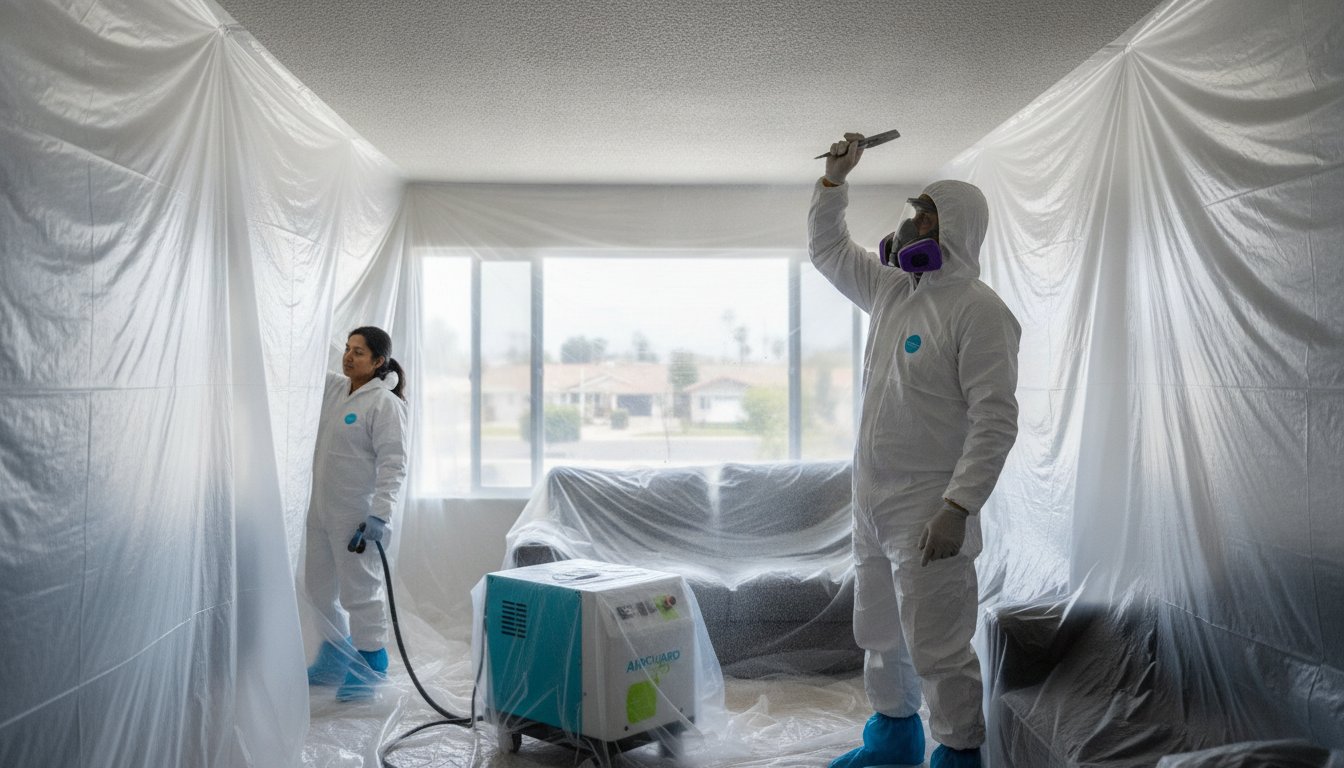
Professional popcorn ceiling asbestos removal is a surgical operation designed to transition your home from a state of environmental concern to a verified clean environment. The process is highly methodical, prioritizing containment and fiber suppression above all else. Technicians begin by removing all furniture and non-permanent fixtures from the room. Any items that can’t be moved are sealed under double layers of 6-mil polyethylene sheeting. This rigorous preparation ensures that your property remains protected throughout the technical intervention.
Containment and Negative Air Pressure
The hallmark of a certified abatement project is the creation of a negative pressure enclosure. Technicians seal every HVAC vent, window, and doorway with heavy-duty plastic and specialized tape. We then deploy HEPA-filtered negative air machines that run continuously. These units exhaust air out of the home, creating a vacuum effect that pulls fresh air into the work area. This pressure differential ensures that microscopic fibers can’t escape the “bubble.” Technicians enter and exit through a three-stage decontamination chamber, ensuring they don’t track hazardous dust into the clean areas of your home.
Wet Scraping and HEPA Filtration
Effective popcorn ceiling asbestos removal relies on moisture to manage the risk of fiber release. Dry scraping is strictly prohibited under Southern California safety standards. Our teams use amended water, which contains specialized wetting agents, to saturate the acoustic texture. This moisture keeps the material heavy and prevents fibers from becoming airborne during the scraping process. Once the texture is removed, the team performs a comprehensive HEPA vacuuming of all surfaces. This is followed by a “wet wipe” of every square inch of the containment area. If you’re ready to secure your home’s safety, contact our certified abatement specialists to discuss your project requirements.
Post-Removal Air Clearance Testing
The final phase of the project is the air clearance test. Before any containment barriers are removed, an independent third-party laboratory collects air samples to verify that the environment is safe for re-occupancy. This ensures that the fiber count is well below the legal safety threshold. For a detailed breakdown of these safety protocols, consult our professional asbestos removal pillar. Once the lab provides a passing result, the containment is dismantled, and your home is returned to a normal, safe state.
Choosing a Certified Abatement Partner in Long Beach
Selecting the right partner for popcorn ceiling asbestos removal in Long Beach involves more than comparing quotes. You need a team that understands the specific architectural nuances of Southern California homes, from mid-century bungalows in Lakewood to coastal properties in Seal Beach. A qualified partner must possess specific credentials, including a C-22 Asbestos Abatement Contractor license from the CSLB and registration with the Division of Occupational Safety and Health (DOSH). These certifications aren’t mere formalities; they’re your primary protection against legal liability and environmental contamination during a major renovation.
In regions governed by the South Coast Air Quality Management District, compliance is non-negotiable. Working with a contractor who is intimately familiar with Rule 1403 ensures that all notifications are filed correctly and all hazardous waste manifests are documented. This level of professional oversight prevents the project from being sidelined by local inspectors and ensures that your home remains a safe environment for your family long after the technicians have finished their work.
Coastline’s Methodical Approach to Your Home
Coastline Environmental Solutions, Inc. has operated as a dependable local guardian since 1985. We serve Long Beach, Huntington Beach, Cerritos, and the wider Orange County area with a methodical, safety-first philosophy. When you face the stress of a hazardous material discovery, we provide a calm, professional hand to guide the restoration. Our specialized experience in popcorn ceiling asbestos removal allows us to handle complex containment scenarios with the precision required to return your property to a normal, healthy state.
We project the personality of a meticulous restorer, someone who is not just looking for a quick fix but is dedicated to a thorough, long-term solution. This community-oriented focus means we are as invested in the outcome as the property owner is. By maintaining a steady, methodical pace, Coastline Environmental Solutions, Inc. moves the project from a state of emergency to an organized resolution, ensuring every microscopic fiber is accounted for and safely extracted from your living space.
Beyond Removal: Restoring Your Home’s Value
Successful abatement is the foundational step toward a modern, updated home. Once the hazardous texture is gone, your ceilings are ready for contemporary smooth finishes or knockdown textures that reflect light better and increase the aesthetic value of your space. This transition is also the ideal time to invest in indoor air quality testing to verify the complete removal of all legacy particulates and ensure a truly clean environment.
Providing a certified “Clean Bill of Health” from a recognized abatement partner like Coastline Environmental Solutions, Inc. is a significant asset during future property transactions. It reassures potential buyers that the home has been meticulously restored and is free of the hidden environmental risks often associated with older construction materials. This return to normalcy doesn’t just protect your health; it secures your home’s equity and provides lasting peace of mind for the next generation of residents.
Securing Your Home’s Environmental Future
Identifying the presence of hazardous materials is the definitive first step toward a healthier living environment. As we’ve explored, professional laboratory confirmation replaces uncertainty with a concrete plan for popcorn ceiling asbestos removal, ensuring your renovation proceeds without risking cross-contamination. By prioritizing a surgical, contained approach, you effectively eliminate legacy environmental threats while safeguarding your property’s structural integrity and future marketability.
Coastline Environmental Solutions, Inc. has served as a steady hand for homeowners across Long Beach and Orange County since 1985. As certified abatement contractors, we ensure every technical intervention is fully SCAQMD Rule 1403 compliant, providing the methodical care your property deserves. We specialize in transitioning homes from a state of emergency to one of organized, long-term resolution. Schedule your professional asbestos assessment with Coastline Environmental Solutions, Inc. today.
You don’t have to navigate these technical complexities alone. With an expert partner by your side, you can finally clear the air and move forward with your modern design goals with absolute confidence.
Frequently Asked Questions
How can I tell if my popcorn ceiling has asbestos?
Visual identification is impossible since asbestos fibers are microscopic. The only definitive method is to have a certified technician collect samples for Polarized Light Microscopy (PLM) analysis in a laboratory. While homes built before 1978 are at high risk, research indicates existing stockpiles were used well into the 1980s. Professional testing ensures you don’t accidentally disturb hazardous materials during a routine renovation or repair.
Is it safe to live in a house with asbestos popcorn ceilings?
Asbestos-containing materials in good condition generally don’t pose a health risk if left undisturbed. The danger arises when the texture becomes friable, meaning it can be easily crumbled or powdered. If the material is flaking, water-damaged, or in a high-traffic area, it’s a potential hazard. For instance, homeowners can explore Water Damage Restoration to learn how professional firms like Dryrite Restoration stabilize and remediate moisture-impacted ceilings. Professional intervention is necessary to evaluate the integrity of the surface and prevent accidental fiber release.
Can I just paint over my popcorn ceiling to seal the asbestos?
Encapsulation through painting is possible, but it carries specific risks. Adding the weight of heavy paint can cause the texture to pull away from the drywall, potentially releasing fibers. Additionally, once a popcorn ceiling is painted, professional popcorn ceiling asbestos removal becomes much more labor-intensive. The paint seals the texture, so it’s harder to saturate the material with the necessary wetting agents.
How much does professional popcorn ceiling asbestos removal cost per square foot?
The cost of professional abatement varies based on project-specific factors. These include the square footage, ceiling height, and containment complexity. Since every home is different, it’s impossible to provide a flat rate without an inspection. We recommend scheduling a professional assessment. This allows you to receive an accurate estimate tailored to your property’s unique layout and the specific asbestos concentration found in your lab results.
How long does the professional asbestos removal process take?
Most residential projects take two to four days. We’ll spend the first day on meticulous containment and setting up negative air machines. After removal, the area requires a thorough cleaning and mandatory air clearance testing. We wait for independent lab results to verify the air is safe. Only then do we dismantle the barriers and return the space to you, ensuring your home is completely safe.
Do I need to move out during the asbestos abatement process?
We generally recommend that residents vacate the home during the active removal phase. Technicians use high-grade containment to isolate the work area, but the process is still intrusive. The noise from negative air machines and the presence of decontamination showers can be disruptive. Vacating ensures you are completely separated from the work zone. It’s also the best way to allow our team to move methodically.
What are the local Southern California regulations for asbestos disposal?
The South Coast Air Quality Management District (SCAQMD) enforces Rule 1403, which requires a certified survey before any renovation. In cities like Long Beach, you must provide a 10-working-day notification to the district for regulated removal work. Disposal is also strictly regulated. Asbestos waste must be double-bagged in 6-mil plastic and transported to a landfill permitted to accept hazardous materials with a proper manifest.
What is the difference between asbestos abatement and simple ceiling removal?
Simple ceiling removal involves scraping non-hazardous texture without specialized equipment or environmental controls. In contrast, asbestos abatement is a strictly regulated safety process. It involves the use of HEPA-filtered negative air pressure and wet-scraping techniques to prevent dust. Professional popcorn ceiling asbestos removal also includes third-party air monitoring. This methodical approach is designed specifically to prevent the spread of toxic fibers throughout your home.